The Salt Desert as a Photographic Subject
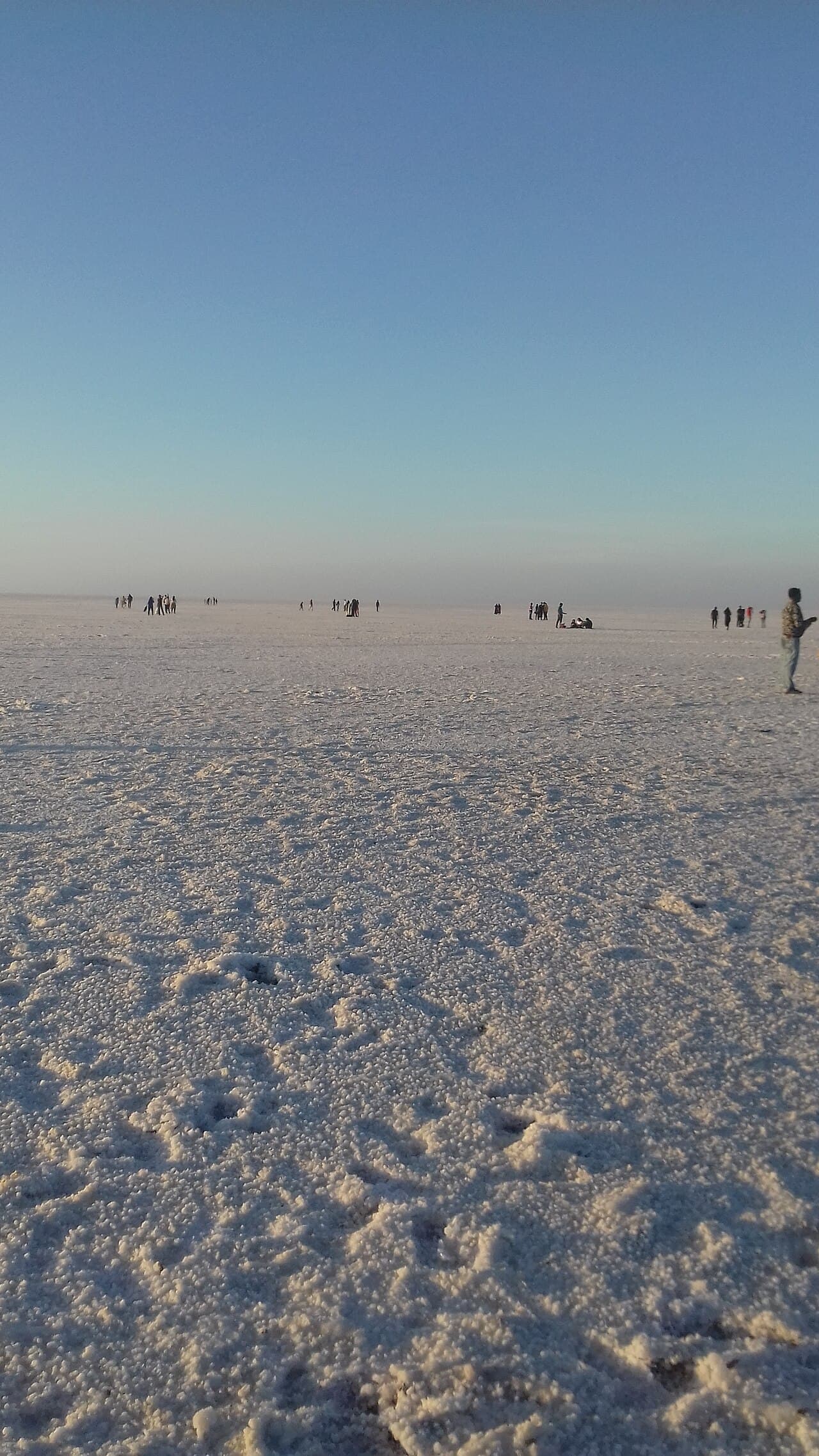
The White Rann of Kutch is one of the most technically challenging and rewarding photographic subjects in India. It challenges because of its extremes: blinding reflected light during the day, deep shadow and intense moonlight at night, flat horizons that demand compositional discipline, and a surface that confuses autofocus systems. It rewards because those same extremes produce images that look unlike anything shot in more conventionally beautiful landscapes — otherworldly, minimal, and arresting.
This guide covers the six best photography spots at Rann Utsav, the optimal times of day for each, and the camera settings that work in conditions most photographers encounter for the first time at the Rann.
Location 1: The White Rann at Golden Hour
The salt flat from the main viewpoint at Dhordo, photographed in the 45 minutes before sunset, produces the most reproducible "iconic Rann" image: flat white extending to a horizon where the sky shifts from orange to rose to pale violet. Long shadows at this hour, cast by nothing (the Rann has no features) somehow still exist, because even tiny irregularities in the salt surface cast shadows two to three times their own height.
Arrive at the viewpoint by 5 pm in November-January (sunset is around 6:15-6:30 pm during peak season) to secure a position and wait for the light to develop. The peak light window is the final 20 minutes before the sun touches the horizon.
Camera settings: Expose for the sky rather than the salt — the salt will always be recoverable in post-processing, but blown highlights in the golden sky are not. Set aperture to f/8 to f/11, ISO 100-200, and adjust shutter speed to place the sky's exposure reading in the centre of your histogram. Shoot in RAW; the tonal range in post-processing for these images is substantial.
For phones: use the standard camera app, tap the sky to set exposure, and use portrait mode sparingly (the bokeh effect does not suit landscape work).
Location 2: Full Moon Night on the Salt Flat
Full moon night on the White Rann is the image most associated with Rann Utsav in travel media, and for good reason. The combination of moonlight reflected from both above and below — the sky and the salt surface — creates a quality of illumination that has no parallel in normal photographic experience. Shadows are crisp. The horizon glows. The sky is simultaneously dark enough to show stars and bright enough to register detail.
Arrive at the viewpoint 20 minutes before moonrise. Check the moonrise time for your specific date — in December and January, moonrise is typically between 5:30 and 7:30 pm. The minutes when the moon is just above the horizon and still orange-tinted, with the sky in blue-hour transition, are the most dramatic of the entire night.
Camera settings for full moon night: ISO 800-3200 (depending on your camera's noise performance), aperture f/2.8 to f/4, and shutter speed calculated to expose for the moonlit salt correctly — typically 2 to 10 seconds. Use a tripod without exception. Set your camera on a 2-second timer or use a remote shutter release to prevent camera shake from your touch.
For including the moon in the frame: the moon in a long-exposure image at ISO 1600 is extremely bright relative to the landscape. To include the moon as a disc rather than a blown-out blob, either take two exposures (one for the landscape, one for the moon) and composite them in post, or use a shorter exposure at lower ISO and accept that the landscape will be underexposed — then brighten it in Lightroom.
Location 3: Folk Dancers at the Cultural Programme
The evening cultural programme is one of the richest portrait and action photography opportunities at Rann Utsav. Rajasthani and Gujarati folk dancers in full costume — mirror-work fabrics catching the stage light, spinning skirts creating circular blurs of colour — produce images that are immediately striking and culturally specific.
The challenge is artificial light: the stage is lit with a combination of LED wash lights, spotlights, and occasionally fire (fire dancers appear in many programmes). Mixed lighting sources create colour casts that require attention in post-processing.
Camera settings: Set white balance manually to 5000-5500K as a starting point and adjust in post. Use a fast lens — f/1.8 or f/2.8 — to allow a high enough shutter speed to freeze movement (1/250 second minimum for spinning dancers, 1/500 second preferred). ISO will be high — 1600 to 6400 is typical. Do not be deterred by noise; a well-exposed image at ISO 6400 is preferable to a motion-blurred one at ISO 400.
Position yourself at the front corners of the audience area rather than the centre — this gives a more dynamic angle than shooting straight-on from the middle.
Location 4: Bhuj Ruins and Old City Architecture
Bhuj, the district capital 85 km from Dhordo, is an extraordinary photography location in its own right and worth a half-day trip. The 2001 earthquake destroyed significant portions of the old city, but the ruins have been partially preserved as a kind of open-air memorial — collapsed Aino Mahal walls, tilted Rani Mahal columns, and the extraordinary Prag Mahal palace that survived largely intact.
The morning light in Bhuj old city between 8 and 11 am, falling on the carved stone facades and narrow lanes, produces documentary architectural photography of exceptional quality. Bring a 35mm or 50mm equivalent lens for the lanes — wide angles distort the proportions of historic buildings — and a longer 85-135mm for compressing the layers of the old city skyline.
Location 5: Camel Silhouettes at Sunrise
Camels at sunrise on the salt flat: this is arguably the most requested image from Rann Utsav and it is achievable with planning. Speak to the Tent City activities desk on arrival and ask to book the earliest camel ride possible — typically starting around 6:30 am in winter. Being on the camel ride as the sun rises places you in the scene rather than photographing it from outside.
With a telephoto lens (200-400mm equivalent), the compressed perspective of camel silhouettes against the rising sun — the flat salt, the long shadows, the orange-red disc — is immediately commercial-quality. Use your phone to photograph other riders on their camels from your own camel for a more authentic, less set-up composition.
Location 6: The Artisan Bazaar in Mid-Morning Light
The Tent City bazaar, with its rows of Kutchi artisans working on embroidery, lacquer furniture, block printing, and silver jewellery, is one of the best portrait photography locations at the festival. The covered stalls have a quality of diffused sidelight in the mid-morning hours — approximately 9 am to 12 pm — that is flattering for portrait work.
Ask permission before photographing artisans working. Most are accustomed to cameras and happy to be photographed, but some prefer not to. Engage with them first, make a small purchase if possible, and then ask — this approach invariably produces more relaxed, natural portraits than pointing a lens from a distance.
What NOT to Do Photographically at Rann Utsav
Do not use your camera flash on the salt flat at night. It destroys your own night vision for 10-15 minutes, disturbs other visitors, and produces flat, ugly images. The moonlight provides adequate illumination for long-exposure work.
Do not crop or zoom aggressively on the White Rann landscape — the power of the image comes from scale and emptiness. Fight the instinct to fill the frame and instead leave the vast majority of the frame as flat white desert. This is compositionally counterintuitive but produces the most striking images.
Do not photograph other visitors' faces without consent. This applies everywhere but is particularly important during the cultural programme, where devotional and ceremonial elements of the performances deserve respect.
Phone Photography Tips
Modern flagship phones — the iPhone 15 Pro, Pixel 8 Pro, Samsung Galaxy S24 Ultra — produce excellent images on the Rann with the right approach. Night Mode with a stabilised base (leaning against a post, using a small tripod) produces sharp long-exposure results on the salt flat. The 5x and 10x telephoto lenses on current phones are very capable for folk dancer portraits and camel silhouettes. Shoot ProRAW or maximum quality JPEG, never compressed format.
Cold temperatures drain phone batteries at twice the normal rate — keep your phone in an inner pocket against your body when not shooting, and bring a power bank.
The Rann Utsav is one of those locations that rewards both the dedicated camera photographer and the thoughtful phone photographer equally. What matters most is not the equipment — it is being present at the right location at the right time, which this guide will help you achieve.