Before You Go: What Nobody Tells First-Timers
First-time Rann Utsav visitors arrive with one of two sets of expectations. Some arrive expecting a kind of elaborate camp — a tent in a field, some cultural entertainment, a walk in the desert. They are overwhelmed by what they find: the scale of the salt flat, the quality of the food, the genuine artistry of the folk performers, the extraordinary night sky. Others arrive expecting a luxury resort experience and are briefly surprised by the canvas, the evening cold, the absence of room service. Both groups leave the same way: wanting to come back.
The 12 points in this guide are designed to calibrate expectations accurately — not to lower them, but to ensure you arrive knowing what you will encounter, with the right kit, the right timing, and the right mindset to have the best possible first visit.
1. Book Your Accommodation Well in Advance — Especially for Full Moon Nights
The Tent City at Dhordo has finite capacity, and full-moon travel windows can be popular. For 2026–27 the published Dhordo stay season runs from 1 November to 7 March, with four listed full-moon windows from November through February. Check availability rather than assuming a date is open or sold out.
If you have fixed dates or a preferred tent category, enquire early. The listed December window is 21–24 December 2026; the provider can confirm inventory and any date-specific supplement in a written quote.
If you are reading this in June or July 2026 with a December visit in mind, act now. The flexibility to choose your preferred tent category and get the specific dates you want is almost entirely a function of how early you book. Last-minute availability exists, but it comes with compromises: less preferred tent categories, less convenient dates, or dates that are not full moon nights.
To book, call or WhatsApp +91 92747 30220. Direct booking gives you the best prices and the ability to discuss specific requirements before committing.
2. Choose a Date Within the Published Stay Season
The published 2026–27 Dhordo Tent City stay season runs from 1 November 2026 to 7 March 2027. October can be suitable for broader Kutch travel where access is confirmed, but it should not be treated as a Dhordo package month. Weather and programmes vary within the listed season.
November can suit visitors who prefer milder evenings. The listed 22–25 November full-moon window is an option to check with the provider; a lower early-season price is not guaranteed for every category or date.
December and January are generally colder and can be busy around holidays and full-moon windows. Pack warm layers and check the provider's date-specific rates. The listed windows are 21–24 December and 20–23 January.
February may offer milder weather than midwinter. The listed full-moon travel window is 18–21 February 2027; verify the forecast, activities and availability for your selected stay.
Early March is the closing period for the published stay season, ending on 7 March. Do not assume availability, lower prices or a full-moon package after that date.
3. Getting There: Bhuj is Your Gateway
Rann Utsav is located at Dhordo village, 85 kilometres north of Bhuj in Gujarat's Kutch district. Bhuj is your entry point regardless of where you are travelling from.
By air: Bhuj airport (BHJ) has direct flights from Mumbai and Ahmedabad during the festival season, and sometimes from Delhi. Flight times are short — about one hour from Mumbai, 50 minutes from Ahmedabad. Book flights three to four months ahead for peak season.
By train: The Bandra-Bhuj Express from Mumbai (approximately 14 hours overnight) is comfortable, scenic, and significantly cheaper than flying. From Ahmedabad, multiple daily trains reach Bhuj in four to five hours. Train travel is the most atmospheric arrival — the Kutch landscape unfolds around you across the final hours of the journey.
By road: If you are driving from Ahmedabad, budget five to six hours for the 380-kilometre journey. The roads are well-maintained and the landscape increasingly dramatic as you approach Kutch. Private taxis and self-drive cars are practical options if you want flexibility for day trips during your stay.
From Bhuj to Dhordo: hire a taxi or book a transfer through the Tent City (ask at booking — transfers are often included or available for a modest fee). The 85-kilometre drive takes approximately one hour and 30 minutes to two hours. The road passes through the characteristic Kutch scrubland and occasional salt pan edges before arriving at the festival grounds.
4. The Tent Accommodation is Glamping, Not Camping — Understand What You Are Getting
The word "tent" can mislead people who associate it with sleeping bags and camp stoves. Rann Utsav tents are canvas structures on permanent platforms with proper beds (mattress, pillow, clean linen), attached bathrooms with hot and cold running water, Western-style toilets, and electricity for lighting and charging. The standard Non-AC tent is roughly the size of a mid-range hotel room — perhaps 20–25 square metres — with enough space for two adults comfortably and modest storage.
What makes it a tent rather than a room is the canvas: the walls flex slightly in wind, the sounds of the desert at night are audible, and on full moon nights the moonlight diffuses through the fabric and gives the interior an extraordinary glow. This is not a limitation — it is the point of the experience.
Premium Deluxe tents add air-conditioning units (used as heaters in winter), better furniture, and improved bathrooms. Rajwadi tents are fully decorated in a Kutchi aesthetic — mirror-work fabric panels, carved wooden furniture, brass fittings — and offer the closest thing to a luxury suite in a canvas structure. For couples on a significant trip, the Rajwadi tier is worth the premium.
The one thing all tent categories share: Non-AC standard tents rely on blankets and bedding for warmth rather than mechanical heating. In December and January, this means you need to dress warmly for sleeping — thermal base layers under your sleeping clothes are advisable. In October, February, and March, the bedding alone is perfectly adequate.
5. Dress Conservatively and Warmly — Two Different Requirements
Rann Utsav sits in a culturally conservative rural community. Dhordo village is home to Rabari and Meghwal families with traditional dress codes that differ significantly from urban norms. You are a guest in their community as much as you are a visitor to the festival.
Practically, this means: avoid very short shorts or skirts in the bazaar and village areas. Shoulders covered is appreciated (and also sensible given the cold). Avoid loud or provocative messaging on clothing. Most visitors dress in what they would wear for a comfortable cultural excursion in any Indian city — light trousers or jeans, a top that covers the shoulders, a scarf or dupatta for women. This approach works perfectly for the social context and requires no special effort.
Separately: dress warmly for the evenings. This is a practical requirement rather than a cultural one, and the specifics depend on your month of visit. For October, a light jacket is enough. For December and January, you need thermal base layers, a proper down jacket, warm socks, a hat, and gloves. The cultural programme takes place partly outdoors, and the salt flat walk is fully exposed to the desert wind. Under-dressing for the cold is by far the most common mistake first-timers make.
6. Cash is King in the Bazaar
The artisan bazaar at Dhordo is one of the finest concentrations of Kutchi craft you will find anywhere — Rabari and Meghwal embroidery, Rogan art, block-printed textiles, Kutchi silver jewellery, lacquered furniture, handmade leatherwork. Most of the artisan stalls in the bazaar operate on a cash-only basis. Many do not have card machines; some have UPI QR codes but connectivity is patchy enough that digital payments sometimes fail.
The nearest ATM is in Bhuj, approximately 85 kilometres away. There are no reliable ATMs at Dhordo. The Tent City's main counters accept cards for the package itself, but for the bazaar, the food stalls, tips, and any small purchases around the festival grounds, cash is essential.
Bring ₹3,000–5,000 in cash for the bazaar and incidentals if you plan to shop at all. If you intend to buy significant pieces — a full embroidered wall hanging, a set of Kutchi silver jewellery, multiple textiles — bring ₹8,000–15,000 in cash and set a budget before you arrive. The combination of beautiful work, direct-from-artisan pricing, and the festive atmosphere makes it extremely easy to spend more than planned.
7. The Cultural Show Timings — and How to Make the Most of Them
The evening cultural programme at the Tent City main stage runs nightly from approximately 7:30 pm and lasts 90 minutes to two hours. It typically opens with a shorter folk dance set (this is often the most visually spectacular segment for first-timers — the spinning skirts, the mirror-work costumes, the live percussion), moves through a middle section that varies by night (Bhavai theatre, puppet shows, Sufi music, or communal Garba dancing), and closes with a headline act.
For full value, arrive at the stage by 7:15 pm. Front seats fill early, and the viewing quality from the sides of the stage is significantly better than from the back. Bring a light layer even for October and November evenings — the open-air performance area becomes cool quickly after sundown.
If the evening includes a Garba section, participate when invited. The Garba circles at Rann Utsav are among the most joyful collective experiences the festival offers — the music is live, the circles are inclusive regardless of whether you know the steps, and first-timers almost universally describe it as a highlight. Do not let self-consciousness about the steps keep you on the sidelines.
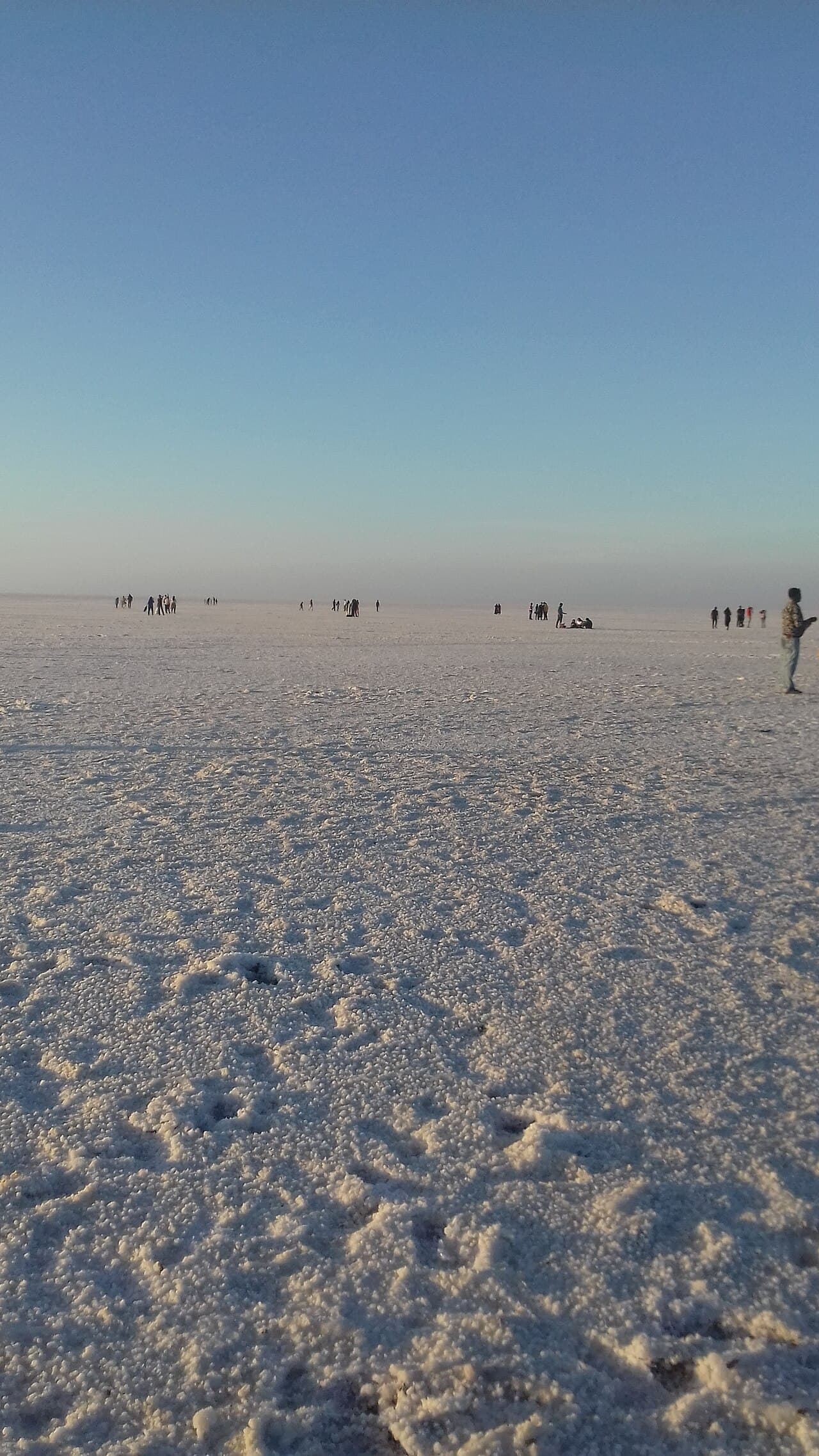
After the cultural programme, the salt flat walk is the natural next event. The walk to the White Rann viewpoint takes 10–15 minutes from the Tent City entrance (or a short buggy ride). Plan to spend at least 30–45 minutes on the salt flat — the longer you stand in the silence, the more deeply the landscape registers.
8. Activities to Pre-Book Versus Those Available on the Day
Some activities at Rann Utsav benefit from pre-booking; others are reliably available on arrival. Here is the distinction:
Pre-book (or book on arrival evening for the following day): - Camel ride at sunrise — the early-morning ride slots fill quickly in peak season; book at the activities desk on your first evening - Jeep safari into the Rann — popular in the afternoon and books out in peak season; reserve a day ahead - Kalo Dungar day trip — vehicle hire should be arranged the evening before
Available on the day without advance booking (outside extreme peak): - ATV rides — long operating hours and multiple vehicles mean walk-up availability is usually possible - Craft workshops — most run on a walk-in basis - Camel cart rides — available throughout the day - Horse rides — walk-up availability in most conditions
The general rule: anything that has a fixed time slot (sunrise camel rides, jeep safaris with a set departure time) should be booked the evening before. Anything continuous-access can be done on the day.
9. Photography Etiquette — Ask Before You Point
The artisans, folk performers, and local community members at Rann Utsav are not props for your travel photography — they are people doing their work. The etiquette is straightforward: engage before you photograph.
For bazaar artisans: sit with them, ask about their work, make a small purchase if you can. Then ask permission to photograph them working. Almost all will say yes, and the resulting portrait — of someone who is relaxed, seen, and respected rather than caught off guard — is invariably better than a candid snap.
For folk performers: the cultural programme is a performance space where photography is generally welcomed, but use your judgement about flash (avoid it — it disturbs the performance and kills your own ability to see the stage properly) and intrusive positioning. Do not walk in front of other audience members or onto the performance area during acts.
For children in the village: always ask a parent or accompanying adult before photographing children. This is courteous everywhere and essential in rural community contexts.
On the salt flat: photography is unrestricted and the landscape is your canvas. The etiquette here is simply environmental — do not leave rubbish, do not disturb the natural state of the surface, and be considerate of other visitors who have come for the silence. Not everyone in the space wants to be in your photograph; be aware of strangers in your frame.
10. What to Eat — and What Not to Miss
The Tent City dhaba serves Gujarati thali meals that are considerably better than most visitors expect. Gujarati cooking is mild (not aggressively spiced), predominantly vegetarian, and built around a combination of sweet, sour, and savoury flavours that is genuinely distinctive. Do not eat the thali as a convenience — eat it as the destination food that it is.
The items worth specific attention: bajra rotla (thick flatbread from pearl millet, served with white butter and jaggery — this is Kutch on a plate), dal dhokli (wheat dumplings in a turmeric-bright lentil sauce), and whatever the seasonal sabzi is (ask the dhaba staff what is freshest that day).
In the bazaar: Kutchi dabeli is non-negotiable. This bread roll stuffed with spiced potato, pomegranate seeds, peanuts, sev, and three chutneys is the regional snack that has spread across India but tastes completely different at source. Eat at least one per day. Mawa peda — the dense reduced-milk sweet flavoured with cardamom — is the correct souvenir food to bring home; it keeps well and is impossible to replicate outside the region.
What to avoid: do not eat from any stall that does not look freshly prepared. The desert air is dry and food spoils less quickly than in humid climates, but freshness is still the best guide. Stick to stalls with visible cooking activity.
11. Language Tips — What Gets You Further Than English
The working languages at the Tent City and bazaar are Gujarati, Kutchi (a dialect related to Sindhi, distinct from Gujarati), and Hindi. English is understood in the Tent City itself — staff are accustomed to visitors from across India and internationally. In the bazaar and village areas, a few words of Hindi or Gujarati go significantly further than English.
The most useful phrases: "Ketlu che?" (How much? — Gujarati), "Sundar che" (It's beautiful — Gujarati, useful in the bazaar and invariably appreciated), and "Shukriya" or "Dhanyawad" (Thank you — Hindi/Gujarati respectively). Attempting even these minimal phrases signals respect and usually produces a warmer response from artisans and stall-holders than English-only interaction.
Kutchi, the mother tongue of most Dhordo village residents, is not necessary to learn — but if you encounter it, you are hearing a language with significant historical depth, carried by a community that crossed the Sindh-Gujarat border across generations. Understanding that you are in the presence of a distinct linguistic community adds dimension to the encounter.
12. What NOT to Bring
A few things commonly brought to Rann Utsav that are either prohibited, impractical, or unnecessary:
Alcohol: Gujarat is a dry state. Possession and consumption of alcohol is illegal. The Tent City does not serve it and there is no legal source within 85 kilometres. Do not attempt to bring it.
A drone without permits: The Rann of Kutch is in a border-sensitive zone adjacent to the Pakistan border. Drone use requires explicit prior permission from the relevant authorities — a process that takes weeks. Bringing a drone and flying it without permission risks confiscation and legal consequences. If drone photography matters to you, begin the permit process months before travel.
A large hard-sided suitcase: The Tent City access paths are sometimes on compacted salt and earth rather than tarmac. A large rolling suitcase is awkward to manoeuvre and adds stress to arrival and departure. Bring a 55–65 litre backpack or a medium-sized soft duffel for a three-night stay. This is also practical if you plan day trips around Kutch.
High heels or thin-soled fashion shoes: The salt flat surface is crystalline and uneven. You will walk on it at night, often for 30–45 minutes at a time. Comfortable, closed walking shoes or trainers are the correct footwear for every on-foot activity at Rann Utsav, including the cultural programme.
Excessive valuables: The Tent City is generally safe and incidents of theft are rare. But the festival environment, with its high crowds and multiple points of public access, is not the right setting for expensive jewellery or cash above your shopping budget. Leave high-value items secured in the tent or at home.
The expectation that you have seen it before: Rann Utsav is genuinely singular. Whatever photographs you have seen of the salt flat under a full moon, the reality of standing on it — the scale, the silence, the luminosity of the surface, the cold wind carrying nothing from every direction — is different from the image. Go with curiosity rather than a checklist, and it will exceed what you expected.