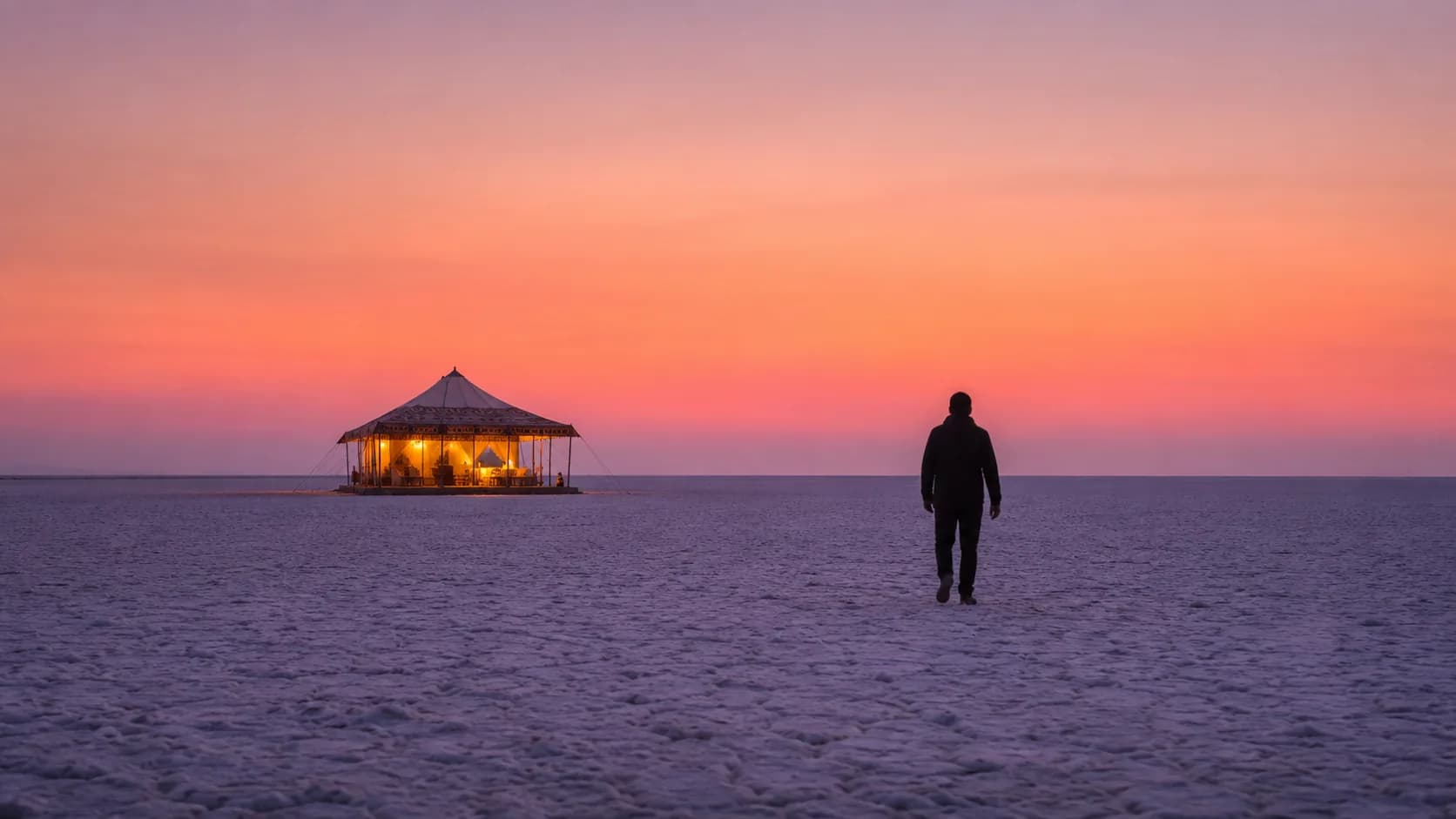
A Season of Many Characters
Ask ten experienced Rann Utsav visitors when the best time to go is, and you will receive nine different answers — each one correct for the person who gave it. The reason is not that the question is subjective in an evasive sense but that it is genuinely dependent on what you are optimising for. The person who prioritises photography in magical light will name a different month from the person who prioritises not being cold, who will name a different month from the person who wants the most immersive cultural festival atmosphere, who will name a different month from the family with school-age children whose dates are fixed by term calendars.
The published 2026–27 Dhordo Tent City stay season runs from 1 November 2026 to 7 March 2027. Kutch's broader cool-weather travel window can start earlier, but an October regional trip is not the same as a bookable Rann Utsav Tent City stay. This guide compares the months so you can choose dates that fit the experience you want.
October 2026 — Kutch Travel Before the Dhordo Stay Season
October can suit a wider Kutch road trip, subject to weather and local access conditions. It is not within the published 2026–27 Dhordo Tent City stay dates, so do not assume festival accommodation or programming is available then.
If you want the festival stay, start with November dates. If you prefer October, plan it as a separate Kutch visit and check the permit, accommodation and White Rann access rules for your exact dates.
Post-monsoon surface and weather conditions vary in October. Check a current forecast before leaving and avoid assuming the salt flat will be dry or open for a particular activity.
The October full moon falls before the published Dhordo stay season, so it is not one of this site's four listed 2026–27 full-moon visit windows. For a Tent City stay around a full moon, compare the November, December, January and February windows on the special-dates page.
October suits: regional Kutch travellers who can confirm conditions and arrange accommodation independently of the Dhordo Tent City season.
November 2026 — The Season Hits Its Stride
November falls within the published Dhordo stay season and can be a good choice for a first visit. Confirm which tent categories, cultural programmes, craft stalls and activities are available from the provider for your particular dates; they are not identical every day.
November temperatures offer an excellent balance. Days run from 24 to 30°C — warm enough to be pleasant on the salt flat without the intensity of October's heat. Nights drop to between 12 and 18°C, which is cool rather than cold and requires a proper fleece or light down jacket for evenings outdoors. The air in November is exceptionally clear — the post-monsoon dust has settled, the humidity is very low, and visibility on the salt flat can extend to 40 or 50 kilometres on a clear morning.
The listed November full-moon travel window is 22–25 November 2026. If that experience matters to you, ask about provider availability, White Rann access and any special programme before booking transport.
Crowd levels in November are moderate to high in the second half of the month but more manageable than December. The cultural programme has its full variety — Garba, Langa musicians, Bhavai theatre, Kalbelia dance — playing across successive evenings. If you are visiting for two or three nights, every evening offers something genuinely different.
November suits: families with school-age children (mid-November coincides with some school break periods), couples, groups of friends, photographers who want the clarity of late-autumn light, first-time visitors who want the full festival experience without the extremes of December cold.
December 2026 — The Peak of Peaks
December is a popular choice for the White Rann, with cooler weather, holiday travel and the listed 21–24 December full-moon window. The programme, activities and accommodation vary by provider and date, so compare written itineraries rather than assuming every event runs throughout the month.
All of this comes at a cost, and the cost is twofold: cold and crowds.
December nights in Kutch are genuinely cold. By the third week of December, nights can drop to six to eight degrees Celsius, with cold waves from Rajasthan occasionally pushing the mercury to three or four. The open, windswept salt flat at midnight feels colder still. Full thermal layering — base layers, down jacket, warm hat, gloves — is not excessive; it is exactly what is needed. Visitors who come to December full moon nights underprepared for the cold are the ones who leave early, and leaving the White Rann early on a December full moon night is a genuine loss.
The listed December full-moon travel window is 21–24 December 2026. Ask the selected provider which nights have availability, whether there is a supplement and what, if any, special programme is included. No fixed sell-out timeline applies to every category.
The Christmas and New Year period (December 24 through January 1) is the busiest stretch of the entire Rann Utsav season. Availability is extremely limited, prices are at their seasonal peak, and the tent city operates at full capacity. The cultural programme is at its most festive — special performances, extended evening events, and a New Year's Eve celebration that has become a fixture of the Gujarati travel calendar.
December suits: photographers, travellers who want the peak festival atmosphere, those celebrating special occasions, couples on romantic getaways, anyone who specifically wants the full moon experience at its most dramatic. Not ideal for: visitors sensitive to cold, those who prefer quieter experiences, families with very young children who may struggle with cold nights.
January 2027 — Cold, Clear, and Underappreciated
January is, in some ways, the most rewarding month for visitors who know what they are looking for — and the least obvious choice for those who do not. The cold deterrent that keeps some visitors away in January creates a paradox: the experience is arguably at its most intense, its most beautiful, and most privately enjoyed in the month that fewest people choose.
The Uttarayan kite festival on January 14 brings an enormous surge of energy to Kutch that has nothing to do with Rann Utsav tourism and everything to do with local Gujarati culture. The skies over Bhuj and the surrounding districts are filled with kites for days around this date, and the Rann Utsav tent city participates in the celebration. If you are in Dhordo around Uttarayan, the festival acquires a distinctly local, non-tourist quality — the kind of cultural immersion that most heritage travel destinations struggle to provide.
January nights are the coldest of the season. Single-digit temperatures are standard; cold waves can push to three or four degrees. The salt flat at night requires the full winter wardrobe described in the clothing guide. But the reward is proportional. January's sky is the clearest of the season — dust levels are at their lowest, humidity is minimal, and astrophotography conditions are excellent. The Milky Way on a January new-moon night at the White Rann is something that very experienced night-sky photographers name as the finest they have captured in India.
The listed January full-moon travel window is 20–23 January 2027. Check the weather and White Rann access for your chosen night; cold or clear conditions cannot be promised in advance.
January suits: repeat visitors, cold-tolerant travellers, astrophotographers, those who want a quieter version of the peak experience, travellers who missed December and do not want to compromise with the tail-end of the season.
February 2027 — The Gentle Wind-Down
February occupies a comfortable middle position in the season's arc: the intensity of December and January has passed, the temperatures have begun their gradual climb toward spring warmth, and the festival is still running with sufficient energy to make a visit genuinely rewarding. What changes is the mood — from celebratory frenzy to something quieter and more contemplative.
Daytime temperatures in February reach 25 to 30°C, and nights rarely drop below 12°C after the first week. The light-jacket protocol is sufficient from mid-February; heavy winter gear can be left behind. The salt flat in February has a quality of light that photographers who visit in this month often specifically seek: the sun is slightly higher in the sky than in December, creating a different shadow quality and a warmer colour temperature in the golden hours.
Crowds are meaningfully lower in February than in the December-January peak. The artisan bazaar has room to breathe. The cultural programme is less elaborate than at peak season — some performance groups have concluded their festival engagements — but the core of the programme remains in place.
The listed February full-moon travel window is 18–21 February 2027, the final full-moon window shown in this site's published Dhordo stay calendar. Confirm the provider's programme and access arrangements for your selected date.
February suits: couples seeking romance without the December crush, solo travellers, those who prefer quieter cultural experiences, visitors from warmer climates who want Rann Utsav without serious cold, anyone who has missed earlier months and is considering whether February is "too late."
March 2027 — The Season's Final Note
March is the conclusion of the published Dhordo stay season, which ends on 7 March 2027. Confirm whether your chosen accommodation and any activities are available on the specific days you want; do not assume the Tent City operates through the rest of March.
March days can be warmer than mid-winter. The 22 March 2027 full moon falls after the listed 7 March closing date; it should not be presented as a bookable full-moon Tent City date. Check the forecast and the selected provider's schedule.
March suits: travellers with no other window in the season, those who particularly enjoy mild evenings, visitors who appreciate quietness over fullness. Not ideal for those who want peak atmosphere or the clearest winter photography conditions.
Full Moon Calendar for 2026-27
For the published 2026–27 Dhordo stay season, this site's listed full-moon travel windows are 22–25 November, 21–24 December, 20–23 January and 18–21 February. Dates in October and after 7 March are outside the listed stay season. Compare the four windows on the special-dates page and confirm availability before booking travel.
Published Non-AC Swiss Cottage base-category starting rates are ₹6,300 for one night, ₹12,600 for two nights and ₹18,900 for three nights per person, twin-sharing, before applicable GST. Full-moon and holiday supplements may apply; call +91 92747 30220 for a written quote for your dates.