Fire on the Salt: Why the Rann Utsav Bonfire Evening Is Something Altogether Different
There are various ways to experience a bonfire. The suburban garden bonfire, the beach fire at a music festival, the fire pit in a luxury resort's courtyard — all have their pleasures and their social contexts. None of them quite prepare you for what it means to sit around a fire on the White Rann of Kutch at nine o'clock in the evening, with the salt flat extending in every direction into darkness and the winter sky overhead dense with stars.
The bonfire evenings at Rann Utsav are not a scheduled attraction in the way that the Garba programme or the camel safari are. They are, rather, a natural gathering point — an invitation to slow down from the stimulation of the festival's other activities and simply be present in the landscape.
How the Bonfire Evenings Work
On most evenings throughout the Rann Utsav season, a bonfire is lit on the salt flat a short walk from the tent city at Dhordo. The fire is organised by the tent city staff, who ensure wood is available and the fire is properly established before guests arrive. Seating — low stools, wooden platforms, or simply thick durries laid on the salt — is arranged around the fire in a rough circle.
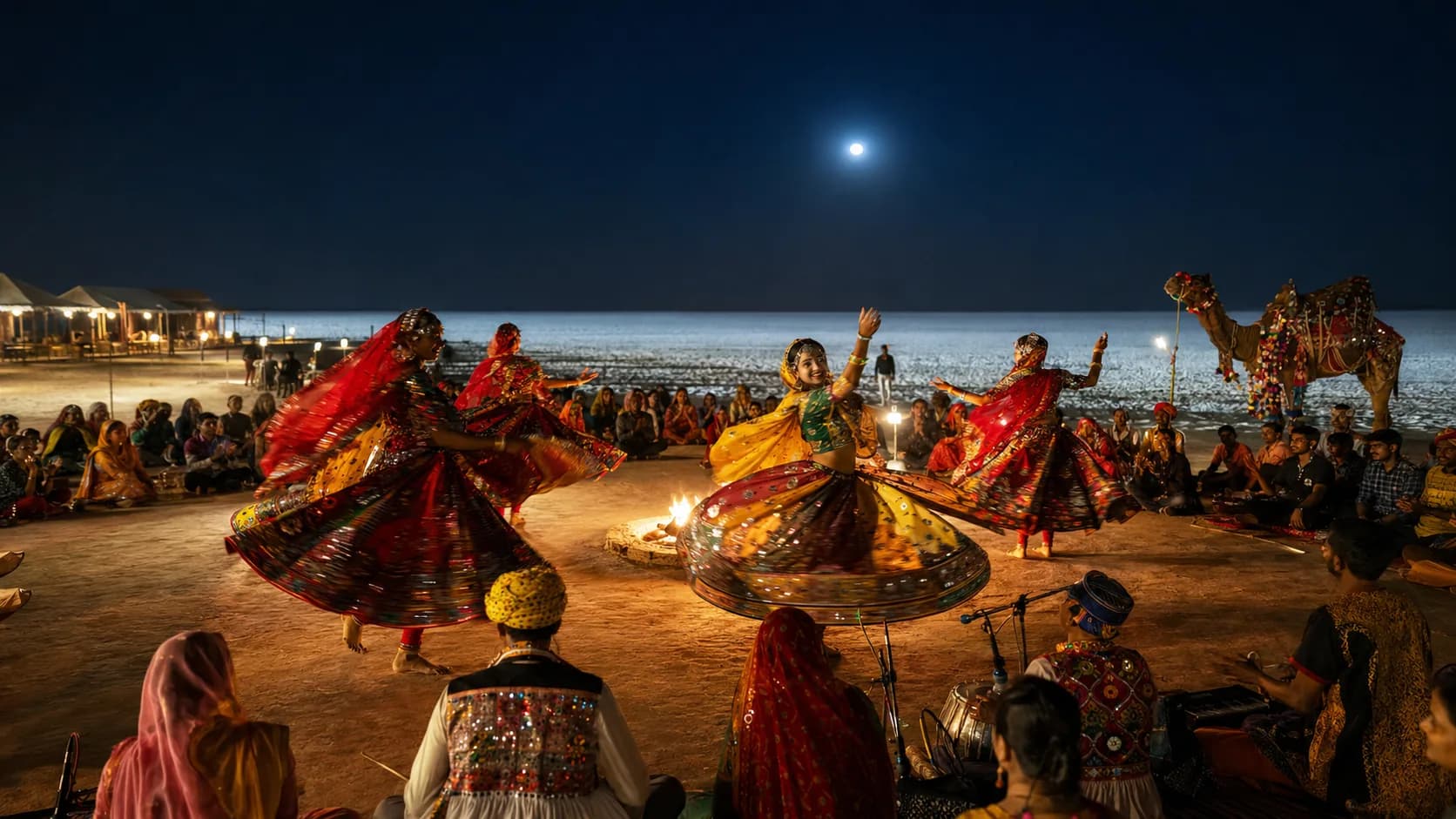
Chai is the invariable accompaniment. The Rann Utsav staff understand that warm chai and cold night air around a bonfire is one of those combinations so obviously right that no embellishment is required. Sometimes music follows — a musician from the cultural programme playing informally, outside the pressure of a stage performance — and these informal sessions are frequently described by visitors as more moving than the organised concerts.
The bonfire runs parallel to the main cultural programme rather than instead of it. Some visitors move between the fire and the cultural stage across the course of an evening; others choose the bonfire exclusively and find that the more intimate context suits them better than the larger performance space.
Why the Wilderness Context Changes Everything
The crucial thing about the Rann Utsav bonfire is where it happens. The same fire, the same chai, the same company would produce a pleasant but ordinary evening almost anywhere else. On the White Rann, the combination of extreme flatness, extreme openness, and the profound silence of the desert produces a context that changes the character of everything within it.
When you sit around the fire, the light reaches only a short distance into the surrounding darkness. Beyond the firelight's reach, the salt flat continues invisibly in every direction. You know, intellectually, that it stretches for tens of kilometres to the horizon — but the knowledge and the sensation are different things. The darkness beyond the fire is not threatening; it is the same quality of darkness that makes the stargazing extraordinary, the same openness that makes the sunrise so affecting. It is the darkness of a landscape that has not been rearranged by human habitation.
Winter temperatures at Dhordo drop quickly after sunset, and by nine or ten in the evening the cold is real — somewhere between five and twelve degrees Celsius depending on the month, with wind that makes it feel colder. This cold is not incidental to the bonfire experience. The fire's warmth is proportionally more appreciated in this context, and the necessity of pulling a shawl or jacket tightly around yourself is part of the texture of the evening.
What to Bring for Bonfire Night
Warm clothing is non-negotiable. The gap between what visitors expect and what they actually experience in terms of cold on winter evenings at the Rann is considerable, and the bonfire, however warm at the front, does not heat your back. Thermal underlayers, a substantial outer layer, a hat, and gloves are appropriate in November through January. A shawl adds versatility — it can be pulled around shoulders when seated and draped over the head in wind.
The tent city offers chai and sometimes snacks at the bonfire in the evening; confirm with the front desk on arrival whether food service runs to the bonfire location. Carrying a personal water bottle is always sensible on the salt flat regardless of time of day.
Leave the bright phone screen for later if you can. The bonfire's light is warm and low, and the contrast with the darkness around it is part of the experience. A bright phone screen, held up for photographs every few minutes, disrupts the quality of attention that makes the bonfire evening what it is.
The Bonfire and the Full Moon
The bonfire takes on a particular quality on full moon nights — the most celebrated occasions in the Rann Utsav calendar. When the full moon is above the horizon, its light on the salt flat creates a silver landscape in every direction, and the bonfire becomes an island of warm gold in a world of cool silver light. On these nights, the bonfire is often more crowded, the atmosphere more festive, and the music more abundant. The full moon nights at Rann Utsav are worth planning around specifically; the special dates page and the team at +91 92747 30220 can help you identify which full moon nights fall within the season.
The overnight packages — ₹6,300 for one night, ₹12,600 for two nights, and ₹18,900 for three nights — all include access to the evening activities at Dhordo, and the bonfire is part of this. There is no additional charge for joining the fire circle.
If you have a specific question about evening programming, bonfire arrangements, or what to expect on the evening of your stay, the team at +91 92747 30220 will be happy to advise.