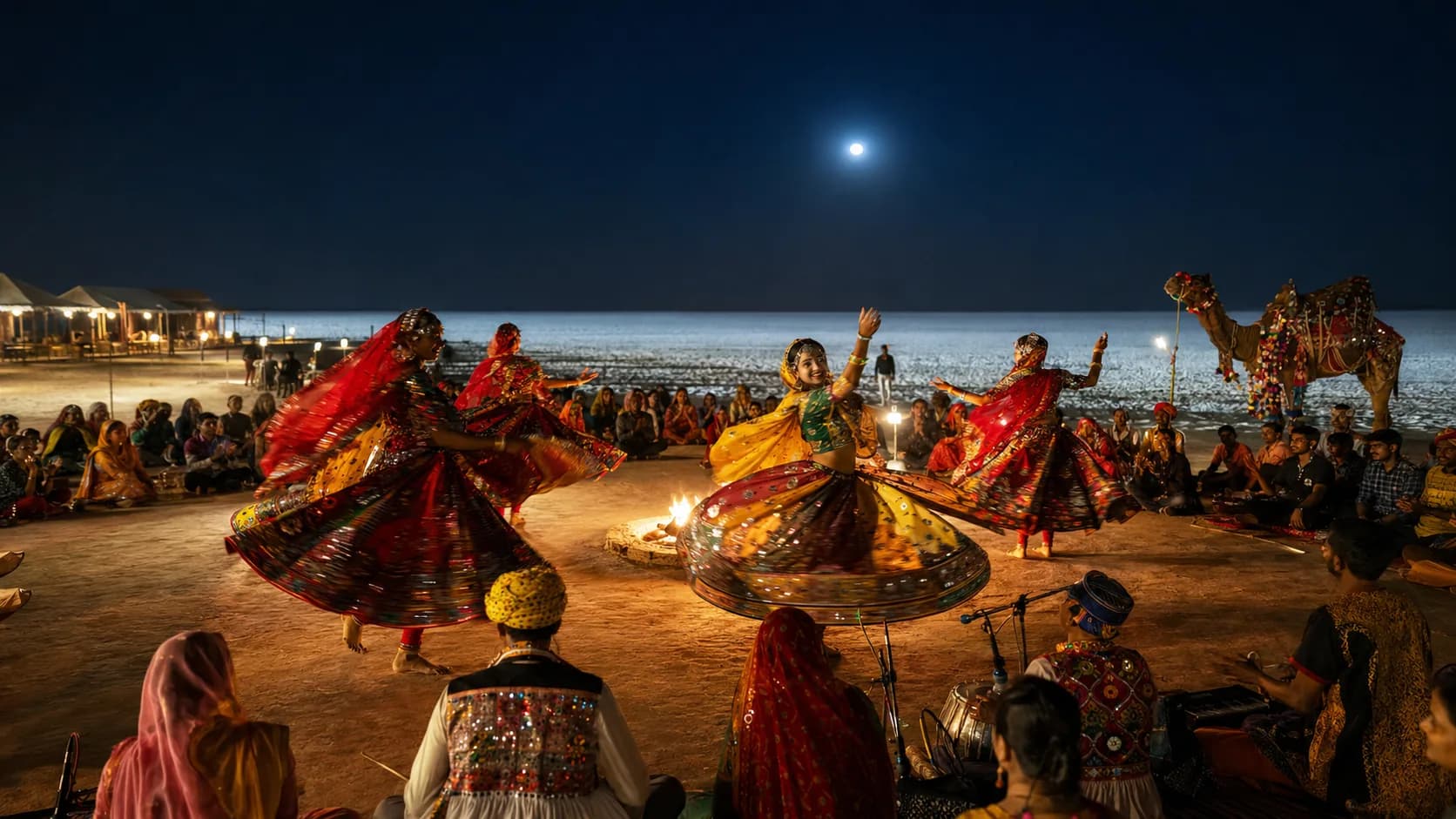
Riding High Above the Salt: The Camel Safari Experience at Rann Utsav
There are few experiences in India quite as disorienting — in the most wonderful sense — as climbing onto the back of a Kutchi camel and watching the White Rann unfold beneath you from a height of two metres. The salt crust, already one of the most surreal landscapes on the subcontinent, transforms entirely when viewed from camel height. The horizon appears to stretch another ten kilometres in every direction. The silence, broken only by the rhythmic crunch of hooves on crystallised earth, settles over you like a warm shawl.
The camel safari at Rann Utsav is not a peripheral add-on. It is, for many visitors, the experience they carry home most vividly — more so even than the celebrated full moon nights or the spectacular Garba evenings. There is something irreducibly ancient about travelling this landscape on camelback, exactly as the Kutchi trading families and salt merchants did for centuries before the motor car changed everything.
The Kutchi Camel: A Brief Cultural History
The camels of Kutch are not simply working animals; they are woven into the social and economic fabric of the region. The Rabari and Jat communities of Kutch have herded camels across these plains for generations, and the relationship between herder and animal in this part of Gujarat is one of genuine partnership. Kutchi camels are typically of the Kharai breed — an extraordinary variety uniquely adapted to coastal and saline terrain, capable of swimming between islands and grazing on mangroves. These are animals of considerable intelligence and surprising gentleness.
When you book a camel safari at Rann Utsav, you are engaging directly with this living tradition. Your camel handler — usually a young man from one of the pastoral communities — will have grown up alongside these animals. He will know your camel's temperament, its gait, whether it prefers a slower pace in the early part of a ride. Conversations with these handlers, usually in a mixture of Kutchi, Hindi and patient gestures, offer a glimpse into a way of life that the rest of India has largely forgotten.
When to Go: Sunset Is Everything
Camel rides and safari-style experiences depend on the operator, weather and access conditions. The published 2026–27 Dhordo Tent City season runs from 1 November to 7 March, but an activity is not guaranteed on every date. Confirm its availability separately for your stay.
The consensus among repeat visitors — and the recommendation you will hear consistently from the Dhordo tent city staff — is that late afternoon, timed to coincide with sunset, is when the White Rann reveals its most extraordinary face. As the sun drops towards the horizon, the flat white salt crust begins to absorb colour in a way that flat terrain during midday simply cannot. Shades of apricot, rose, and eventually deep amber wash across the surface. Camel silhouettes extend in long shadows. The sky above turns operatic.
Morning safaris — departing around six or seven o'clock — offer their own rewards. The salt is at its whitest and most reflective, the air is still and cool, and you may encounter birds that have retreated by midday. Flamingos are occasionally spotted at certain edges of the Rann during the early season. But if you can only do one safari, choose the sunset slot. You will not regret it.
Duration, Distance, and What You Actually See
A standard camel safari at Rann Utsav runs between one and two hours, covering somewhere between two and five kilometres depending on the route your handler takes and the pace of your group. This is not a long-distance trek; it is a contemplative journey designed around immersion rather than mileage.
The route typically begins at the edge of the tent city at Dhordo and moves out across the open salt flat. As you progress, the sounds of the camp — music from the cultural stage, the hum of generators — fade entirely. What remains is the Rann itself: vast, pale, and genuinely otherworldly. On clear days, and most days in the October-February season are clear, you can see the low hills of Kala Dungar (the Black Hill) to the north, rising improbably from the flat expanse.
Partway through the route, your handler will typically bring the camel to a halt on a particularly open stretch and allow you time to simply sit and absorb the view. This pause — unscheduled, unhurried — is often when photographs happen and sometimes when something more than photographs happens. Visitors regularly describe a sensation of genuine stillness, of the kind that is increasingly difficult to find in modern life.
The Practical Side: How to Ride a Camel Comfortably
If you have never ridden a camel before, the mounting and dismounting process will come as a mild surprise. Camels kneel to accept riders, but the motion of standing up — which happens in two distinct lurches, rear legs first, then front — is more dramatic than it sounds. Hold the saddle horn with both hands and lean back as the front legs rise. Most people find it easier than expected once they understand the sequence.
Once in motion, the camel's gait is a gentle, rolling sway — quite different from a horse's trot or canter. It is this sway that makes camel-back photography simultaneously more interesting and more challenging. Your shots will have a natural movement to them, a slight blur that experienced photographers use deliberately to convey motion and the living quality of the landscape. For sharper images, photograph during the pauses your handler builds into the route, or use a burst mode to capture the moments between sways.
Wear comfortable, non-restrictive clothing. Loose salwar kameez or similar loose-fit trousers are ideal; tight jeans can become uncomfortable over an hour. A light shawl is useful for afternoons in November through January, when the temperature drops rapidly after sunset. Closed-toe shoes are recommended over sandals, as the salt crust can have sharp edges in places.
Camel Safari Pricing and Package Inclusions
This is where visitors sometimes encounter mild confusion, so it is worth being clear. The camel safari is included in some Rann Utsav packages and available as a paid add-on in others. The base packages — starting from ₹6,300 for a one-night, two-day stay — may include one camel safari per person as part of the standard activities programme. The two-night, three-day package at ₹12,600 typically includes more comprehensive activity access, and the three-night, four-day package at ₹18,900 generally covers the full activities calendar including multiple safaris.
If the safari is not included in your package, it can be booked on-site at Dhordo for an additional fee. The tent city activity desk processes these bookings and can confirm availability and pricing at the time of your visit. For group bookings or special arrangements, it is worth calling ahead on +91 92747 30220 to understand exactly what your package covers and what remains bookable on arrival.
Tips for Making the Most of Your Camel Safari
Go once at sunset, and if your package length permits, go again at sunrise. The two experiences are genuinely different and complement each other beautifully. The sunset safari is emotional; the sunrise safari is meditative.
Take less with you than you think you need. A single camera or phone is sufficient. The temptation to photograph constantly can actually diminish the experience — some of the most powerful moments on the White Rann happen in the intervals between photographs, when you simply look.
Talk to your handler if you can. Even a limited Hindi vocabulary opens doors. Ask how long he has worked with camels, whether this particular camel has a name, what the Rann looks like after the monsoon floods recede. These conversations anchor the experience in something real and local rather than leaving it as a purely visual spectacle.
Finally, allow yourself to be slightly uncomfortable. The salt flat is disorienting in scale. The silence can feel almost physical. Lean into that rather than retreating to your phone. The camel safari at Rann Utsav is one of those experiences that rewards full attention, and those who give it that attention tend to describe it, months later, as something quietly transformative.