The Site That Rewrites What You Know About India
There is a particular quality of feeling that comes from standing inside a 4,500-year-old city and realising that the people who built it were solving the same problems you solve today — where to store water, how to manage traffic, where to put the marketplace — with an elegance that has not been matched since. Dholavira gives you that feeling, and it does it in a place that most visitors to the Rann Utsav have never considered putting on their itinerary.
This is the story of the Dholavira tent city — why it exists, what staying there is like, and why a night or two on Khadir Bet Island, beside one of Asia's most significant archaeological discoveries, is one of the most rewarding ways to extend a Rann Utsav trip.
What Is Dholavira?
Dholavira is, first and foremost, an archaeological site — the ruins of an Indus Valley Civilisation city that was inhabited continuously from approximately 3000 BCE to 1500 BCE. Located on the rocky island of Khadir Bet in the Great Rann of Kutch, it was excavated over more than three decades by the Archaeological Survey of India and granted UNESCO World Heritage status in July 2021.
The city that has been uncovered is remarkable in scale and sophistication. Dholavira was a planned urban settlement — a city designed and built according to a coherent spatial logic rather than one that grew organically. The archaeologists have identified a three-tiered structure: a citadel at the highest point, a middle town, and a lower town. The divisions between them are marked by massive defensive walls constructed from locally-cut stone — a building technique that distinguishes Dholavira from other Indus Valley sites, which more typically used fired brick.
The water management system is what consistently astonishes experts and laypersons alike. In a landscape that receives very little rainfall, the Dholavira civilisation built an elaborate network of reservoirs, channels, and dams to capture and store every drop of monsoon water. At least sixteen reservoirs have been identified at the site — a feat of civic engineering that was not matched in India for many centuries. The largest reservoir could hold millions of litres of water, ensuring the city's survival through long dry seasons.
The Signboard: A Mystery Carved in Stone
At the northern gate of the citadel, the Archaeological Survey of India discovered what is now believed to be the earliest example of a sign system in the Indian subcontinent: ten large stone symbols, each approximately thirty centimetres tall, arranged in a line that once formed an inscription on a wooden board above the entrance. The board has long since disintegrated, but the stone symbols — which were preserved because they fell to the ground during the city's decline — were recovered and are now displayed at the site entrance.
The script has not been deciphered. Nobody knows what those ten symbols say — whether it is the name of the city, a dedication, a declaration of ownership, or something else entirely. Standing before them, you are confronted with a message written by one of the world's earliest civilisations that we cannot yet read. There are few archaeological experiences anywhere in India as quietly humbling as this one.
The Tent City at Dholavira
The Dholavira tent city operates during the Rann Utsav festival season and is positioned as a companion experience to the main Dhordo tent city — an option for travellers who want to combine the White Rann experience with an encounter with Kutch's ancient heritage.
The tent city is smaller than Dhordo: fewer cottages, a more intimate setting, a correspondingly quieter atmosphere. This is not a weakness — it is a character. Where Dhordo buzzes with the energy of hundreds of visitors, the Dholavira tent city feels like a retreat. The number of guests at any given time is smaller, the evenings are quieter, and the relationship between visitor and landscape feels more personal.
The Accommodation
The accommodation options at Dholavira mirror those at Dhordo in category — Non-AC Swiss Cottage and AC Swiss Cottage. The cottages are similarly furnished and maintained, and the package structure is the same: one night and two days from ₹6,300, two nights and three days at ₹12,600, and three nights and four days at ₹18,900, with breakfast, dinner, cultural programme access, and a desert safari included.
The key difference is the view. Where Dhordo's tent city looks out over the festival grounds and the distant salt flat, the Dholavira tent city is oriented toward the archaeological landscape — the rocky terrain of Khadir Bet, the excavated ruins visible in the near distance, and beyond them, the vast white expanse of the Rann. It is a view that rewards contemplation.
The Evening Cultural Programme
The Dholavira tent city runs its own cultural programme, smaller in scale than Dhordo's but often noted for its intimacy and authenticity. Local Kutchi folk musicians and dancers perform in the evenings — the particular traditions of this part of Gujarat, which have evolved over centuries in a landscape defined by the Rann. The proximity to the heritage site gives these performances a particular resonance: you are watching living traditions in the shadow of an ancient city that represents the earliest roots of this culture.
The Desert Experience from Dholavira
The White Rann visible from Khadir Bet is a different experience from the viewpoint at Dhordo. The developed viewpoint infrastructure at Dhordo — the platform, the organised transport, the other visitors — creates a mediated encounter with the salt desert. At Dholavira, access to the Rann is more raw. You drive or walk toward the salt flat and encounter it with less framing. The silence is more complete.
Sunsets from the edge of the Rann near Dholavira are extraordinary. The sky here is unobstructed in every direction — no hills, no tree cover, no buildings — and the light shows are correspondingly vast. Photographers who have visited both locations consistently note that Dholavira's sunsets, while less famous, are equally spectacular.
Getting to Dholavira: The Journey as Experience
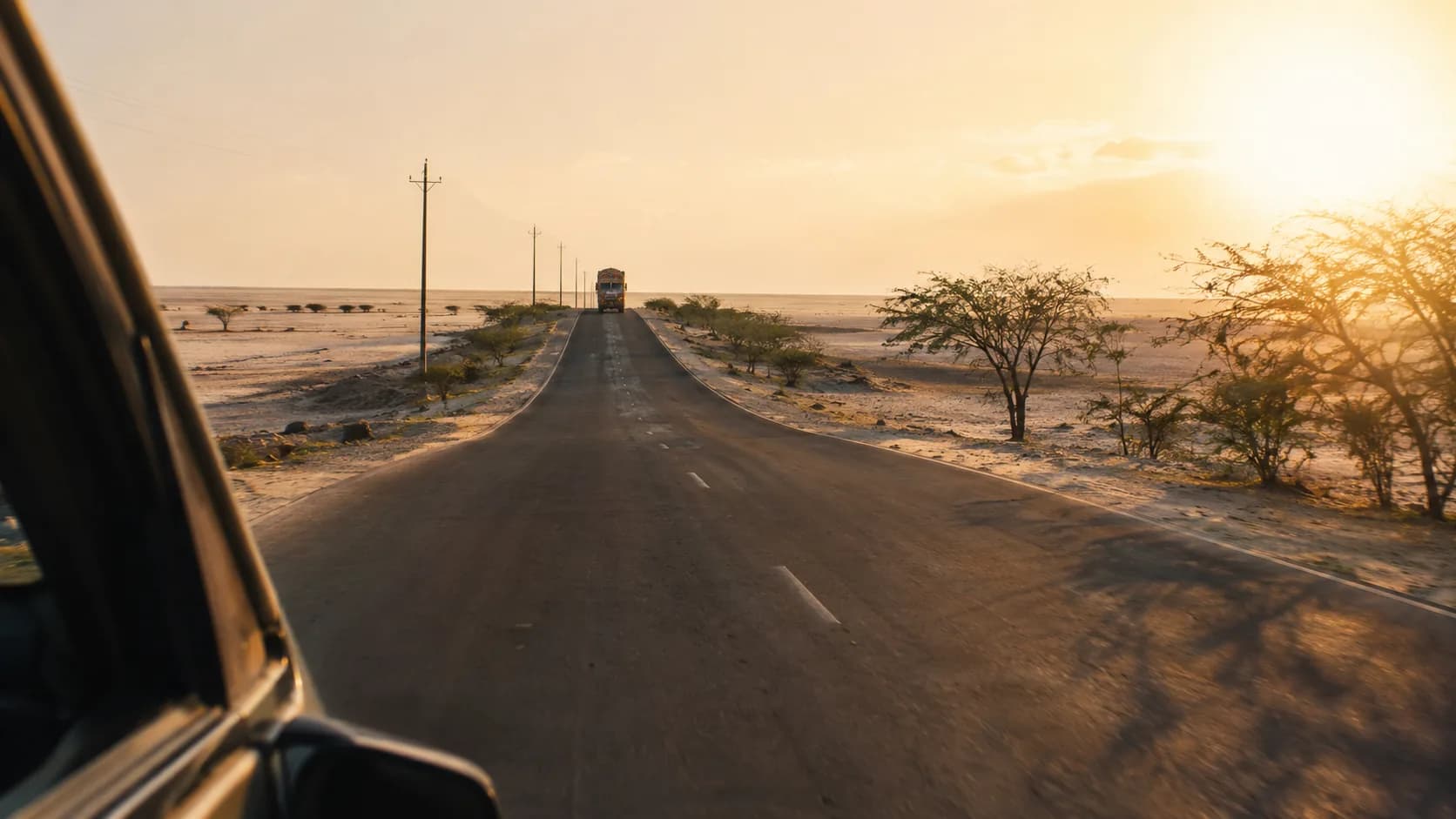
Dholavira is reached from Bhuj via a drive of approximately two and a half to three hours, passing through the town of Rapar and then across the salt marsh causeway to Khadir Bet. The causeway drive is itself worth the detour: the road crosses the Rann with salt desert on both sides, the white expanse extending to the horizon, the sky enormous overhead. On a clear day, with the light at the right angle, it is one of the most visually arresting drives in India.
Self-driving is possible in a sturdy vehicle. A four-wheel drive is not necessary in dry weather, but a reliable car is important — the causeway road, while paved, passes through remote terrain with limited assistance available if something goes wrong. Many visitors prefer to arrange transport through their package provider; our team can organise transfers from Bhuj or from Dhordo for travellers combining both locations.
Combining Dhordo and Dholavira in One Trip
The most rewarding way to experience both tent cities is in sequence. A typical combined itinerary might look like this: arrive at Dhordo for two nights — attending the full cultural programme, visiting the White Rann viewpoint at sunrise and again for the full-moon night, exploring the Rann Bazar — and then travel to Dholavira for a final night, visiting the archaeological site in the morning and spending the afternoon at the salt flat before returning to Bhuj the following day.
This itinerary gives you the festival energy of Dhordo and the contemplative depth of Dholavira, and it positions the two experiences as complementary rather than competing. The contrast enriches both: after the noise and colour of the tent city, Dholavira's quietness feels like a reward.
Why Dholavira Remains Overlooked — And Why That Is Good News
Part of Dholavira's charm is that it remains relatively unknown to the broader India travel market. The site received UNESCO status in 2021 — a relatively recent designation — and the tourism infrastructure is still catching up. Visitor numbers are a fraction of what comparable UNESCO sites in Rajasthan or Maharashtra attract.
For travellers who visit in 2026-27, this means encountering the ruins largely undisturbed. You can walk through the ancient streets at your own pace, stop for as long as you like at the signboard inscription, and sit in the silence of the citadel without the press of crowds. This quality of encounter — which is increasingly rare at India's heritage sites — is Dholavira's greatest gift, and it may not remain available indefinitely as awareness grows.
To enquire about Dholavira tent city packages or to plan a combined itinerary with Dhordo, call our team at +91 92747 30220. We can help you structure a trip that makes the most of both experiences within your available dates and budget.