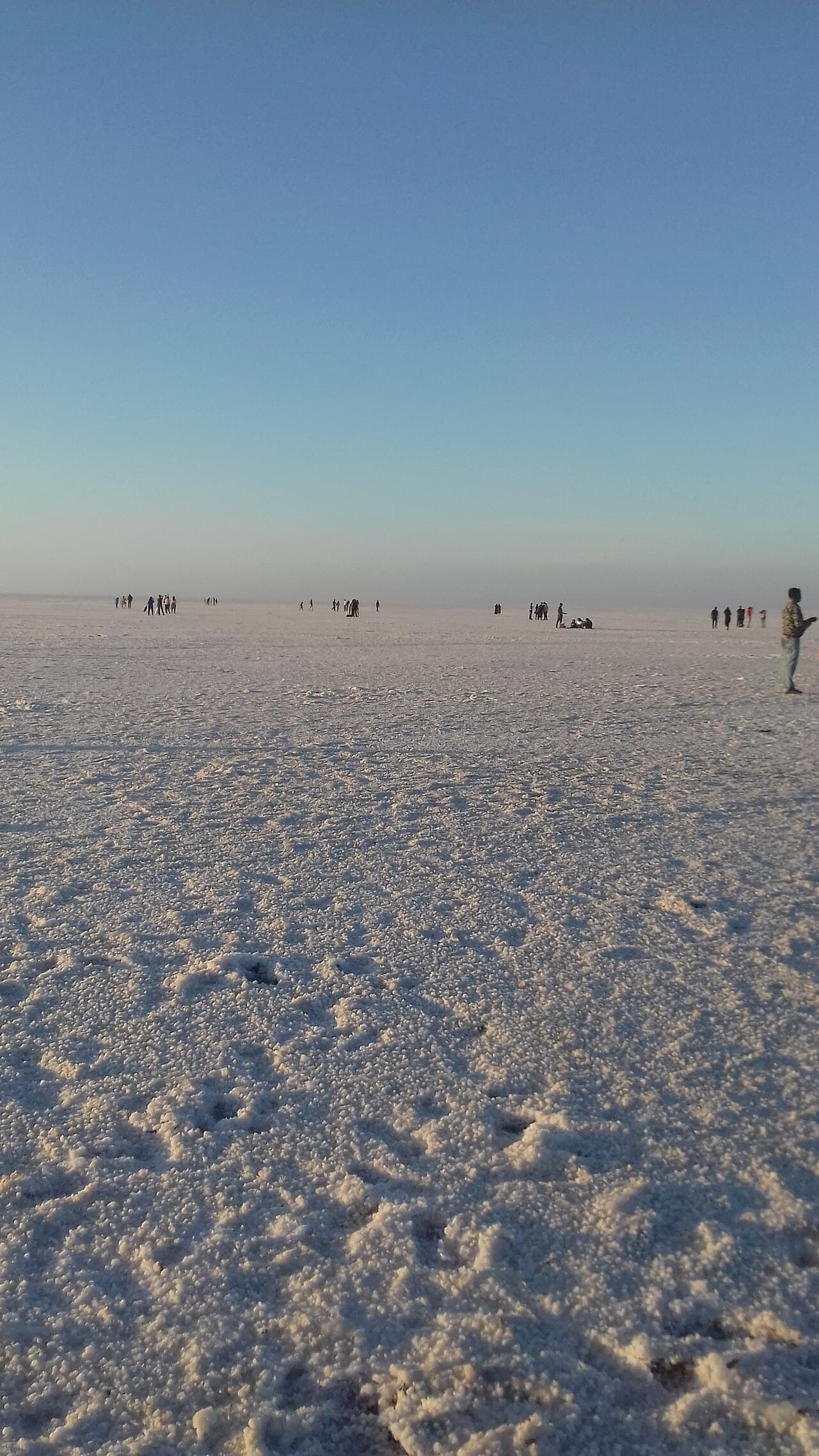
The Rann Utsav Experience: More Than a Landscape
People who have visited Rann Utsav describe it in terms you do not often hear about travel in India. Not "beautiful" or "interesting" — words that are true but insufficient. They say things like: "It changed something." Or: "I understood, for the first time, what silence sounds like." Or, more practically: "The food was extraordinary." The experience of the White Rann is partly visual and partly physical — the salt under your feet, the cold wind off the desert at night — but it is also sensory in a much more grounded way: what you eat, what you watch in the evenings, how you wake up, and what you do between the grand moments.
This guide covers the food and the experiences of Rann Utsav 2026-27 in detail — not the headline facts, but the texture of what being there actually feels like.
Food at Rann Utsav: The Tent City Dhaba
The Tent City at Dhordo has a dhaba — an open-sided dining hall — that serves as the communal kitchen for festival guests. For most visitors staying on package deals, meals here are included (breakfast and dinner on the 1-night/2-day package; all meals on longer packages). The dhaba's food is Gujarati in character, generous in quantity, and prepared fresh for each service.
The Gujarati Thali: What Comes to the Table
The dinner thali at the Tent City dhaba is typically served on a steel tray with multiple small bowls. What arrives — and refills are almost always offered — includes:
Dal: Gujarati dal is sweeter than its north Indian counterparts, often tempered with jaggery and tamarind alongside the standard mustard seed and dried red chilli treatment. On cold December evenings, a bowl of the Tent City dal is as warming as anything you could order. The dal dhokli version — thickened with wheat flour dumplings — is particularly satisfying and appears regularly on the menu.
Sabzi: Two or three seasonal vegetable dishes, typically including a dry sabzi (a slightly spiced stir-fry of whatever is seasonal — often methi, valor, or brinjal) and a gravy-based preparation. The cooking is primarily in peanut oil and uses a restrained hand with chilli — Gujarat cuisine is mild by the standards of most other regions, which makes it accessible to visitors who find the food of other parts of India too fierce.
Bajra Rotla: This is the bread you should eat at Rann Utsav. Bajra — pearl millet — is the staple grain of arid Kutch, grown successfully in conditions where wheat cannot survive. The rotla (thick flatbread made from bajra flour) arrives warm, slightly coarse-textured, and is served with white butter (makhan) and raw jaggery in pieces. The combination — the nutty, slightly earthy grain against the richness of the butter and the raw sweetness of the jaggery — is as elemental as food gets, and entirely specific to this region.
Rice and Kadhi: Plain steamed rice and Gujarati kadhi (a turmeric-yellow yoghurt-based sauce, mildly sour, lighter than a curry) round out the main meal. The kadhi here often has small pakoda dumplings floating in it — add them to the bajra rotla for an unimprovable combination.
Sweets: Gujarati dessert culture is prolific. The thali typically ends with something sweet — often a Mawa peda (a dense, fudge-like sweet made from reduced milk and sugar, flavoured with cardamom), a serving of shrikhand (strained yoghurt sweetened with sugar and saffron), or a simple adadiya (a fenugreek and jaggery ladoo particularly common in winter, reputed to generate internal warmth).
Breakfast at the Tent City
Breakfast in Gujarat is its own culture, and the Tent City dhaba does it well. The typical morning spread includes poha (flattened rice cooked with mustard seeds, turmeric, curry leaves, and green chilli), thepla (thin flatbread made with methi fenugreek leaves and spices — the definitive Gujarati travelling food, good hot or cold), and jalebi fresh from the oil alongside chai. The morning chai at the Tent City is generally excellent — a proper masala chai, not the pale imitation common in tourist-facing establishments in other cities.
Street Food and the Bazaar: Kutchi Specialities
Beyond the dhaba, the artisan bazaar at Dhordo has a food section where stall-holders sell the street food and regional specialities of Kutch. These are among the most important food experiences of the trip.
Kutchi Dabeli
The dabeli is Kutch's most famous export to the Indian snack lexicon — a bread roll (similar to a pav) stuffed with a spiced potato mixture, topped with pomegranate seeds, roasted peanuts, sev (crispy chickpea noodles), and three distinct chutneys (tamarind, garlic, and a red chilli paste). The original version from Mandvi in Kutch is considerably better than the versions sold across Gujarat and Maharashtra, and the Dhordo bazaar stalls make it close to the original tradition. A dabeli costs ₹30-50 and is worth eating at least once each day.
Bhajiya and Fafda
Hot bhajiya (pakoda) fresh from the oil are sold from carts in the bazaar, particularly in the evenings when the cold creates an appetite for fried food. The Kutchi version often uses local vegetables — raw banana, fresh methi, or green moong beans — rather than the onion-dominant version familiar from north Indian street food. Fafda (crispy chickpea flour strips with raw papaya chutney) is the Gujarati morning snack par excellence and appears at bazaar stalls from breakfast onwards.
Local Sweets: Mawa Peda and Kopra Pak
The sweet stalls at the Dhordo bazaar sell Mawa peda — the dense reduced-milk fudge sweet flavoured with cardamom and occasionally saffron — that is among the best confections in India. Kopra pak (a coconut and jaggery sweet with cardamom) is another Kutchi speciality worth seeking out. Both are sold by weight; buy more than you think you need.
Evening Cultural Shows: The Heart of Rann Utsav
The evening cultural programme at the main stage is the centrepiece of the Rann Utsav experience. It runs nightly from approximately 7:30 pm and lasts 90 minutes to two hours. The programme varies across the season and across different evenings — here is what you might encounter:
Garba and Folk Dance
The Garba — Gujarat's circular group dance form, performed in concentric rings with a central lamp or deity image — is at its most joyful when it is communal rather than performance-only. On Garba nights at the Tent City, the audience is invited into the circles. This is the moment that catches most visitors off guard: you are not watching the festival, you are part of it. The music is live, the circles are inclusive, and the energy generated by hundreds of people moving in the same direction under a desert sky is unlike anything produced by a ticketed concert.
Bhavai Theatre
Bhavai is a centuries-old Gujarati theatre form that combines comedy, devotion, social commentary, and remarkable physical feats — performers balance multiple clay pots on their heads while dancing, or walk on the edges of swords, or spin while carrying lit diyas in both hands. The form is specific to Gujarat and has no close equivalent elsewhere in India. An evening of Bhavai at Rann Utsav is both entertainment and cultural introduction.
Sufi and Folk Music
Kutch sits at the intersection of Hindu, Muslim, and Jain communities, and its musical traditions reflect this plurality. The Manganiyar and Langa communities of Rajasthan — hereditary musician castes whose sarangi, dholak, and khartal playing has sustained a tradition spanning centuries — regularly perform at Rann Utsav. The Sufi evenings, when the music moves from folk to the devotional poetry of Kabir and the Sindhi Sufi tradition, create a particular atmosphere: the desert night, the cold, the open sky, and music that has been sung in roughly this form for five hundred years.
Morning Experiences: Sunrise on the Salt Flat
The morning of a Rann Utsav day begins before dawn. The salt flat at first light — when the sky moves from absolute black to deep blue to the first smear of orange on the eastern horizon — is as memorable as any full moon experience, and significantly fewer visitors see it because it requires an early alarm.
The dawn sequence on the White Rann moves through colour in a way that landscape photographers specifically travel here to document: black sky and black salt (they are indistinguishable in the last hour before dawn) — then the very faintest separation as the horizon lightens — then the rapid shift through rose and apricot as the sun approaches — then, for ten to fifteen minutes, a light that falls at such a low angle that every surface irregularity in the salt crust casts a shadow three times its own height — and then sunrise proper, and the salt becomes white, and the experience becomes something that photographs can record but not adequately convey.
The Camping Experience: Sleeping Under the Desert Sky
The Tent City experience is often described as "glamping" — glamorous camping — and the description is apt. You are genuinely sleeping in a tent, with canvas walls and the sounds of the desert around you, but the tent has a proper bed, clean bedding, an attached bathroom, and electricity. What makes it different from a hotel room is precisely the canvas: at night, when the wind picks up across the Rann, the tent moves slightly. The sound of the desert at night — the wind, occasional animal calls, the deep silence underneath — is audible in a way that no permanent structure would allow.
On full moon nights, the moonlight through the tent canvas creates a diffused glow that makes the inside of the tent luminous even without the electric light. Guests in Rajwadi tents with their embroidered fabric walls describe the moonlit interior as one of the most beautiful spaces they have ever slept in.
Stargazing from the tent door — or from a mat spread on the salt flat 200 metres from the nearest tent — is the private experience that most visitors carry home most clearly. The Milky Way is visible to the naked eye. Shooting stars are common. The complete absence of artificial light means that the sky performs, hour by hour through the night, in a way that most modern travellers have never experienced.
This is the Rann Utsav experience at its most essential: good food from a generous kitchen, a cultural programme that is genuinely alive rather than curated-for-tourists, a morning sky unlike anything in your urban life, and a night so full of stars that you lie awake watching them for longer than you intended.