The Question Deserves an Honest Answer
We are the booking platform for Rann Utsav packages. We have a commercial interest in your visit. That relationship is transparent, and we think it deserves an equally transparent response to the question a significant number of potential visitors ask: is Rann Utsav actually worth it?
The honest answer is yes — but with qualifications that matter. Rann Utsav is one of the most genuinely remarkable travel experiences available anywhere in India, and it delivers its promises to visitors who arrive with accurate expectations. It also consistently disappoints a minority of visitors, and those disappointments share a common origin: a misunderstanding of what the experience is and is not.
This review attempts to lay both sides out plainly. It covers what Rann Utsav genuinely is, at its best. It covers what it is not, and what some visitors incorrectly expect it to be. And it offers a clear-eyed verdict on value for money — because the price question, beginning at ₹6,300 for a one-night package, is one that many people are genuinely uncertain about.
What Rann Utsav Is: The Case for Going
A Landscape That Exists Nowhere Else on Earth
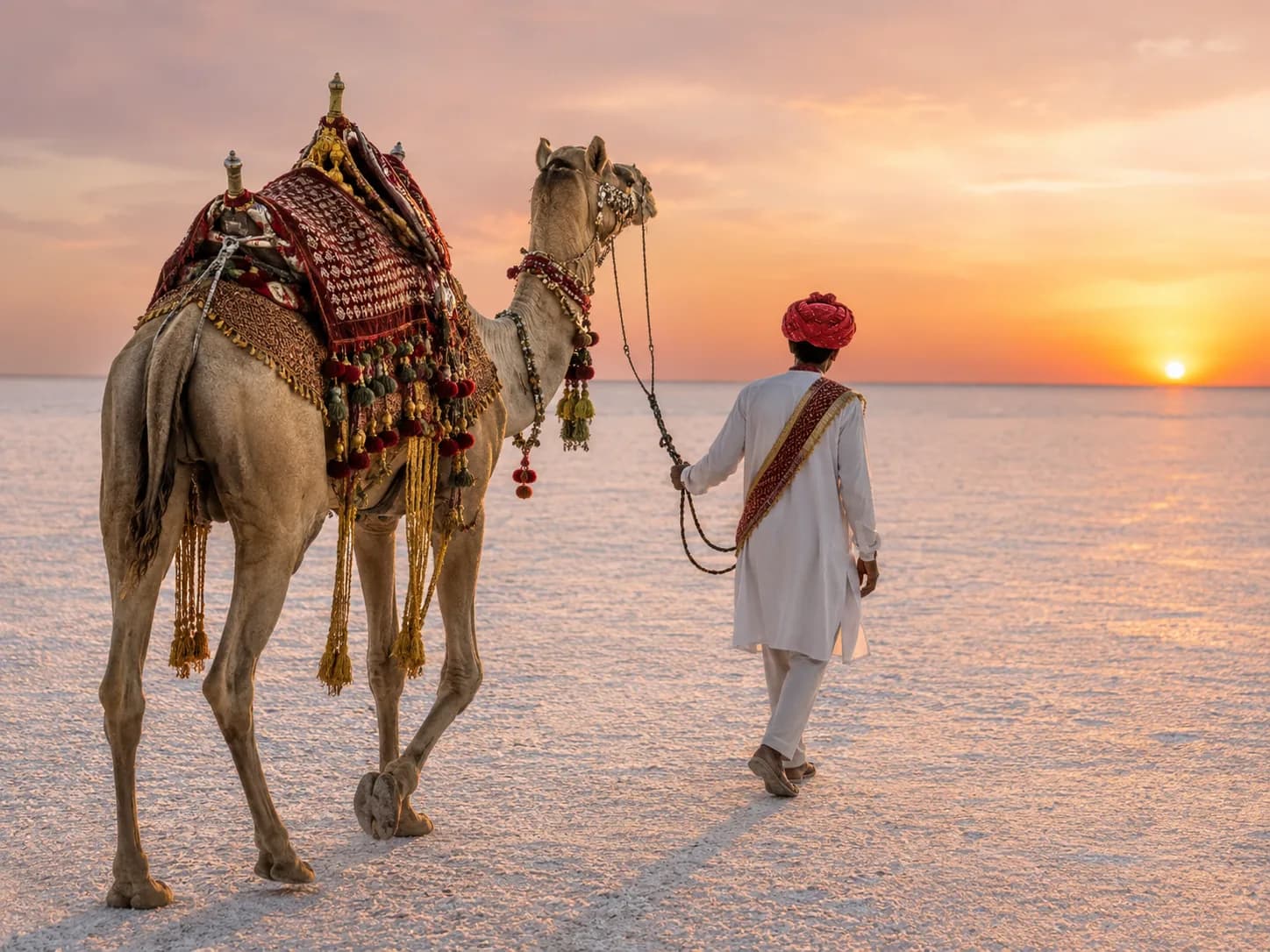
The White Rann of Kutch is the world's largest salt desert — a seasonal salt marsh that dries through winter into a flat, blindingly white expanse of crystallised salt that extends, from Dhordo, to a horizon that appears implausibly distant. At full moon, the salt crust reflects moonlight with such completeness that the landscape appears to glow from within. At sunrise, every warm colour in the spectrum washes across a perfectly flat surface simultaneously. At midnight under a clear sky, the Milky Way arches overhead in a way that requires genuine flatness and genuine darkness to be seen at all.
No photograph — and there are many excellent photographs — fully conveys the experience of standing on the White Rann. The scale is experienced bodily, not visually: your body's sense of the horizon, its calibration of distance and openness, are disrupted in a way that produces a physical sensation as much as a visual impression. Visitors who have travelled widely in India consistently describe the White Rann as one of the two or three landscapes that most affected them — alongside the high-altitude deserts of Ladakh and the backwaters of Kerala.
This is what Rann Utsav delivers that nothing else can: two days and two nights (at minimum) in one of the world's truly irreplaceable natural landscapes. The festival provides the logistical infrastructure to make this accessible — accommodation, transport from Bhuj, meals, guided access to the salt flat — in a way that independent travel to the region in any comparable season would not.
A Living Cultural Festival
The Rann Utsav is not a theme park version of Kutchi culture. The artisans demonstrating Rogan art (a form of fabric painting unique to a single Muslim family in Nirona, Kutch), the Langa and Manganiyar musicians performing in the cultural tent, the Rabari women stitching mirror-work embroidery near the bonfire — these are practitioners of living traditions, not heritage re-enactors. The Garba circles at Dhordo include village women who have been dancing Garba since childhood and who treat the cultural programme not as employment but as an extension of their festive life.
This matters because it means the cultural encounter at Rann Utsav has a quality of authenticity that cultural tourism programmes in most Indian states struggle to achieve. You are not watching a performance created for tourists. You are sitting in on an expression of Kutchi culture that happens to welcome visitors, which is a meaningfully different thing.
The artisan bazaar — Rann Bazar — is genuinely one of the best places in India to buy Kutchi craft directly from makers. Block-printed Ajrakh textiles, Bandhani tie-and-dye, traditional silver jewellery, and Kutchi embroidery are available from the communities that create them, at prices that reflect the absence of a middleman. For visitors interested in Indian craft, the bazaar alone could justify a trip.
An Accessible Window into Remote Gujarat
Kutch is one of India's most historically and culturally rich districts, and it is also one of the most difficult for independent travellers to explore productively. The infrastructure is sparse, the craft villages scattered, and the distances long. Rann Utsav solves this problem by concentrating — imperfectly but effectively — a significant portion of Kutch's cultural richness into a single festival ground accessible from Bhuj with included transport.
The festival creates a condition in which a traveller from Delhi or Mumbai, with two days and a modest budget, can encounter Langa musicians, Rabari embroidery, Rogan art, the White Rann at full moon, a camel safari, and a genuinely Gujarati thali — without logistical heroics. That is a meaningful achievement, and it explains why Rann Utsav has become one of the most attended winter festivals in India.
The Value for Money at ₹6,300
The one-night, two-day package at ₹6,300 per person includes accommodation in a Non-AC Swiss Cottage, breakfast and dinner, entry to the cultural programme, a desert safari to the White Rann viewpoint, and return transport from Bhuj. Breaking this down: the accommodation alone at a comparable tent property would cost ₹2,500 to ₹3,500 per person per night. Meals for two at ₹400 per person. Cultural programme entry is typically ₹200 to ₹500. Transport from Bhuj by taxi costs ₹1,500 to ₹2,000 return.
The package at ₹6,300 bundles all of this at or below what independent booking would cost — and independent booking in Kutch is both logistically complex and time-consuming. For the one-night package, the value is clear and straightforward.
The two-night, three-day package at ₹12,600 and the three-night, four-day package at ₹18,900 hold the same per-night rate while offering considerably better experiential value: a second evening at the cultural programme is qualitatively different from the first, a second sunrise is materially different from the first, and the sense of being embedded in the festival — rather than passing through it — only arrives after the first night.
What Rann Utsav Is Not: Managing Expectations
It Is Not a Luxury Hotel
The Non-AC Swiss Cottage at ₹6,300 is a clean, functional canvas tent with a proper bed, an attached washroom, and basic furnishings. It is not a hotel room — not in terms of soundproofing, mattress quality, or bathroom finish. The AC Swiss Cottage and Rajwadi Cottage are meaningfully more comfortable, but even the Rajwadi is a premium tent, not a four-star hotel. Visitors who arrive expecting hotel-standard comfort from the standard package will find themselves adjusting expectations.
This is not a criticism of the accommodation — it is exactly what it describes itself as, and within the category of festival camping accommodation, it is well run and well maintained. The issue is visitors whose frame of reference for "package accommodation" is a business hotel. If you need a specific mattress firmness, guaranteed hot water pressure, or room service at midnight, the standard Rann Utsav package is not the right product. The White Rann Resort nearby does offer hotel-standard accommodation if that is a non-negotiable requirement.
It Is Not a Beach Resort
The White Rann in winter is not warm. It is not a place to sunbathe. There is no swimming. The landscape, while extraordinary, is stark rather than lush — white, flat, crystalline, austere. Visitors who equate "festival in Gujarat in winter" with any kind of tropical relaxation are categorically misreading the product.
The Rann Utsav experience is active and engaged: walking on the salt flat, attending cultural performances, exploring the bazaar, taking camel safaris, watching sunrises. It is not a place to lie by a pool with a book (though the White Rann Resort has a pool if that is the afternoon you need). If you are looking for a relaxed, resort-style winter break, Goa or Kerala is the right destination. If you are looking for an active, culturally rich, landscape-centred winter experience, Rann Utsav is precisely that.
It Is Not Quiet
Rann Utsav is a festival. The tent city during peak season — particularly in December and January — operates at full capacity, with hundreds of guests, a daily programme of performances, ATV noise from the salt flat, music from the cultural stage running until late evening, and the general ambient energy of a large gathering. The White Rann viewpoint itself, particularly on full moon nights, is shared with many other people.
Visitors who want to encounter the White Rann in solitude — the kind of solitude that produces meditative silence — will need to schedule their salt-flat time carefully. Very early morning, before the rest of the camp wakes, is genuinely quiet. Late at night, after the cultural programme ends, the salt flat offers more privacy. But during the main hours of the day and the cultural programme evenings, Rann Utsav is a busy, social, energetic place. This is a feature for most visitors; for those who need quietness, it is worth knowing in advance.
Who Will Love Rann Utsav Without Reservation
Travellers who combine curiosity with adaptability get the most from Rann Utsav. Specifically: anyone who is interested in Indian folk culture and craft, anyone who responds to landscape as a form of travel experience, anyone who enjoys the energy of a well-run festival, families whose children respond to animal experiences and visual spectacle, couples who want a romantic experience that is memorable rather than generic, and photographers at any level of seriousness.
The festival is also excellent for travellers who are somewhat jaded with India's mainstream heritage circuit — those who have been to the Taj Mahal, to Kerala's backwaters, to Rajasthan's palaces — and want something that feels genuinely different. The White Rann is categorically unlike any landscape in India's mainstream tourism inventory, and that difference is part of its value.
Who Might Not Enjoy Rann Utsav
Visitors who need specific luxury standards in their accommodation and who cannot let go of that requirement will have a difficult time appreciating what the Rann Utsav genuinely offers. Visitors who are very sensitive to cold and who are travelling in December or January without adequate winter clothing will be physically uncomfortable enough to affect their enjoyment. Visitors who are looking for a relaxing, soporific beach-type holiday are in the wrong place.
Young children below three or four years of age may struggle with the cold nights and the early starts required to fully experience the sunrise. Parents with infants should consider whether the logistics — particularly night temperatures and the physical requirements of the salt flat — are manageable with a very young child.
The Verdict: Yes, With the Right Expectations
Rann Utsav is worth it. For the overwhelming majority of visitors who arrive with a clear picture of what they are coming for — the extraordinary landscape, the living cultural festival, the full moon experience, the craft and food of Kutch — it exceeds expectations rather than merely meeting them. The number of visitors who return for a second or third season is the clearest possible evidence of this.
The qualification is real: Rann Utsav delivers its promises to visitors who know what they are booking. It is a festival in a remote salt desert in the winter, with canvas accommodation and no alcohol and an early-morning culture that rewards the people who wake up for it. For those who come looking for exactly that — and there is a large and growing community of Indian travellers who come looking for exactly that — it is one of the finest experiences their country offers.
Package options begin at ₹6,300 for one night and two days, ₹12,600 for two nights and three days, and ₹18,900 for three nights and four days. For advice on which package suits your group, travel dates, and preferred experience, call the team at +91 92747 30220.