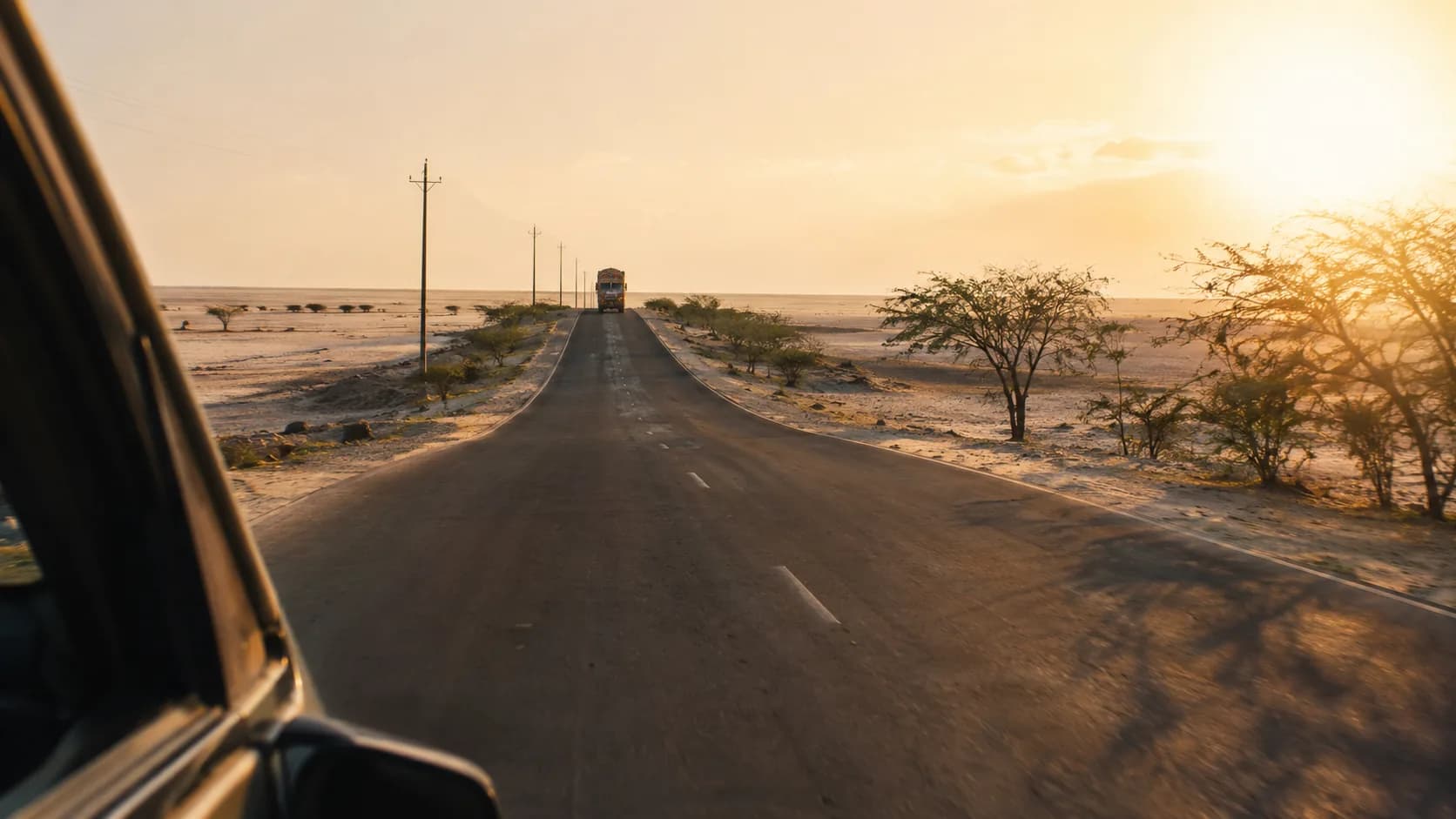
Kutch: The District That Defies Easy Description
There is a particular quality to Kutch that resists the usual travel-writing shorthand. It is too large to summarise — at 45,674 square kilometres, it is the largest district in India, roughly the size of Switzerland — and too varied to reduce to a single image. The salt desert is the most famous feature, yet Kutch also contains a UNESCO World Heritage archaeological site, one of India's finest palace complexes, an 87-kilometre stretch of relatively undiscovered coastline, and a constellation of craft villages whose embroidery, block printing and metalwork are recognised among the finest in Asia.
Rann Utsav is, quite rightly, the event that brings most visitors to Kutch for the first time. But the festival, magnificent as it is, is best understood as a doorway rather than a destination — an introduction to a region that repays extended exploration enormously. This guide is written for those who want to see all of Kutch: those who arrived for the White Rann and discovered they needed a fortnight.
Bhuj — The Capital and Its Extraordinary Palaces
Bhuj is where most Kutch journeys begin and end, and the city rewards a stay of at least two nights. It is a place of layers — Mughal-influenced architecture sitting beside Victorian Gothic beside post-earthquake reconstruction — and the contrast creates a cityscape that is simultaneously melancholy and alive with energy.
Aina Mahal
The Aina Mahal, or Palace of Mirrors, was built in the 18th century by Rao Lakhpatji and designed with the extraordinary assistance of Ram Singh Malam, a Kutchi craftsman who had spent years in the Netherlands learning glasswork, enamel and mechanical craftsmanship. The Hall of Mirrors — its walls and ceiling covered with hundreds of Venetian glass panels framed by gilded ornamentation, lit by Flemish chandeliers — is one of those interiors that makes visitors lower their voices involuntarily. The palace was damaged in the 2001 earthquake and has undergone careful restoration; it is now open to visitors and houses a small museum of royal artefacts.
Prag Mahal
Adjacent to the Aina Mahal stands Prag Mahal, built in 1865 by Maharao Pragmalji II in the Italian Gothic Revival style — a choice of architecture that feels surreal against the Kutch landscape and is precisely what makes it so memorable. Its 45-metre-tall clock tower offers the best panoramic views of Bhuj, and the Durbar Hall, with its ornate columns and painted ceilings, gives some sense of the ceremonial grandeur that attended princely rule in the region.
Kutch Museum
Established in 1877, the Kutch Museum is the oldest museum in Gujarat and a genuinely illuminating introduction to the district's history. Its collections span archaeology, tribal artefacts, weapons, textiles and natural history — an eclectic accumulation that reflects the passions of successive curators across nearly 150 years. The textile gallery, which displays examples of every major Kutch embroidery tradition alongside their regional origins, is particularly useful for visitors who plan to shop in the craft villages and want to develop an eye for quality and authenticity.
Mandvi — Coast, Palaces and Dhow Yards
Mandvi, roughly 60 kilometres south-west of Bhuj, is Kutch's only significant coastal town and one of its most beguiling destinations. Its beach is clean, uncrowded and fringed by casuarina trees — a near-complete contrast to the arid interior. The Vijay Vilas Palace, built in 1929 as a summer retreat for the Kutch royal family, sits on a private stretch of the Mandvi coastline; its Rajput-style turrets and cream-coloured facades are photogenic to the point of cliché, yet the interior, with its original furnishings and family memorabilia, has a more lived-in charm than many palace hotels.
What is less commonly known about Mandvi is that the town has been building wooden dhow sailing vessels for over four centuries. The dhow yard on the eastern bank of the Rukmavati River — where craftsmen still construct these massive wooden ships using techniques passed down through generations, without formal blueprints — is one of the most astonishing working heritage sites in India. Visiting in the morning, when the yard is most active, is an experience that tends to feature prominently in travellers' memories long after the more obviously spectacular sights have faded.
Dholavira — A UNESCO City at the Edge of the Rann
Dholavira, declared a UNESCO World Heritage Site in 2021, is one of the five largest cities of the Indus Valley Civilisation and arguably the most dramatically situated archaeological site in India. It occupies a small island in the white expanse of the Little Rann of Kutch — accessible by road, though the landscape of salt and scrub that surrounds it on all sides reinforces the sense that you are arriving at a place genuinely apart from the ordinary world.
The site dates to approximately 3000 BCE and its excavations — conducted over decades by the Archaeological Survey of India — have revealed a sophisticated urban planning system: a citadel, a middle town and a lower town, each separated by massive stone walls, connected by an intricate water management system of reservoirs and drains that speaks to extraordinary engineering intelligence. The signboard at Dholavira's northern gate, a reconstruction of the world's first known signboard (found in situ and believed to bear the earliest writing in the Indus script), is among the most quietly moving archaeological objects in South Asia.
Plan to spend at least three to four hours at the site with a good guide. The archaeological museum at the entrance provides essential context. Evening light on the ruins is particularly beautiful. Accommodation is available at the Dholavira tent city — our dedicated tent city at Dholavira offers a comfortable base from which to explore the site across two mornings, which we strongly recommend for those who want more than a surface-level experience.
The Craft Villages — Nirona, Hodka and the Rogan Art Trail
Perhaps the most singular cultural experience available in Kutch is not a building or a landscape but a craft — specifically, Rogan art, a textile painting technique so rare that only one family in the world still practises it.
Nirona Village
Nirona, a village of fewer than 500 households about 60 kilometres from Bhuj, is home to the Khatri family, the sole remaining practitioners of Rogan art. The technique involves making paint from castor oil — heated, cooled and mixed with pigment — and then pulling it in threads across cloth using a metal stylus, never touching the stylus to the fabric itself, creating extraordinarily intricate patterns in mid-air. A single dupatta (stole) might represent forty hours of work. When Prime Minister Modi gifted a Rogan art piece to President Obama, it was the Khatri family of Nirona who made it.
Visiting the Khatri workshop — where you can watch the process and purchase directly from the artisans — is an experience of an entirely different order to shopping in a bazaar. The family is gracious about explaining the history and technique, and their prices, while not inexpensive, are fair for work of this calibre. Rogan pieces start at around ₹1,500 for small items and can run to ₹15,000 or more for large, complex compositions.
Nirona is also home to the lacquerwork (lakh) crafts and copper bell makers whose work you will hear throughout Kutch — particularly the distinctive copper bells hung at temple entrances and on livestock.
Hodka Village
Hodka, near the Banni grasslands approximately 70 kilometres from Bhuj, is a Maldhari community village whose mud houses are painted with intricate geometric patterns and embedded with mirror-work — an architectural tradition as impressive as any gallery installation. Hodka has been sensitively developed for community tourism through the Shaam-e-Sarhad initiative, which operates a heritage village stay where guests sleep in traditionally decorated bhungas (round mud huts) and eat home-cooked Kutchi food. Spending a night here, between a Rann Utsav visit and a return to Bhuj, offers an insight into daily life in rural Kutch that no festival visit can replicate.
Rann Riders Craft Village
For visitors with limited time who want to encounter multiple craft traditions in a single setting, Rann Riders craft village — located close to the Dhordo tent city — offers a curated experience with demonstrating artisans working in embroidery, block printing and pottery. It is not a substitute for visiting the source villages, but as an introduction or a supplement it serves its purpose well.
How Rann Utsav Fits Into a Broader Kutch Trip
Rann Utsav runs from November through February at the Dhordo tent city, with packages starting at ₹6,300 for one night and two days, ₹12,600 for two nights and three days, and ₹18,900 for three nights and four days. Most guests visiting Kutch for the first time spend two or three nights at the festival and combine it with two or three nights exploring Bhuj, Mandvi and the craft villages.
A seven-day itinerary — Ahmedabad arrival, one night in Bhuj for orientation, two nights at Rann Utsav, a day in the craft villages, a day at Mandvi, and a return through Bhuj — covers the essential Kutch without feeling rushed. Those with ten days can extend to Dholavira, which adds a profoundly different dimension to the journey: from the ephemeral, seasonal beauty of the salt desert to the permanent, ancient weight of one of humanity's earliest cities.
Our team at +91 92747 30220 is happy to help design a Kutch itinerary that fits your interests and dates. Whether you are primarily drawn by the festival, the craft heritage, the archaeological sites or the coastline — or all of the above — Kutch will likely exceed what you imagined.
Practical Information for Kutch Travel
The best time to visit Kutch is between October and March, when temperatures are mild (ten to twenty-five degrees Celsius) and the Rann is at its most spectacular. Summer temperatures regularly exceed 45 degrees Celsius and are not suited to outdoor exploration. The monsoon (July to September) transforms the Rann from a salt desert into a shallow inland sea — a dramatic sight, but one that makes most roads impassable.
Bhuj has a domestic airport with direct flights from Mumbai, Delhi and Ahmedabad. The Bhuj railway station connects to Ahmedabad and Mumbai. Within Kutch, private vehicle hire is the most practical mode of transport — the distances are manageable and the landscapes between destinations are themselves part of the experience. Carry cash; ATMs are reliable in Bhuj and Mandvi but absent in most villages and the Dhordo area.
Mobile connectivity is generally good on the main highways and in Bhuj but patchy in remote villages and near the border areas. Download offline maps for the craft village routes before you leave Bhuj.