Eating in Kutch: Why the Food at Rann Utsav Is More Than an Afterthought
For many visitors to Rann Utsav, the food is a pleasant surprise — something they did not specifically come for but find themselves discussing at length on the journey home. Kutchi cuisine is not widely represented in India's mainstream restaurant culture. It does not have the profile of Punjabi food in Delhi, or the reach of Gujarati thali chains in Mumbai. It is a regional cuisine that rewards the traveller who encounters it in its home territory, with local ingredients, prepared by cooks who have been making these dishes all their lives.
This is what Rann Utsav offers: not a generic "Indian food" experience but a specifically Kutchi one, rooted in the ecology and culture of the region, shaped by centuries of pastoral life and trading connections with Sindh, Rajasthan, and the Arabian coast. Understanding what to order — and why — enriches the experience considerably.
The Gujarati Context: A Vegetarian-Forward Cuisine
Gujarat is one of India's most comprehensively vegetarian states, a fact rooted in Jain religious influence, Vaishnav devotion, and centuries of cultural tradition. Kutch shares this character. The vast majority of food available at Rann Utsav is vegetarian, and the vegetarian options are genuinely extraordinary rather than a concession made for dietary restriction.
This is important for meat-eating visitors to understand clearly: you will not feel deprived. The richness of Kutchi vegetarian cuisine — its use of multiple legumes, its layered spice profiles, its dairy traditions, its fermented and pickled elements — produces a table of considerable variety and satisfaction. Many confirmed non-vegetarians have left Rann Utsav having barely noticed the absence of meat and having eaten some of the most interesting food they have encountered in India.
Gujarat is also a dry state — alcohol is prohibited. This applies equally to Rann Utsav. There are no exceptions for tourists or permit holders in the festival context. The beverages on offer are chai, lassi, local fruit juices, and water. Visitors who plan carefully around this in advance tend to find it irrelevant within a day; the food, the experience, and the environment are sufficiently engaging that the absence of alcohol becomes a non-issue.
Dabeli: Kutch's Greatest Street Food Contribution
Dabeli is, without question, the most widely beloved street food to emerge from Kutch, and it is one of those dishes that demonstrates how regional Indian snack culture can achieve extraordinary complexity in a simple hand-held format.
The base is a soft, small bread roll — the pav — stuffed with a spiced potato mixture that includes a masala of tamarind, red chilli, coconut, and a proprietary blend of Kutchi spices. This filling is topped with pomegranate seeds, roasted peanuts, sev (crispy chickpea noodles), fresh coriander, and multiple chutneys — tamarind, coconut, and date chutneys are the classic trio. The assembled dabeli is pressed and warmed on a tawa (griddle) before serving.
The version available in the bazaar at Rann Utsav, made by vendors from Bhuj and the surrounding towns, is often the definitive version: balanced in spice, abundant in texture, slightly crispy from the tawa, and entirely unlike the watered-down interpretations that pass for dabeli in Mumbai restaurants. Eat at least two. Possibly three.
Kutchi Khichdi: Comfort Food of the Desert
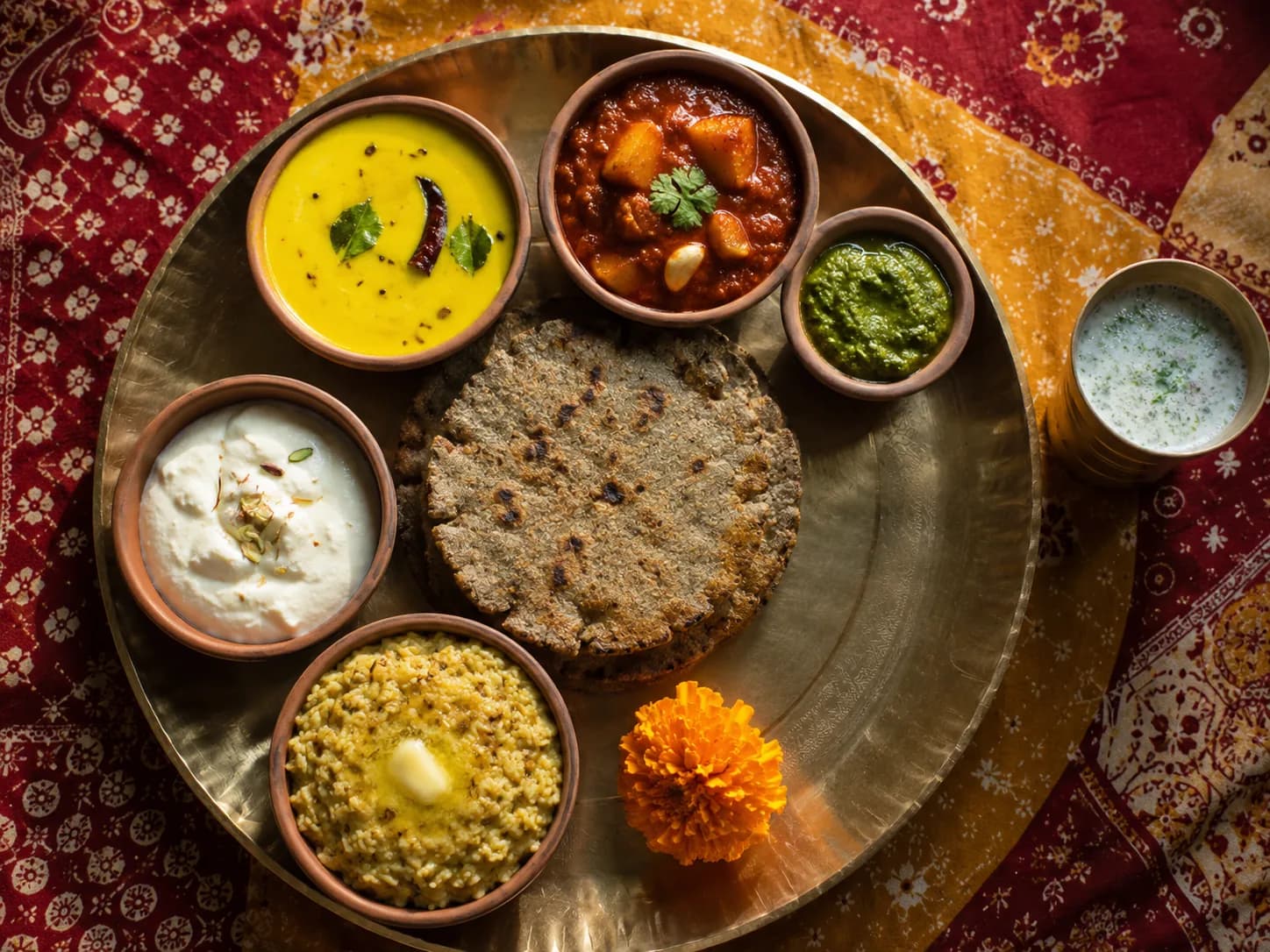
Kutchi khichdi is the region's elevated interpretation of a dish found across India. The Kutchi version uses local millet or rice combined with lentils and cooked slowly with a generous amount of ghee, turmeric, whole spices, and sometimes the addition of seasonal vegetables or peanuts. It is seasoned with a cadha (tempering) of cumin, mustard seeds, dried red chillies, and asafoetida added at the end.
The result is a deeply satisfying, nourishing dish that reflects the practical wisdom of desert cuisine: simple ingredients, extended cooking, generous fat, robust spice. It is typically served with kadhi — a yoghurt-based curry tempered with fenugreek seeds and dried chillies — and the combination is one of those pairings that feels immediately right, as if no further augmentation could improve it.
Khichdi at Rann Utsav is often served as part of the thali at the tent city restaurant, alongside rotlo (millet flatbread), pickles, and papad. It is the sort of lunch that leaves you comfortable rather than heavy, which matters when the afternoon activity programme follows.
Rotlo and Bajra Dishes: The Bread of Kutch
Gujarat's interior is bajra (pearl millet) country, and the flatbreads of Kutch reflect this. Rotlo — thick, rustic millet flatbreads cooked directly on an open flame or on a tawa — are the staple of village meals throughout the region. They have a slightly smoky, nutty character that wheat rotis do not replicate, and they pair naturally with the bold flavours of Kutchi cooking.
In the winter months, when Rann Utsav runs, bajra dishes are at their most appropriate seasonally — millet is considered a warming grain in Ayurvedic tradition, and the cool desert evenings make the warmth of a freshly made rotlo eaten with ghee and fresh garlic chutney a genuinely pleasurable experience. Do not overlook the garlic chutney (lasan chutney) that accompanies rotlo in the tent city restaurant; it is made with raw garlic and dried red chillies and has a pungency that is temporarily overwhelming and then deeply satisfying.
The Fafda-Jalebi Breakfast: Gujarat's Non-Negotiable Morning Ritual
Across Gujarat, the morning hours mean fafda and jalebi. At Rann Utsav, where the festival context creates a celebratory atmosphere every morning, this combination appears throughout the season, often available from stalls in the bazaar area from around seven in the morning.
Fafda is a crispy, elongated snack made from chickpea flour (besan) flavoured with carom seeds (ajwain) and black pepper, deep-fried until rigid and golden. Jalebi is the fermented, spiral-shaped sweet fried in ghee and soaked in sugar syrup until it achieves a crispy exterior and a syrup-saturated interior. The combination of savoury fafda and sweet jalebi eaten together, with or without a papaya chutney on the side, is a textural and flavour experience that takes a moment to understand and then makes complete sense.
It is also — and this is culturally significant — a meal eaten standing up, in conversation, at a street stall, at speed. The fafda-jalebi breakfast is a social ritual as much as a nutritional one, and partaking in it at Rann Utsav, surrounded by other guests and local vendors in the early morning, is a small but genuine cultural immersion.
The Gujarati Thali at the Tent City Restaurant
The formal meals at the Rann Utsav tent city restaurant are served thali-style: a metal tray arranged with small bowls (katoris) of multiple preparations, accompanied by breads, rice, pickles, and accompaniments. The Gujarati thali tradition is one of generosity — unlimited refills are the norm, and the person serving will continue to offer more of each item until you actively decline.
A typical Rann Utsav thali might include dal (lentil soup), shaak (vegetable preparation), kadhi, khichdi, roti, rice, papad, pickle, and a sweet such as mohanthal (a dense chickpea-flour fudge) or shrikhand (sweetened strained yoghurt with cardamom and saffron). The sweet course is served alongside the savoury in Gujarati tradition rather than after — an arrangement that initially surprises visitors from other regional backgrounds and then seems entirely logical once you understand it.
The thali at the tent city is generally included in the accommodation packages. The ₹6,300 one-night package includes meals; the ₹12,600 and ₹18,900 packages include all meals throughout the stay. Bazaar food — the dabeli, the fafda-jalebi, the chai stalls — is additional and very reasonably priced.
Chai Culture and What to Drink
Kutchi chai is made strong and sweet, with generous milk and a masala of ginger, cardamom, and sometimes fennel. It is served in small glasses and is refreshed repeatedly throughout the day by attentive staff at the tent city and by chai vendors throughout the bazaar. Accepting a glass of chai when offered is a fundamental courtesy in Kutchi culture and usually the beginning of a pleasant conversation.
For visitors who find sweet, milky chai overwhelming, buttermilk (chaas) is widely available and is one of the genuinely great drinks of Gujarat — thin, slightly tangy, seasoned with cumin and curry leaf, and deeply cooling. Aam panna (green mango drink) and local fruit juices round out the beverage options during the season.
For any questions about dietary requirements, meal inclusions in your package, or food availability at Rann Utsav, the team at +91 92747 30220 is happy to advise.