Why Rann Utsav Is the Most Extraordinary Place to Welcome a New Year
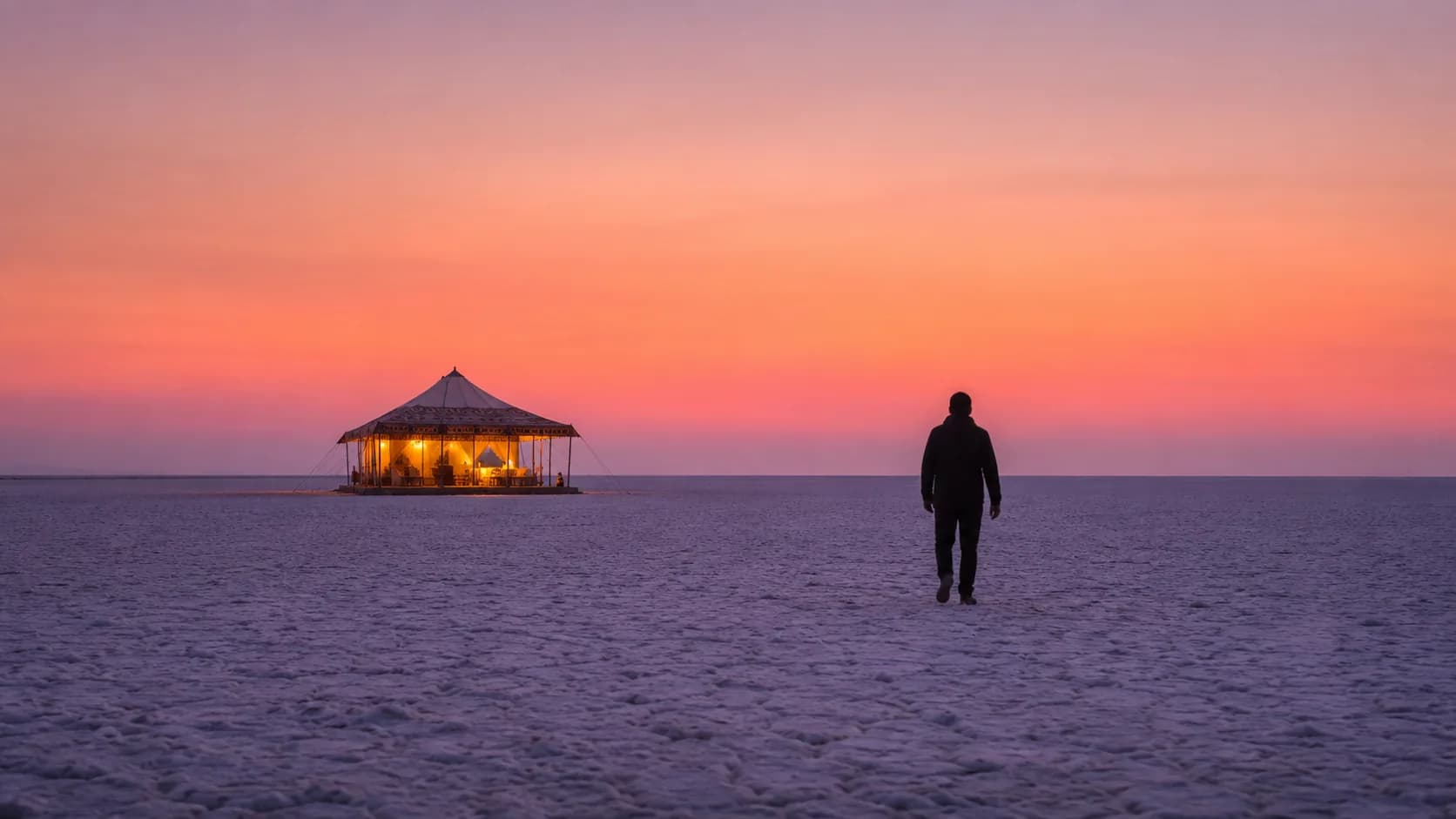
There is a particular kind of silence that settles over the White Rann after sunset — a silence so vast, so complete, that the distant crackle of a bonfire carries for what feels like kilometres. Most people spend the final night of the year in a city bar, on a crowded beach, or watching fireworks through a screen. A small number of travellers choose something altogether different: they stand on an ancient salt desert at the edge of the subcontinent, wrapped in shawls, looking up at more stars than they have ever seen in their lives, and they let the new year arrive quietly, beautifully, on its own terms.
This is what New Year's Eve at Rann Utsav feels like. It is not a party in the conventional sense. It is something richer — a cultural celebration layered over one of India's most spectacular natural backdrops, organised by Gujarat Tourism's iconic Rann Utsav festival, which runs from November through February each year at Dhordo tent city in the Rann of Kutch.
If you are considering spending the last night of 2026 here — and you should be — this guide covers everything: what the programme looks like, what the weather demands, what the experience actually feels like on the ground, and how early you need to book to secure a tent.
The Setting: Dhordo Tent City and the White Rann at Night
The Rann Utsav takes place at Dhordo, a small village in Kutch district, Gujarat, approximately 85 kilometres from Bhuj. The festival's centrepiece is an elaborately designed tent city — hundreds of air-conditioned Swiss tents arranged around a central cultural hub, with restaurants, craft bazaars, camel rides, ATV tracks, and live performance stages. During the day it functions as a self-contained resort. After dark, it transforms into something almost theatrical.
The White Rann itself is a short drive or walk from the tent city. This is the vast salt flat — roughly 7,500 square kilometres of crystallised salt — that reflects moonlight so purely that a full moon night here is frequently described as walking on snow. On New Year's Eve, this landscape becomes the backdrop for the midnight countdown. Guests gather at the viewing point at the edge of the Rann, bundled against the cold, and watch the clock turn in one of the most geographically dramatic settings available to any traveller in India.
What Happens on December 31: The New Year's Eve Programme
The Rann Utsav team organises a dedicated New Year's Eve cultural programme that typically begins in the late afternoon and runs through to the early hours of the morning. While the specific lineup varies from year to year, the broad shape of the evening has remained consistent across recent seasons.
The afternoon sees the craft bazaar in full swing — artisans from across Kutch displaying their bandhani textiles, Rogan art, hand-embroidery, and mirror-work. This is a good time to walk the stalls unhurriedly, before the evening energy picks up. As the sun begins its descent over the salt flats — and a Rann Utsav sunset is genuinely extraordinary, the sky turning from gold to deep amber to a bruised purple — the main cultural stage comes alive.
The evening programme on December 31 typically features extended folk music and dance performances. Kutch has one of the richest living folk traditions in India: the Rabari community's songs, Garba performed by women in mirror-studded chaniya cholis, Bhavai dance, and the hypnotic Sufi music of the Langa and Manganiyar communities from the broader region. On New Year's Eve, the performances are notably longer and more elaborate than a standard night — organisers understand that guests are here to celebrate, and the programme reflects that.
A bonfire is lit at a designated gathering point in the tent city. This is where much of the social energy of the evening concentrates — families, couples, and solo travellers gravitating toward the warmth, sharing food and chai, listening to music floating across the cold air. The tent city's restaurant serves a special New Year's Eve dinner, and there are typically arrangements for sweets, snacks, and warm beverages throughout the night.
As midnight approaches, guests are guided toward the Rann viewing area for the countdown. Standing on the edge of the salt desert — with the White Rann stretching out ahead, the sky absolutely thick with stars, the temperature somewhere around eight degrees Celsius — is a moment that most people describe as genuinely moving. There is no fireworks display over a harbour, no confetti drop, no DJ set. There is the desert, and the sky, and the sound of a few hundred people saying "Happy New Year" to each other in the dark. It is, in its own way, perfect.
The Weather: What Eight to Twelve Degrees Actually Means
December 31 in the Rann of Kutch sits firmly in the heart of winter. Daytime temperatures are pleasant — typically fifteen to nineteen degrees Celsius, comfortable for walking and sightseeing. But by the time the sun goes down, the temperature drops sharply. By ten or eleven at night, when the countdown energy is building, you are looking at eight to twelve degrees Celsius. By midnight itself, it can feel colder still, particularly if there is any wind moving across the open salt flat.
This is not extreme cold by the standards of northern India, but it is genuinely chilly — cold enough that guests who arrive unprepared find themselves retreating to their tents earlier than they intended. The key is layering. Thermal innerwear, a warm fleece or pullover, and a substantial outer layer — a down jacket or a heavy shawl — are essential. Warm socks and closed shoes rather than sandals. A scarf or neck warmer for the outdoor countdown.
The Gujarat Tourism tents at Dhordo are heated, so the moment you return to your accommodation you will be warm and comfortable. The issue is the hours spent outside in the evening. Pack thoughtfully and the cold becomes atmospheric rather than uncomfortable — it is, after all, part of what makes standing on a moonlit salt desert at midnight feel so different from standing on a beach.
The New Year's at Rann Utsav vs. a City or a Beach
The obvious question is: why spend New Year's Eve here rather than Mumbai's Marine Drive, Goa's Baga Beach, or a rooftop bar in Delhi? The answer is largely about what you want the experience to feel like.
City New Year's events are fundamentally about spectacle and crowd energy — the sense of being part of a massive collective moment. Beach New Year's events offer a version of this with a natural backdrop, but rarely genuine solitude or silence. Both are wonderful if that is what you want.
New Year's at Rann Utsav offers something else: intimacy with a landscape that most people will never see. The tent city community on December 31 is large enough to feel festive — guests from across India and internationally, all here by deliberate choice — but small enough that the evening retains a personal, almost private quality. You are not lost in a crowd of thousands. You are among a few hundred people who all made a similar decision to be somewhere extraordinary.
There is also the matter of what the Rann itself does to the senses. Salt deserts are among the most disorienting landscapes on earth — in the best possible way. The flatness, the whiteness, the absence of horizon lines at night, the sound of your own footsteps on crystallised salt — it rewires something in your perception, and that rewiring tends to make the arrival of a new year feel genuinely significant rather than simply scheduled.
The January 22 Full Moon: A Combination Trip Worth Considering
One of the most compelling reasons to book New Year's Eve at Rann Utsav in 2026-27 is what follows just three weeks later: the full moon of January 22, 2027. This falls within the Rann Utsav season, and the January full moon night at the White Rann is widely considered among the most beautiful experiences in Indian travel.
On full moon nights, Gujarat Tourism organises special access to the Rann after dark. The moonlight transforms the salt flat into something that defies easy description — it genuinely appears to glow, a vast white plain reflecting light with an intensity that makes the sky above seem less dark than merely different in texture. Travellers who have experienced both the Diwali and December full moons consistently describe the January full moon as their favourite, partly for the clarity of the winter sky and partly because the season is at its most experienced by then.
Guests who book a longer stay spanning from late December through mid-January can experience the New Year's Eve countdown, the cultural programming of early January, the Kite Festival on January 14, and the full moon on January 22 — essentially the entire peak of the festival season in a single extended trip. Alternatively, those with limited time can plan two separate shorter visits and combine New Year's Eve with the January full moon in a ten-to-fourteen day Kutch itinerary.
Packages and Pricing: What New Year's Eve Costs
Rann Utsav accommodation is priced per package, with the following standard rates:
The 1 Night 2 Days package is priced at ₹6,300 per person and is suitable for guests who wish to arrive on the afternoon of December 31, experience the New Year's Eve programme and overnight stay, and depart on January 1. This is the minimum stay for experiencing the event.
The 2 Night 3 Days package is priced at ₹12,600 per person. This allows arrival on December 30, full New Year's Eve programming on the 31st, and a leisurely departure on January 1 — giving you time on both sides of midnight to explore the tent city and the Rann without rush.
The 3 Night 4 Days package is priced at ₹18,900 per person. This is the most relaxed option, ideal for guests who want to combine the New Year's visit with a fuller exploration of the Rann, Dhordo village, and the surrounding Kutch landscape.
All packages include accommodation in air-conditioned Swiss tents, meals, and access to the cultural programme. For specific inclusions and availability, contact the Rann Utsav booking team on +91 92747 30220.
How Far in Advance to Book
This cannot be overstated: New Year's Eve at Rann Utsav is among the most in-demand nights of the entire festival season. The tent city has finite capacity, and the combination of a once-a-year occasion with one of India's most spectacular settings means that availability disappears well before December.
Booking should ideally happen by September — three months before the event. This is not a conservative estimate; it is a genuine reflection of how quickly December 31 fills. Guests who approach in October or November frequently find that preferred accommodation categories are no longer available and must either settle for remaining options or wait-list for cancellations.
If you are reading this in June or July with a clear intention to be at Rann Utsav for New Year's, the right moment to call +91 92747 30220 and confirm your booking is now, not later. The price is the same in June as it is in November, but the availability is not.
Getting There: The Journey to Dhordo
The nearest city to Dhordo is Bhuj, approximately 85 kilometres away. Bhuj has a domestic airport served by flights from Mumbai, Ahmedabad, and other major cities. From Bhuj, the tent city is a roughly two-hour drive through the Kutch landscape — a journey that is itself part of the experience, passing through small villages, across flat scrubland, and eventually into the distinctive terrain of the Rann border.
Train services run to Bhuj from Ahmedabad and other Gujarat cities. Taxis and hired vehicles are readily available from Bhuj for the drive to Dhordo. The Rann Utsav team can also advise on transport arrangements when you book.
New Year's Eve at Rann Utsav: A Final Thought
Some experiences are worth protecting from the habit of deferral. "We'll do it next year" is a sentence that has cost many travellers many extraordinary moments. New Year's Eve at the White Rann of Kutch is the kind of night that people who have done it talk about for years afterward — not because it was loud or spectacular in the conventional sense, but because the landscape did something to them, and standing on that salt desert at midnight did something to the year that followed.
It is available. It is bookable. The number to call is +91 92747 30220. The time to call is now.