What Is the Rann of Kutch?
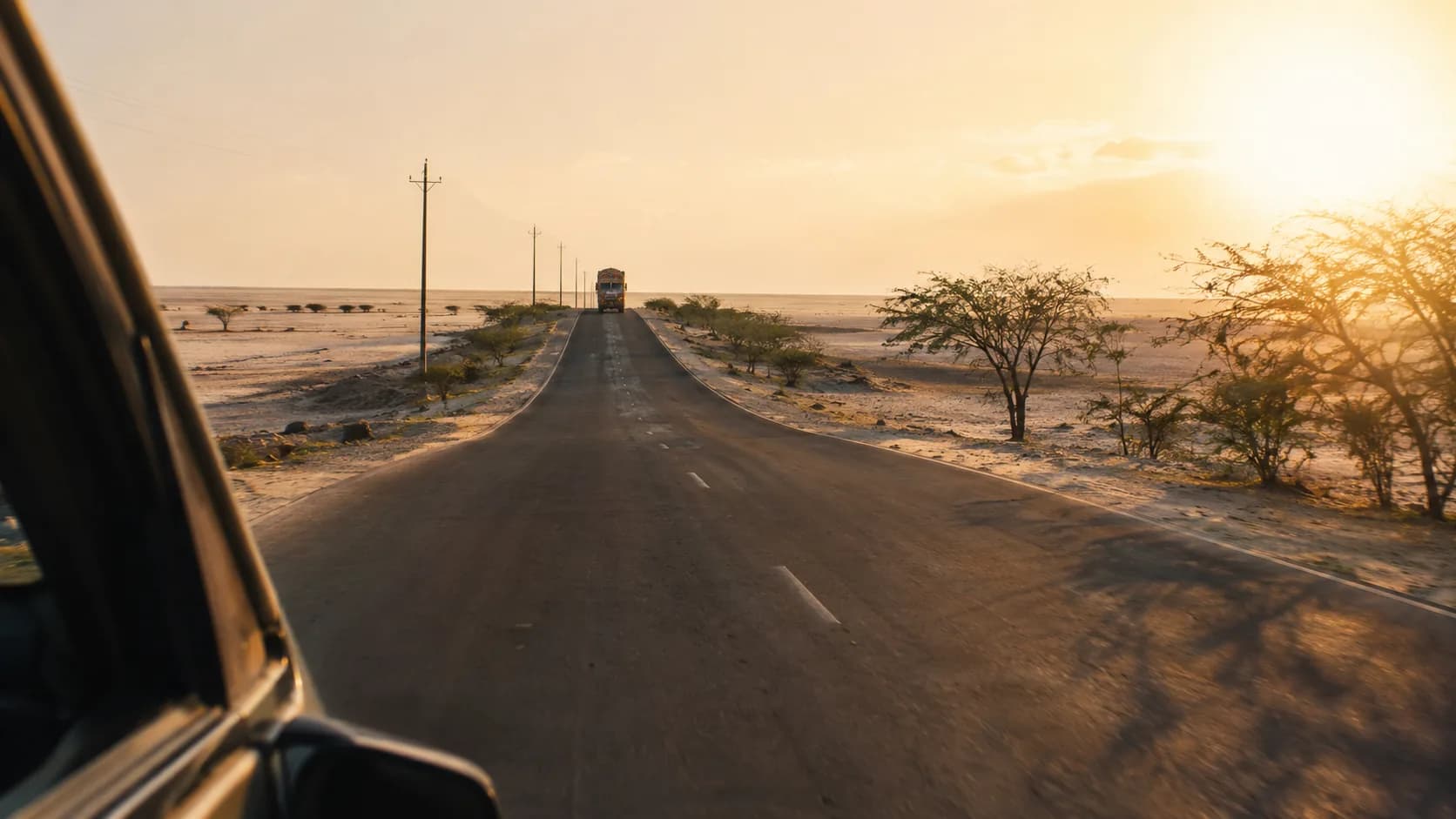
The name alone carries a kind of music — Rann of Kutch, that double resonance of landscape and region, simultaneously evocative and precise. But what exactly is the Rann? The short answer is that it is one of the world's largest seasonal salt marshes: a vast, flat, mineral-white expanse that in summer lies beneath a shallow seasonal sea and in winter — when the water retreats and the salt crystallises — becomes one of the most otherworldly landscapes on the planet.
The full answer is considerably more interesting, and understanding it transforms your experience of the White Rann from a simple visual spectacle into something more layered: a landscape with a story that runs from Harappan cities to Pakistani border skirmishes, from flamingo migrations to moon-watched festivals.
Geography: The Great Rann, the Little Rann and the Boundaries Beyond
The Rann of Kutch is divided by geographers into two distinct sections. The Great Rann forms a crescent shape running roughly east-west along the northern edge of the Kutch peninsula, bordering Pakistan's Sindh province to the north-west. It covers approximately 27,900 square kilometres — larger than Kerala — and is the section most associated with Rann Utsav. The Little Rann of Kutch lies to the south-east, separated from the Great Rann by the Kutch mainland; it is somewhat smaller (approximately 5,000 square kilometres) and ecologically distinct, being more grassland-and-marsh than pure salt flat.
The two Ranns together, along with the Banni grasslands between them and the Gulf of Kutch to the south, form an ecological unit of extraordinary complexity — one of the most biodiverse arid environments in Asia. They sit in the broader context of the Indus river delta system, which once flowed into the northern Rann before tectonic shifts in the late 18th century rerouted the river's course.
The international boundary with Pakistan runs through the northern Great Rann — an invisible line across a landscape where border demarcation is physically impossible for most of the year. The geopolitics of this boundary, contested between India and Pakistan since 1947 and partially adjudicated through international arbitration in 1968, give the landscape an additional layer of significance that visitors standing at India Bridge or the Khavda checkpoint can begin to feel, if not fully comprehend.
Geology: How the Salt Desert Forms
The Rann's most distinctive feature — its blinding white salt surface — is the product of a geological and hydrological cycle that repeats with each monsoon. During the summer months (June to September), the Arabian Sea floods northward through the Gulf of Kutch, inundating the entire Rann basin under a shallow layer of saline water, typically between half a metre and one metre deep. This seasonal sea is connected to the Arabian Sea and supports significant marine and brackish-water ecology during the monsoon months.
As the monsoon retreats in September and October, the water recedes and evaporation begins. The Rann basin — nearly flat, with elevation changes measured in centimetres rather than metres across thousands of square kilometres — retains the water unevenly, and as evaporation accelerates in the dry winter air, the salt dissolved in the water begins to crystallise out on the surface. The process is comparable to what happens in a salt pan, but at a scale that is almost incomprehensible: tens of thousands of square kilometres of salt crystallising simultaneously, building layer upon layer until the surface is hard, white, and capable of supporting the weight of a camel or a human being.
By November — the beginning of the Rann Utsav season — the central Rann near Dhordo is typically dry and walkable, the salt surface firm and clean white. This is when visitors make their evening walks to the Rann edge, their footsteps crunching on the crystallised salt crust, the horizon dissolving into whiteness in every direction.
The salt crust is not entirely uniform. In some areas it is thick and solid; in others, particularly toward the centre of the Rann, it overlies a layer of soft mud that can give way unexpectedly. Visitors exploring the Rann independently should be aware of this variability and stay on established paths or follow local guides, particularly after dark. The tent city at Dhordo organises guided evening walks to the Rann edge specifically to ensure safe access to the most spectacular sections.
Kala Dungar and the Geological Contrast
The presence of Kala Dungar — the Black Hill — rising to 462 metres above the Rann plain near Dhordo is geologically significant. The hills of the Kutch mainland are remnants of an ancient volcanic and tectonic landscape, thrust upward over millions of years while the surrounding Rann basin subsided. The black basaltic rock of Kala Dungar stands in stark visual contrast to the white salt plain below, and the view from the summit across the Rann on a clear winter morning — white desert in every direction, Pakistan visible as a grey line on the northern horizon — is among the most striking in India.
Ecology: Wildlife of the Rann
The ecology of the Rann is paradoxical — a landscape that appears hostile to life but supports an extraordinary range of species. The key to understanding this apparent contradiction is seasonal variation: the Rann is not a single environment but two, changing completely between monsoon and winter.
Flamingos of the Little Rann and Chhari Dhand
The brackish wetlands of the Rann — particularly the Chhari Dhand seasonal lake near Khavda and the marshy fringes of the Little Rann — support one of Asia's largest concentrations of flamingos. Both greater flamingos (Phoenicopterus roseus) and lesser flamingos (Phoeniconaias minor) visit in vast numbers during the winter months, feeding on the blue-green algae and brine shrimps that proliferate in the saline water.
Flamingo numbers at Chhari Dhand during peak season (November to February, coinciding exactly with Rann Utsav) can reach into the tens of thousands — a sight of sufficient spectacle that it draws dedicated birdwatchers from across the world, though most arrive as part of a broader Kutch or Rann Utsav trip and discover the flamingos as an unexpected bonus.
The Great Rann also serves as a flamingo breeding ground, particularly in its shallow western sections near the Pakistani border. Flamingo colonies in India typically breed between January and April, after the Rann has hardened sufficiently to support nesting mounds.
The Indian Wild Ass — A Species Found Nowhere Else
The Indian wild ass (Equus hemionus khur), locally known as the ghudkhur or khur, is the last surviving population of its subspecies on earth — found exclusively in the Little Rann of Kutch. The Indian Wild Ass Sanctuary, established in 1973 and covering approximately 5,000 square kilometres of the Little Rann, protects the habitat of this extraordinary animal, which resembles a donkey in form but moves with the speed and grace of a horse, covering vast distances across the salt flat.
Population estimates vary, but surveys in recent years have placed the khur population at approximately five to six thousand individuals — a remarkable recovery from the fewer than 400 animals recorded in the early 1970s, before formal protection was established. Wildlife drives into the sanctuary from Dasada or Zainabad (on the southern margins of the Little Rann) offer reliable sightings; the animals are not particularly shy of vehicles and the flat terrain makes them easy to observe.
Desert Fox, Spiny-Tailed Lizard and the Scrubland Ecosystem
The scrublands surrounding the Rann — the Banni grasslands, the Kutch plateau and the fringes of the desert near Dhordo — support their own distinct ecology, dominated by drought-adapted species. The Indian desert fox (Vulpes vulpes pusilla) is frequently seen near Dhordo at dawn and dusk; the spiny-tailed lizard (Uromastyx hardwickii) is visible on rocky outcrops throughout the day; and the great Indian bustard — one of India's most critically endangered birds — is occasionally sighted in the Banni grasslands, though numbers are now so low that sightings cannot be predicted or promised.
Migratory birds arrive in enormous numbers at the Rann between October and March: waders, ducks, sandpipers, pelicans and several species of eagles and harriers use the flooded and recently-drained margins as feeding grounds. The Rann of Kutch is listed as an Important Bird Area by BirdLife International and sustains its ornithological reputation throughout the winter season.
History: The Rann Across Five Millennia
The Indus Valley Connection
The Rann's history as a human landscape begins with the Indus Valley Civilisation — specifically with the extraordinary city of Dholavira, which occupied a small island in what is now the Little Rann and flourished between approximately 3000 and 1500 BCE. The Harappan citizens of Dholavira engineered one of the most sophisticated water management systems of the ancient world — a series of reservoirs, dams and channels designed to capture and store the limited rainfall of Kutch through the dry season — precisely because they understood the Rann's ecology as intimately as any modern hydrologist.
The decline of the Indus Valley Civilisation in this region is still debated among archaeologists, but climate change — specifically, a prolonged aridification episode around 2000 BCE — appears to have been a primary factor. The Rann's seasonal flooding patterns may have shifted, disrupting agriculture and water supply, making the cities of the Little Rann untenable.
The British Survey and the Kotri Question
British surveyors who attempted to map the Rann in the 19th century encountered unique challenges. The Rann's seasonal flooding made conventional triangulation nearly impossible, and the optical effects of the salt flat — mirages, heat shimmer and the refraction of light through the shallow water layers — produced measurement errors that plagued the Great Trigonometrical Survey. The question of whether the Rann constituted sea or land — important for establishing the boundary between British India and the princely state of Kutch — occupied administrators and legal minds for decades.
The broader demarcation question came to a head after Partition in 1947, when the Rann became an international boundary zone between India and the new state of Pakistan. The ambiguity of the boundary through the Rann contributed directly to the 1965 Rann of Kutch War — a brief but significant military engagement that preceded the larger Indo-Pakistani War of 1965 and resulted in an international tribunal ruling in 1968 that awarded approximately 90% of the disputed Rann territory to India and 10% to Pakistan.
The Rann Today — A Living Landscape
Today the Rann serves simultaneously as an ecological reserve, an international border zone and a cultural landscape shaped by the pastoral and artisan communities — Maldharis, Rabaris, Harijans — who have lived around its edges for centuries. The Banni grasslands between the Great and Little Rann support the last significant population of the Maldhari cattle herders, whose distinctive long-horned Kankrej cattle are among the finest draught breeds in India.
Rann Utsav was established in 2005 by the Gujarat Tourism Corporation to share this extraordinary landscape with visitors during the accessible winter months. It has grown considerably since its inception, though it retains an admirably managed quality — the tent city at Dhordo is well-contained and the environmental impact on the Rann itself is carefully monitored. Packages for the 2026-27 season start at ₹6,300 for one night and two days, ₹12,600 for two nights and three days, and ₹18,900 for three nights and four days. For bookings and enquiries, contact our team at +91 92747 30220.
When to Visit the Rann of Kutch
The Rann is accessible and visually spectacular between November and February — the winter months when the salt crust is fully formed, temperatures are mild (ten to twenty-five degrees Celsius during the day), and the festival and wildlife seasons coincide. Full moon nights within this period, when the Rann glows under the moonlight, are the most sought-after and should be booked months in advance.
March brings rising temperatures and the gradual onset of heat; the Rann remains accessible but the experience is less comfortable. By May, temperatures routinely exceed 40 degrees Celsius and outdoor exploration is inadvisable. The monsoon months (July to September) flood the Rann and make access impossible — though the sight of the Rann as a shallow inland sea, visible from the Bhuj-Khavda road on a clear day, has its own dramatic quality.
Those interested in wildlife — particularly flamingos and the Indian wild ass — should aim for November to January, when numbers are highest and the animals are most concentrated near accessible viewing areas.
How Rann Utsav Fits Into the Ecology
A question sometimes asked by environmentally conscious visitors is whether a large-scale festival on the edge of a sensitive ecological zone is advisable. The Gujarat Tourism Corporation and Rann Utsav organisers take this question seriously. The tent city is located at the edge of the Rann, not within it; vehicle access to the salt flat is restricted to designated paths; and the evening walks to the Rann are guided and contained to prevent dispersal of large numbers of visitors across sensitive areas.
The festival's economic benefit to the surrounding communities — craft artisans, folk performers, local transporters, food vendors — is substantial and has contributed to the revival of several near-extinct craft traditions. The Rogan art tradition, for instance, was on the verge of disappearing before exposure at Rann Utsav and subsequent national attention gave the Khatri family of Nirona both economic sustainability and cultural recognition.
Like all large-scale tourism, Rann Utsav involves trade-offs. On balance, the evidence suggests that the festival has been beneficial to both the human and ecological heritage of the Rann — a rare outcome that reflects thoughtful management and the robust resilience of the landscape itself.