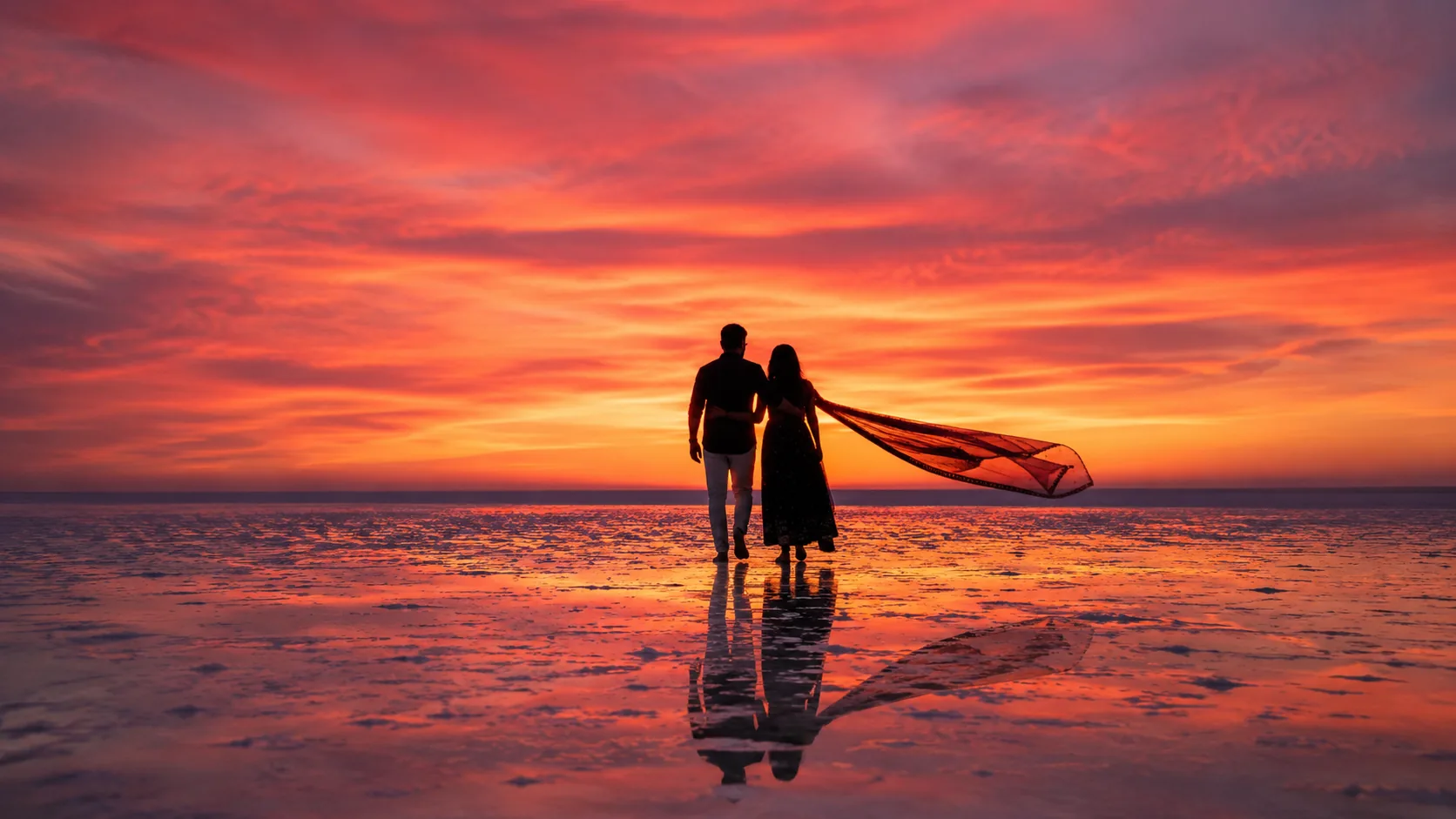
Somewhere between the last light leaving the salt and the first oil lamp being lit outside a bhungani cottage, it becomes obvious why couples keep asking whether Rann Utsav can host a wedding. The white desert does something no banquet hall can: it makes four hundred guests feel like they are standing at the edge of the world, and it does this without a single rupee spent on a false ceiling of fairy lights, because the sky supplies its own.
This piece is written for two readers — the couple who has fallen in love with the idea, and the wedding planner who has to turn that idea into a contract. It covers what a tent-city wedding actually requires: capacity, ceremony space, catering rules, sound restrictions, logistics for a full wedding party, and what it costs in practice.
Quick answer: yes, Rann Utsav can host a destination wedding. The Dhordo and Dholavira tent cities accommodate wedding parties from fifty to five hundred-plus guests, offer an open-air mandap option directly on the White Rann salt alongside dedicated event tents for sangeet and reception functions, and provide in-house catering. Realistic budgets start from roughly ₹15,000 to ₹25,000 per guest depending on tent category, season, and the scale of décor and entertainment.
Why Couples and Planners Are Looking at Dhordo and Dholavira
Rann Utsav was never built as a wedding venue — it was built as a festival tent city on the edge of the Great Rann of Kutch, and that origin is precisely its appeal. Unlike a resort dressed up to look like a desert, this is the desert, with hospitality infrastructure — power, plumbing, catering kitchens, security, and several hundred guest rooms — already laid over it in the form of AC and non-AC cottages, Swiss tents, and luxury tents.
For a wedding, that translates into three advantages a conventional venue struggles to match: a genuinely unrepeatable backdrop (the white salt desert under a full moon, best planned around the mid-month lunar dates within the 1 November 2026 to 7 March 2027 season), an entire guest list housed within walking distance of the ceremony, and built-in entertainment — folk music, Kutchi dance, craft demonstrations — that would otherwise be a separate line item on any wedding budget.
The trade-off, and planners should say this plainly to clients, is that Rann Utsav is a managed tent city inside an eco-sensitive zone bordering the White Rann sanctuary, not a private estate. Every wedding here operates within rules that protect that landscape and the experience of other guests staying in the same tent city. Getting ahead of those rules is what separates a wedding that runs beautifully from one that runs into friction on the day.
Guest Capacity and Room-Blocking for a Wedding Party
Tent city capacity is finite and allocated in blocks, so the single most important planning step is capacity confirmation, done early. As a working guide:
- **Intimate destination weddings (50-120 guests)**: comfortably accommodated with a dedicated cluster of cottages or tents, workable even at moderate lead time. - **Mid-size weddings (120-300 guests)**: require a formal room-block request well ahead of the date, particularly for weekends and full-moon nights during peak season (December to February), when the tent city also carries heavy leisure occupancy. - **Large weddings (300+ guests)**: need to be planned six to nine months out, often across a mix of AC cottages for close family and elders, and Swiss or luxury tents for the wider guest list, since a single room category rarely has that much unbroken inventory.
Room-blocking works differently from a hotel wing reservation — Rann Utsav allocates contiguous or near-contiguous units where possible, but a wedding party should expect to be distributed across a few clusters rather than one unbroken row, especially over three- and four-night stays. This is worth setting client expectations on before anyone sees a room chart.
Ceremony and Mandap Setup: Salt Desert or Tented Venue
Two broad settings are available, and most weddings here end up using both across different functions.
On the White Salt
An open-air mandap or phera setup directly on the salt is the signature choice, usually built for sunset or moonrise ceremonies. It requires a raised platform (the salt surface is not load-bearing in the way a lawn is, and structures need engineered flooring rather than stakes driven into the crust), a designated access route for guests and vendors, and a hard stop time tied to sanctuary curfew hours. Ceremonies on the open Rann are typically scheduled for the golden hour through early evening rather than as late-night events, both for guest comfort and for compliance with the sanctuary's operating window.
In Tented Venues
For sangeet, mehendi, and reception functions — anything involving amplified sound, a dance floor, or a late finish — the tent city's dedicated event spaces and larger community tents are the more practical setting. These come with existing power infrastructure, which meaningfully reduces the generator and cabling load a fully open-desert setup would otherwise need.
Most planners run the wedding ceremony itself on the salt in daylight or dusk hours, then move the celebration indoors after dark. It is a sequence the venue is genuinely suited to, rather than a compromise.
Catering and Outside-Vendor Coordination
This is the section that most often surprises planners used to independent venues. Rann Utsav's tent city runs its own catering operation, and outside catering is restricted rather than freely permitted — a policy that exists because kitchen access, food safety protocols, and staff logistics inside the tent city are centrally managed. In practice, this means:
- **In-house catering** covers the core meal service for the wedding party's stay, and menus can typically be customised for Gujarati, Kutchi regional, and pan-Indian wedding fare, with advance tastings arranged for larger events. - **Outside vendors** — decorators, mandap builders, photographers, lighting and sound teams, entertainment acts beyond the venue's own folk programming — are permitted but must be registered and cleared with the tent city administration in advance. This is not a formality to skip; vendor vehicles, equipment, and personnel all need advance passes to operate inside the controlled zone. - **Alcohol service**, where required, follows Gujarat's dry-state regulations, which means it is handled through permit routes rather than an open bar — a detail planners must flag to clients early, since it shapes the reception format considerably.
The practical takeaway: build vendor clearance into the timeline as its own workstream, with a cutoff date for final vendor lists, well before the wedding week itself.
Sound, Lighting and the Eco-Sensitive Zone
Rann Utsav sits at the edge of the Wild Ass Sanctuary, and the tent city's own operating rules reflect that adjacency — quiet hours, restrictions on open flames and fireworks near the salt, and caps on amplified sound levels after certain hours. For a wedding, this affects planning in a few concrete ways:
- **Sangeet and reception sound** is generally confined to enclosed or semi-enclosed event tents rather than the open desert, both to manage acoustics sensibly and to stay within the venue's sound policy. - **Fireworks and pyrotechnics** are typically not permitted on or near the salt; couples wanting a dramatic finale should discuss lighting-based alternatives — string lighting installations, lanterns, or choreographed illumination — with the venue and their decorator well in advance. - **Lighting design on the open salt** needs to be battery or generator-powered and installed without disturbing the crust, since it is a protected natural surface, not a constructed floor.
None of this makes a Rann Utsav wedding restrictive so much as it makes it a different design problem — one where restraint (a single, well-lit mandap against total darkness, rather than a fully lit stage) tends to produce the more striking result anyway.
Group Transport and Logistics for a Wedding Party
Getting a wedding party of a hundred-plus guests to Dhordo or Dholavira is its own coordination exercise. The nearest airport is Bhuj, roughly 80 kilometres from Dhordo and further still to Dholavira, and most wedding parties arrive in staggered batches over one or two days rather than as a single convoy.
Planners typically arrange:
- **Coach or minibus transfers** from Bhuj airport and railway station, timed against flight and train arrivals rather than a single fixed schedule, since guests will land across several hours. - **A welcome point** at the tent city entrance for check-in briefings, given that a hundred-plus arrivals cannot be processed through individual reception desks efficiently. - **Local transport within the tent city** for elderly guests and those with mobility needs, since distances between accommodation clusters and event venues, while walkable, add up over a multi-day stay. - **A buffer day** built into the itinerary before the main ceremony, both for jet-lagged or long-drive guests to settle and for the venue team to complete final walk-throughs.
Realistic Budget Ranges
Costs for a Rann Utsav wedding scale primarily with guest count and length of stay, since accommodation and catering — not venue rental in the conventional sense — form the bulk of the spend. As a planning-stage guide, based on the tent city's standard per-person tariffs (from Rs 6,300 for 1N/2D, Rs 12,600 for 2N/3D, and Rs 18,900 for 3N/4D):
- **Intimate wedding, 80 guests, 2N/3D**: accommodation and standard catering alone run into several lakhs before decor, mandap construction, outside vendors, and event-specific catering upgrades are added. - **Mid-size wedding, 200 guests, 3N/4D**: accommodation costs scale accordingly, and total budgets — including decor, vendor fees, entertainment, and transport — typically land well into seven figures once every function is accounted for. - **Large wedding, 350+ guests**: at this scale, accommodation, catering, mandap engineering, multi-day vendor access, and dedicated event management form a substantial combined budget, and planners should treat the venue cost as roughly a third to half of the total spend, with decor, vendor fees, and entertainment making up the rest.
These are directional figures rather than quotes — actual costs depend heavily on room-category mix, season (peak December-February weekends carry premium pricing), and how much of the decor and entertainment is sourced through the venue versus outside vendors.
How to Request a Custom Quote
Because a wedding involves room-blocking, catering customisation, and vendor clearance simultaneously, it cannot be booked through the standard per-person package flow that individual travellers use. Planners and couples should approach it as a bespoke request, providing:
- Confirmed or estimated guest count, broken down by accommodation category preference - Proposed dates, with a first and second choice given peak-season demand - Number of functions and whether any require the open salt setting - An initial outside-vendor list, even in draft form, so clearance timelines can be scoped early
Submit this directly to the Rann Utsav Tickets team on +91 92747 30220, ideally alongside a written brief — planners who lead with a clear scope tend to get sharper, faster quotes than those who ask for pricing before capacity and dates are settled. For couples exploring the destination first before committing to a wedding brief, the Dhordo tent city and Dholavira tent city pages are the right starting point to understand the accommodation categories a wedding quote would draw from.
A wedding at Rann Utsav asks planners to trade some of the free-form control of a private venue for something a banquet hall or resort cannot offer at any price — a landscape that does the emotional work of the evening on its own. Handled with the right lead time and the right vendor coordination, that trade is very much worth making.