The Reality of Connectivity at the White Rann
The Rann of Kutch is remote. That is part of its power — the sense of distance from the ordinary world, the silence of the salt flat, the sky undisturbed by city light. But remoteness has practical implications for the modern traveller, and connectivity is the area where Rann Utsav most frequently surprises visitors who have not prepared. The honest summary is this: mobile networks are weak to non-existent at the White Rann and around Dhordo, ATMs do not exist near the tent city, and the WiFi at the tent city is available but shared and limited. None of this is a serious problem if you prepare in Bhuj before you leave — but if you arrive expecting city-level connectivity, you will be caught short.
This guide covers exactly what to expect and, more usefully, exactly what to do about it.
Mobile Network Coverage: The Honest Picture
All four major Indian mobile networks — Jio, Airtel, Vi, and BSNL — struggle in the Dhordo and White Rann area. The region is close to the international border with Pakistan, which places it under specific regulatory restrictions on tower density, and the terrain is flat and sparsely populated, which means commercial incentive for dense network investment is limited. BSNL occasionally shows better signal than the private operators in some parts of Kutch, but this varies and cannot be relied upon.
What you are likely to experience at the tent city is intermittent signal — enough for a brief call or a WhatsApp message when you find the right spot, but not reliable enough for navigation, streaming, video calls, or anything that requires a sustained data connection. On the White Rann itself, particularly when you venture out to the viewing area, signal typically disappears entirely.
The practical consequence is that you should not rely on Google Maps for real-time navigation once you leave Bhuj. Download Google Maps or Maps.me for the entire Kutch region in offline mode while you are still in Bhuj, where the network is strong. Do this before you get in the car to Dhordo — not when you are already on the road and the signal is fading. An offline map means you can navigate the approach to the tent city and find your way around the area without any connectivity at all.
WiFi at the Tent City: Available but Limited
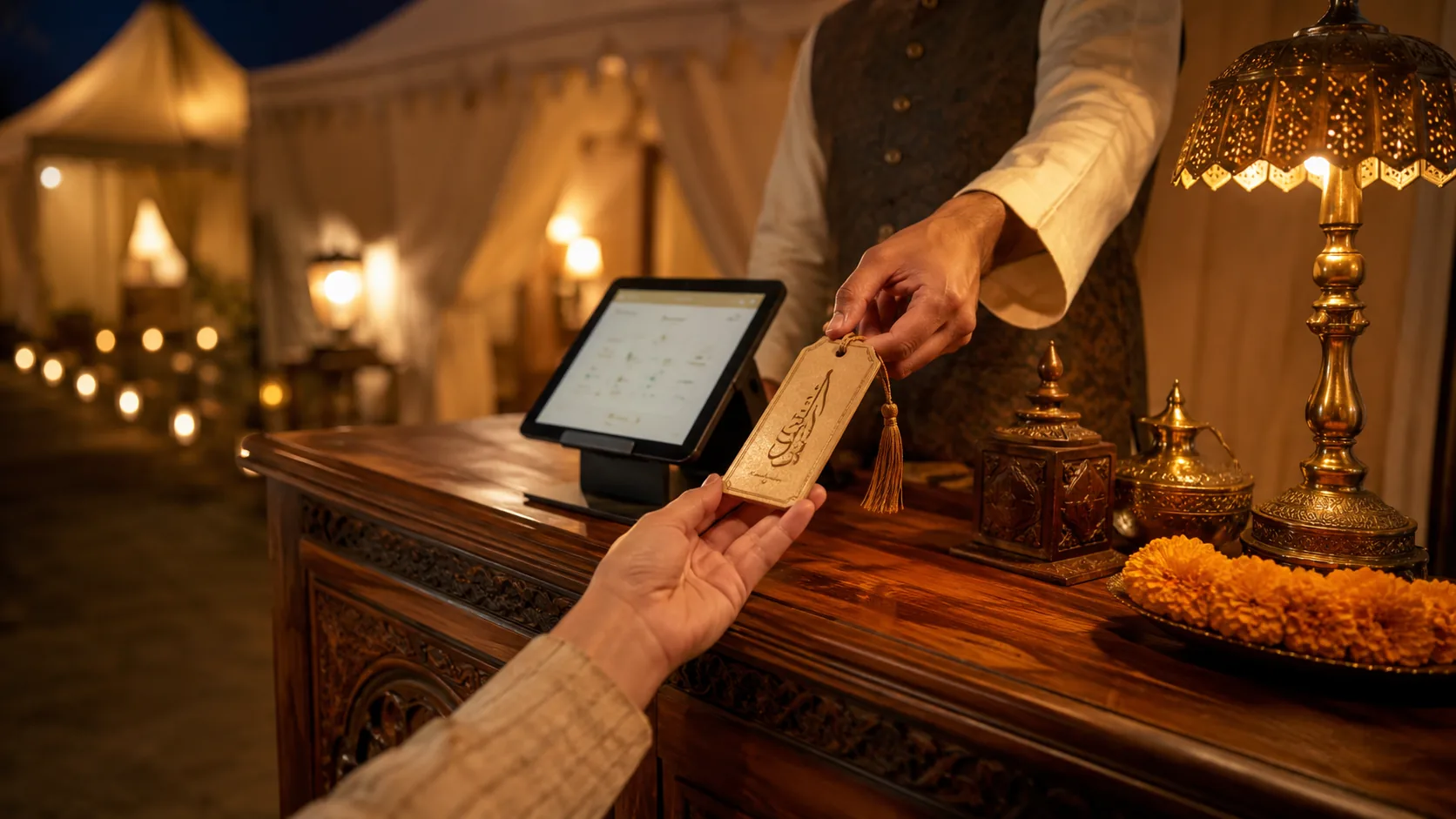
The Rann Utsav tent city at Dhordo does have WiFi, and this is better than nothing. It allows basic messaging, email checking, and light browsing without placing demands on your mobile data. What it cannot reliably support is video streaming, downloading large files, video calling over WhatsApp or Zoom, or uploading the high-resolution photographs you have spent the last two days taking. The connection is shared across all guests on the campus, and during peak hours — evenings particularly — it slows considerably.
The practical workaround is to do anything data-intensive before you arrive and after you leave. Back up photographs to the cloud when you return to Bhuj, where hotel WiFi or a strong mobile connection will handle it easily. Watch downloaded content on your device rather than streaming. Use the tent city WiFi for what it does well — staying loosely in touch with home, sending a few messages to say you arrived safely, checking essential information — and accept its limitations gracefully.
Cash and ATMs: Withdraw in Bhuj, Not After
There are no ATMs at the Rann Utsav tent city or in Dhordo village. The nearest reliable ATMs are in Bhuj, approximately 85 to 90 kilometres from the tent city. This is non-negotiable geography, and it catches a surprising number of visitors who assumed they could top up their cash on arrival or during the festival. They cannot.
The bazaar at Rann Utsav is a wonderful collection of artisan stalls selling Kutchi embroidery, mirror work, block-printed textiles, silver jewellery, leather goods, pottery, and much more. The craftspeople who sell here — many of them from villages that have maintained these traditions across generations — work almost exclusively in cash. UPI and card readers exist at some of the larger stalls, but they are the exception rather than the rule, and connectivity issues mean that even digital payment methods can fail at inopportune moments.
The advice is simple: withdraw generously from an ATM in Bhuj before you set out for Dhordo. Consider how much you might spend on shopping, activity add-ons, tips, and incidentals, and then add a comfortable buffer on top of that estimate. Kutchi craftsmanship has a way of proving more tempting than anticipated, and running out of cash when you are holding a piece of embroidery that took an artisan three months to make is a frustrating experience for everyone.
The major nationalised banks and private banks all have ATM presence in Bhuj city centre and in the areas around the railway station and main market. Standard withdrawal limits apply, so if you are a large group or expecting to spend significantly, make multiple withdrawals or plan for more than one person in the group to withdraw. Bhuj also has branches where larger sums can be withdrawn over the counter with appropriate documentation if needed.
Electricity and Charging: Not a Problem
One area where the tent city performs well is electricity. Power is available throughout the campus, tents have charging points, and keeping your devices topped up is not a difficulty. The supply is generator-based given the remote location, and there may be very occasional brief interruptions, but these are rare and short-lived. Carry a power bank for times when you are away from the tent — at the White Rann viewing area, on a camel ride, or during a long evening at the cultural programme — but do not worry about running out of power at the tent itself.
This means your camera batteries, your phone, your power bank, and any other devices can all be kept fully charged throughout your stay. The limitation is connectivity, not electricity. You have full power available to take hundreds of photographs and collect hours of video — you just will not be uploading them to Instagram until you get back to Bhuj.
Preparing Before You Leave Bhuj: A Practical Checklist
A few hours in Bhuj, approached methodically, makes everything at the tent city run smoothly. Withdraw more cash than you think you need from any of the ATMs in the city centre. Download Google Maps or Maps.me in offline mode for the Kutch region. Download any films, music, podcasts, or entertainment your group might want for evenings at the tent. Back up your existing photographs to the cloud or to your laptop before you leave, so storage is clear for the desert. Fully charge all your devices and power banks. Buy any medications, snacks, or supplies you might need, since shopping options near Dhordo are minimal.
If you are concerned about staying in touch with family at home, set expectations before you leave: explain that you may be difficult to reach by phone for the duration of your stay, that the WhatsApp messages they send may arrive in a burst when you find a signal pocket, and give them the tent city booking team's contact number — +91 92747 30220 — as an emergency contact if they genuinely need to reach you and cannot get through on your mobile. This kind of expectation-setting in advance removes anxiety on both sides and lets you be fully present in one of the most extraordinary landscapes India has to offer.
Packages for the tent city start from ₹6,300 per person for one night and two days. Call the team at +91 92747 30220 to book and to ask any further questions about facilities and connectivity. The White Rann is worth a few days of limited mobile signal — most visitors find that the disconnection is not a burden but a gift.