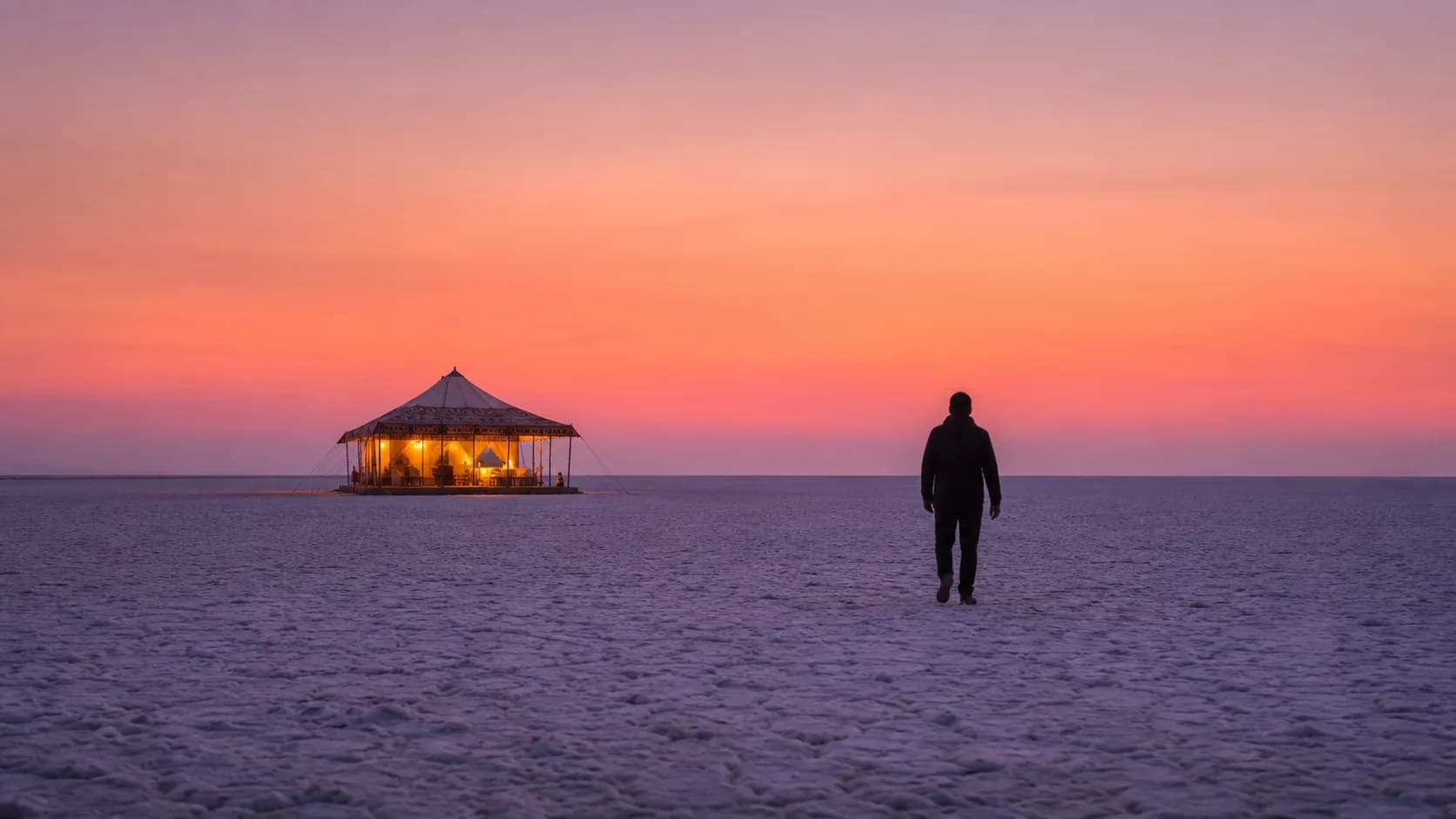
Solo at the Edge of the World
There is a particular freedom in arriving somewhere extraordinary entirely on your own terms. No negotiating over wake-up times, no compromising on which activity to do first, no waiting for someone else to be ready. The White Rann of Kutch, with its vast salt flat stretching to the horizon under a winter moon, is the kind of landscape that can be appreciated at any depth — and solo travellers often find they go deeper than they do in company, simply because there is nothing to distract them from the experience itself.
Rann Utsav is, somewhat counter-intuitively, one of the better Indian festivals for solo travel. The tent city structure creates a naturally social environment without forcing sociability on those who would rather be alone. You can spend an evening entirely in your own company, walking the salt flat at dusk with no one for company but the horizon; or you can sit at the communal dining tent and find yourself in a three-hour conversation with strangers who become friends. Both are entirely available to you, and you can move between them as you wish.
Quick answer: yes, Rann Utsav is one of India's more welcoming festivals for solo travellers. The tent city is staffed and managed, shared dining and evening activities make it easy to meet people, and solo travellers pay the same per-person tariff as anyone else — from ₹6,300 for a one-night, two-day stay, depending on tent category and trip length.
Is It Safe to Travel to Rann Utsav Alone?
Yes, with the straightforward caveats that apply to any travel in India. The tent city at Dhordo is a managed, staffed environment with good security. The guests are a mix of families, couples, corporate groups, and solo travellers from across India and increasingly from abroad. The staff are present and accessible. The surrounding area — the village of Dhordo and the broader district of Kutch — is a safe and hospitable region with a strong tradition of welcoming visitors.
For solo women travellers, the honest picture is largely positive. The tent city is well-lit, the pathways between tents are not isolated, the dining and social areas are communal and lively, and the broader culture of Kutch is notably welcoming. As with any solo travel in India, basic precautions apply: be aware of your surroundings after the evening programme, keep your tent locked, and avoid going very far from the designated areas on the salt flat alone in the dark. The White Rann at night is beautiful but disorienting — it is genuinely difficult to judge distance on the flat expanse under moonlight.
For solo male travellers, the experience is particularly uncomplicated. The tent city is social, the activities naturally generate conversation with other guests, and the whole environment is designed for easy informal interaction.
The Natural Sociability of the Tent City
The Rann Utsav tent city is structured, whether by design or by the organic logic of how people behave in a beautiful, unusual place, in ways that make meeting people easy without making it obligatory.
The communal dining tent is the primary social engine. Three meals a day in a shared space, with long tables and the natural rhythm of sitting wherever there is space, creates the conditions for the kind of easy conversation that rarely happens in a hotel restaurant. You will find that sharing a table at breakfast or dinner leads naturally to comparisons of experience, recommendations, and occasionally to plans to see something together.
The Garba dancing on festival evenings is another naturally social experience. A solo traveller standing at the edge of a Garba circle and watching will often find themselves gently invited in within a few minutes. Garba is participatory in a way that few cultural experiences are, and the invitation is always warm and without pressure.
The bonfire is the most reliably sociable space in the tent city. People gather, conversations start, and the warmth and the darkness create a natural intimacy between strangers. Some of the most memorable conversations solo Rann Utsav visitors describe happened at the bonfire, with people they had never met before and may never meet again.
Making the Most of Your Solo Time
The time you are not socialising is where solo Rann Utsav travel really distinguishes itself. Early morning, before the tent city stirs and before the other guests make their way to breakfast, is the best time to be alone on the White Rann. The sunrise over the salt flat in the quiet and the cold, with no one else around, is one of the most genuinely meditative experiences available to a traveller in India.
Take this time. Set your alarm, wrap up properly, and walk to the viewpoint before the organised sunrise groups arrive. The flat catches the first light in a way that is different from anything you have seen before — the salt crystals refract and shimmer, the light seems to come from everywhere at once, and the silence is so complete that you can hear your own breathing.
The bazaar, too, is worth exploring alone and at your own pace. The Kutchi artisans at the stalls are often willing to talk about their craft in much more depth when they are not being pulled in three directions by a family group. A solo traveller can spend an hour with a single embroidery artisan learning about the regional traditions of mirror work and thread counting in a way that simply is not possible when travelling in a group.
Budget Considerations for Solo Travellers
Solo travel at Rann Utsav is economical compared to many comparable festival experiences in India. The entry-level package starts from ₹6,300 per person for one night and two days, which includes accommodation, meals, and the cultural programme. The two-night, three-day package is priced at ₹12,600 and the three-night, four-day package at ₹18,900.
Note that these are per-person rates, which means solo travellers pay the same as those in couples or groups for the same level of accommodation. There is no single supplement in the traditional sense — the tents are allocated per person and you will have the tent to yourself. This is actually very good value for solo travel: you get a comfortable, private space in a remarkable location for a very reasonable cost.
If you are budgeting carefully, the one-night, two-day package gives you the essential experience — one full day on the Rann, one evening of cultural programme, and one night in the tent city. To properly absorb the experience at a relaxed solo traveller's pace, the two-night option is significantly better.
The FOMO Question
There is, it must be acknowledged, a particular kind of anxiety that solo travel at a social festival can generate. When you see groups of friends laughing around the bonfire or couples photographing each other on the salt flat at sunset, you might occasionally wish you were not there alone. This is a normal human response and not a reason to wait until you can go with someone else.
The honest counter is twofold. First, the solo experience of Rann Utsav is genuinely different from — and in some ways superior to — the group experience. The freedom of your own schedule, the depth of engagement you achieve when there is nothing else competing for your attention, and the openness that comes from not being enclosed within an existing social group are real advantages. Second, you are almost certainly not as alone at Rann Utsav as you might imagine. Solo travellers are more common than you would think, and the social structure of the tent city tends to bring them together by the second morning.
For any questions about solo travel logistics, or to speak with the team about the best package for a solo visit, call +91 92747 30220. The team can advise on tent allocation, activity booking, and the practical details of arriving at Dhordo alone for the first time.
Getting There as a Solo Traveller
The most practical route to the Rann Utsav tent city is via Bhuj airport, which has connections from Mumbai and Ahmedabad. From Bhuj, the most efficient option for a solo traveller is to join a shared transfer arranged through the tent city — call in advance to organise this, as individual transfers from Bhuj to Dhordo are available but more expensive. The ninety-minute drive through Kutch is lovely in its own right.
Within the tent city, everything is walkable. The site is compact enough that you will quickly learn your way around, and the staff are helpful in orienting new arrivals. As a solo traveller, you will find yourself navigating independently within a couple of hours of arrival.
A Final Note on Going Alone
The White Rann at night, alone, under a full moon, is one of those experiences that you cannot adequately describe to someone who has not been there. This is not a romantic cliché. It is a practical observation: the landscape is so unusual, and the conditions of experiencing it — the silence, the scale, the light — are so far outside the normal range of sensory experience, that words genuinely fail. Solo travellers, freed from the obligation to narrate or share the moment, often describe it as among the most profound travel experiences of their lives. Go alone. See what you find there.