An Honest Assessment First
There is a tendency in travel writing to either overstate accessibility ("everyone is welcome, everything is possible") or to avoid the subject entirely. Neither serves the wheelchair user or differently abled traveller who is trying to make a genuinely informed decision. This guide attempts something different: an honest, specific account of what is and is not accessible at the Rann Utsav tent city and the White Rann itself, so that visitors with mobility limitations can make a well-informed decision and plan accordingly.
The headline assessment is this: Rann Utsav is partially accessible to wheelchair users and differently abled visitors, with the most important experiences — the cultural show, the bazaar, the meals, the bonfire, and the White Rann viewpoint — accessible with varying degrees of assistance. Some activities are not accessible. The tent city pathways are largely flat and manageable. Advanced communication with the team is essential and will significantly improve your experience.
The Tent City Pathways
The Dhordo tent city is set up on level ground, and the main pathways between the tents, the dining tent, the bazaar, and the cultural show area are largely flat and firm. A manual or motorised wheelchair can navigate the main routes without significant difficulty, though some sections may have uneven compacted sand or gravel that requires assistance to push over.
The key practical advice: do not attempt to navigate the tent city alone in a wheelchair without having first covered the main routes with a staff member or companion. What appears flat in daylight can have minor variations that are noticeable for a wheelchair. Once you know the layout, it is manageable. The initial orientation is best done with guidance.
The accessible paths between the sleeping tent area and the main activity areas — dining, cultural show, bazaar, bonfire — are all achievable with a wheelchair and a companion to assist on any rougher stretches. The distances are modest and the layout is compact.
The Cultural Show
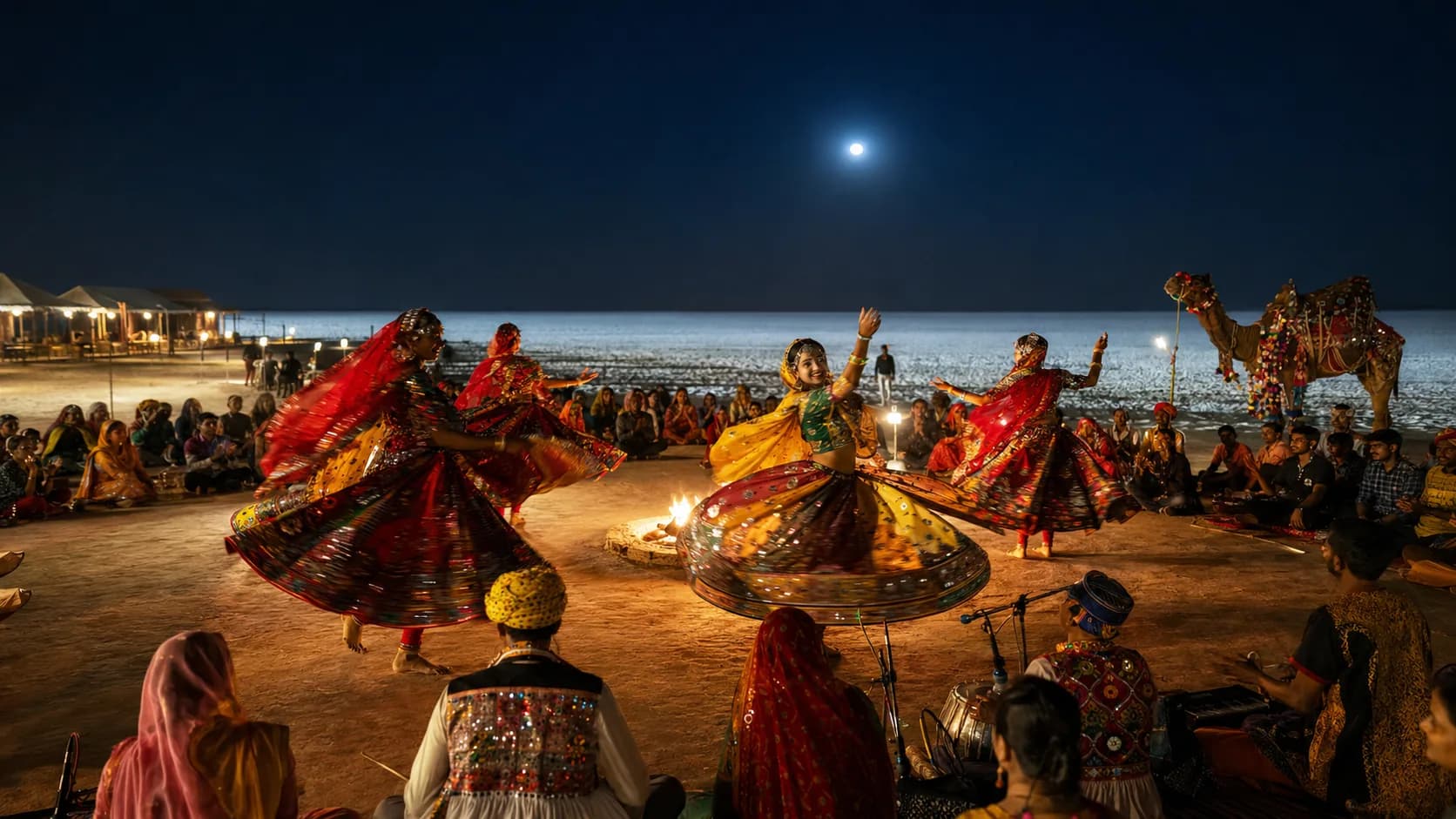
The cultural show amphitheatre has seating available, including arrangements for guests who cannot manage the standard seating setup. Wheelchair users can be positioned at the edge of the seating area with a clear line of sight to the performance. This is one of the most accessible and rewarding experiences of the entire festival — the Kutchi folk music, Garba dancing, and performance arts require nothing from the audience except presence, and it is spectacular.
Mention your specific seating requirements when booking, and the guest relations team will ensure appropriate arrangements are in place. This is one of the experiences where the accessibility is genuinely good.
The Bazaar
The main bazaar within the tent city has a navigable central area that a wheelchair can move through with assistance. The stalls are at accessible heights for browsing, and the artisans are welcoming and patient with all visitors. Some narrower sections between stalls may require careful navigation. A companion makes this a much more comfortable experience, but it is achievable and the bazaar is one of the most colourful and rewarding parts of the festival to experience.
Meals and Dining
The dining tent has tables and chairs, with sufficient space to position a wheelchair alongside a table. The buffet-style serving arrangement means that a companion to carry plates is helpful, but the dining experience itself is fully accessible and the meals are excellent. Communicate any dietary requirements in advance.
The Bonfire
The communal bonfire area has seating around it, with space to position a wheelchair alongside the seated guests. The warmth and the atmosphere are fully accessible, and this is one of the most naturally inclusive experiences at the festival. On cold December or January nights, the bonfire is warmth and light and conversation, and being part of that requires no particular physical capability beyond presence.
The White Rann Salt Flat: An Honest Picture
This is where honesty matters most. The White Rann salt flat itself — the vast, flat, white expanse that is the centrepiece of the festival — is both more and less accessible than it might appear.
The primary viewing area is reached by vehicle from the tent city. The vehicles used for this transfer are standard SUVs or jeeps, which means wheelchair users need to be able to transfer from a wheelchair into a vehicle seat — or travel in a vehicle that can accommodate a wheelchair. Discuss the transport logistics explicitly when calling to book on +91 92747 30220, as this requires advance planning.
At the viewpoint, there is a hard-standing area where vehicles park and guests view the Rann. A wheelchair can reach this area. The experience of seeing the salt flat from this point — the expanse, the horizon, the quality of the light — is fully accessible and is genuinely extraordinary.
Going further onto the salt flat itself involves uneven terrain where the salt crust is not always uniform. A manual wheelchair on the open flat requires significant effort from a companion to push, particularly over any distance. A motorised wheelchair may manage short distances independently, though the terrain is not guaranteed to be smooth. Walking aids such as sticks or frames function reasonably well on the firmer sections.
The honest summary: the viewpoint experience is accessible with assistance. Going far onto the open flat independently in a wheelchair is challenging and depends on the specific terrain conditions and your equipment.
The Sunrise and Sunset Experience
Sunrise and sunset on the White Rann are among the most spectacular moments of the festival. Both are accessible from the viewpoint area, which is reachable by vehicle. The experience of watching the sunrise paint the salt flat in shades of gold and rose, or the sunset turn the white expanse amber and then silver as the moon rises, requires only that you be present at the viewpoint. This is achievable for wheelchair users with the appropriate vehicle transfer and companion assistance.
What Requires Extra Help or Should Be Approached Carefully
Camel riding involves mounting and dismounting the animal, which requires a degree of physical agility and the ability to manage a lurching motion as the camel rises and settles. For many wheelchair users, this will not be manageable without significant assistance, and there is a real risk of injury from the mount and dismount process if balance or strength is limited. The handlers are willing to help, but this should be discussed honestly before attempting it.
ATV rides involve sitting astride a vehicle and managing controls. For those with upper body strength and balance, this may be possible with assistance; for those who cannot manage this independently, it is not appropriate.
Paramotoring is not accessible to wheelchair users.
Before You Book: The Most Important Step
Call +91 92747 30220 before booking to discuss your specific requirements in detail. This conversation should cover: the nature of your mobility limitation and what you use for assistance, the type of wheelchair or mobility aid you use, whether you are travelling with a companion who can provide physical assistance, your accommodation requirements, and which specific activities and experiences you most want to ensure are accessible.
The team can advise on tent allocation that minimises difficult pathways, arrange appropriate vehicle transfer to the White Rann, ensure seating at the cultural show is set up appropriately, and flag anything that is likely to be challenging given your specific situation. This advance communication is the single most important thing you can do to ensure a positive visit.
Packages begin from ₹6,300 per person for one night and two days, ₹12,600 for two nights and three days, and ₹18,900 for three nights and four days. A companion is strongly recommended for wheelchair users visiting the Rann Utsav, both for practical assistance and for safety on the open salt flat.
The White Rann is a place worth getting to. The planning required for a wheelchair user is greater than for able-bodied visitors, but the experience of that landscape — the scale, the silence, the beauty — is entirely independent of physical capability. It is there for everyone who finds a way to reach it.