The Hour Before Light: Why Sunrise on the White Rann Is Worth Every Second of Discomfort
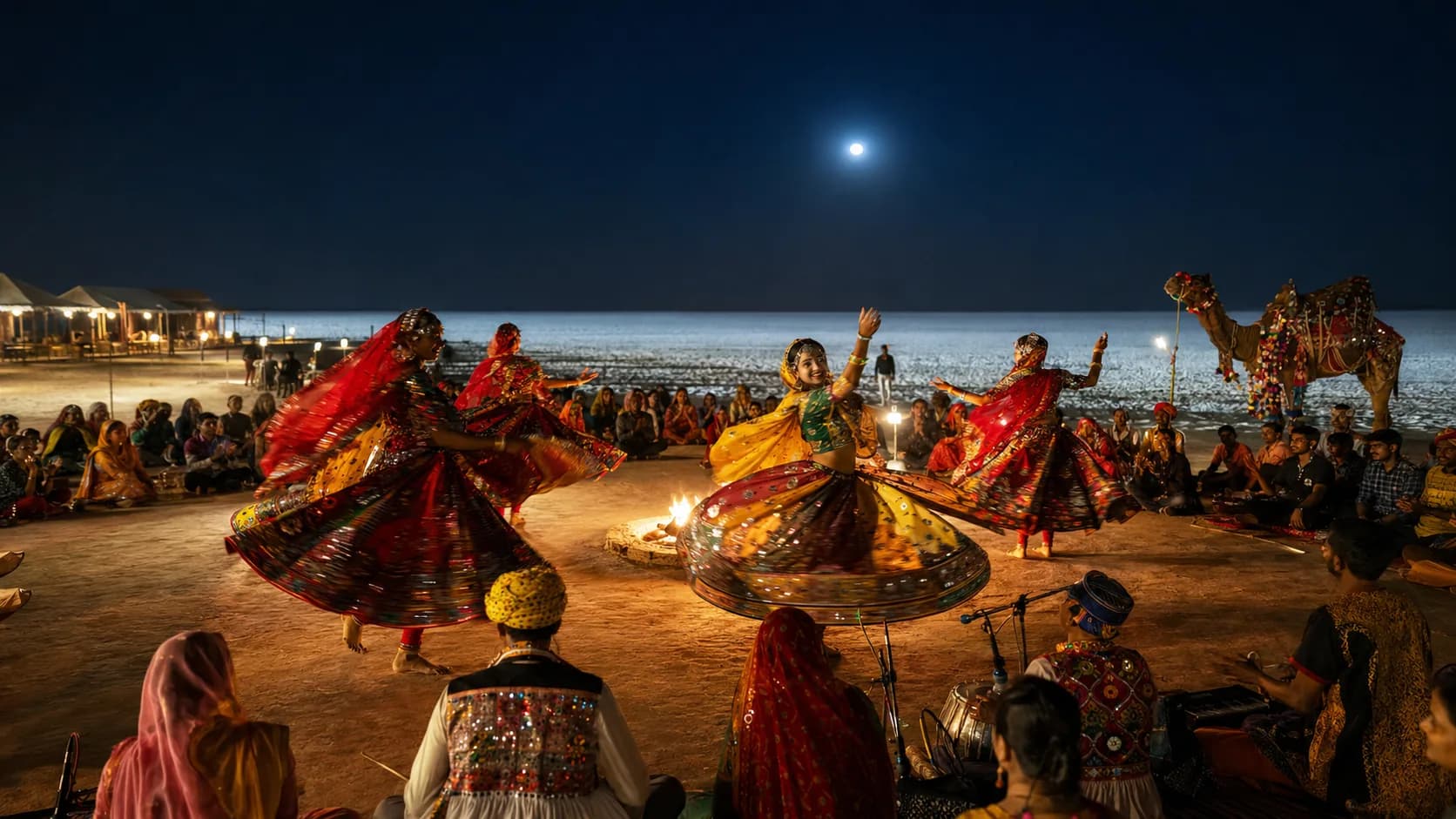
Most visitors to Rann Utsav go to bed reasonably content after the evening's cultural programme — the Garba, the music, perhaps a bonfire on the salt flat — and wake when breakfast is served at eight or nine o'clock. This is a perfectly reasonable way to spend your time at the festival. It is also, with the greatest possible respect, a missed opportunity of the first order.
The visitors who set their alarms for five in the morning, wrap themselves in every layer they have brought, and walk out onto the White Rann before dawn are the ones who come back with a particular look when they talk about what they saw. It is not quite the look of someone who has seen a beautiful view. It is something quieter than that — the look of someone who has witnessed something they were not entirely prepared for.
The Pre-Dawn Walk: Silence as a Destination
Leaving the Dhordo tent city at half past five in the morning in November or December is a cold business. The temperature at this hour typically sits between five and ten degrees Celsius, and the salt flat's open exposure to wind means it feels colder. But the cold serves a purpose: it keeps you fully present, unable to retreat into distraction.
The walk from the tent city to the open salt flat takes between five and fifteen minutes depending on your pace and destination. The path is flat and unmarked — the salt crust is the path — but the pre-dawn darkness means you will want a torch. A head torch is ideal, leaving your hands free. Walk away from the camp's lights until they are a faint suggestion behind you, then stop.
What greets you in the pre-dawn darkness of the White Rann is a very specific kind of silence. It is not the absence of sound so much as the presence of a particular quality of stillness that urban India almost never provides. There is no traffic hum, no distant train, no neighbour's television. The salt flat in winter sometimes produces a faint crackling sound as the crystallised surface responds to temperature — a sound you notice only because everything else is absent.
Above you, if the moon has set and the sky is clear, the stars are still burning with full intensity. At this hour, the Milky Way may still be visible to the west, retreating before the coming dawn.
The Transition: From Pink to Gold to White
The first sign of approaching sunrise on the White Rann is not light but colour. Ten or fifteen minutes before the sun actually rises, the eastern horizon — which on the flat salt plain is a perfect, unbroken line — begins to shift from black to a deep, saturated blue. This blue then softens into violet, then into a pink that seems to absorb into the salt surface simultaneously with filling the sky.
At this stage, something remarkable happens. The White Rann is one of the few landscapes in the world where the sky and the ground are in genuine conversation at sunrise. Because the salt is so reflective and so flat, the colours developing on the eastern horizon are simultaneously rendered on the ground beneath your feet. You are standing inside the colour transition rather than observing it from the outside. The distinction matters enormously to how the experience feels.
The pink deepens into apricot, then into a warm, saturated orange that transforms the entire landscape. In this light, the white salt is not white at all — it is every warm colour simultaneously, shifting second by second as the sun approaches the horizon. This is the peak of the experience for many visitors, before the sun itself appears and the colours begin to resolve back toward the characteristic blue-white brilliance of the Rann at midday.
The moment the sun breaks the horizon is quiet and sudden and, to most people who witness it without prior experience, somewhat overwhelming. The light changes completely in seconds. Shadows appear where there were none — the slightest irregularity in the salt surface throws a long shadow westward as the low sun rakes across the flat ground. A landscape that appeared perfectly uniform in the pre-dawn reveals extraordinary micro-detail: crystal formations, the faint traces of animal tracks, the patterns left by water evaporation in the previous monsoon.
Camel Silhouettes and the Living Landscape
If a camel safari has been arranged for the morning — which the tent city can organise for early risers — the experience of the sunrise is elevated further. Camel silhouettes against an orange-and-pink Rann Utsav sky are a visual that exists in the imagination before the visit and turns out, in person, to be even more affecting than imagined.
Even without a camel, the sunrise walk frequently involves encounters with the landscape's wildlife. Greater flamingos are occasionally spotted at the margins of the Rann, particularly in October and November. Demoiselle cranes, which migrate through Kutch in considerable numbers, sometimes pass overhead at this hour in loose, noisy formations. Foxes, hares, and the occasional desert cat can be seen returning to burrows as the light grows.
The birdlife of the Rann at sunrise is, in the early part of the season, genuinely impressive. Kutch and the Rann of Kutch together form one of the great avifaunal zones of South Asia, and dawn is the hour when the majority of bird activity concentrates. Birders who visit Rann Utsav without their binoculars at sunrise are, as a rule, regretting it by half past six.
How to Arrange a Sunrise Experience at Rann Utsav
The practical logistics are simpler than they might appear. On arrival at the tent city, mention to the front desk that you would like a morning wake-up call at five o'clock. This is a standard request and the staff are accustomed to accommodating it. The tent city can also arrange for a thermos of chai to be available early in the morning — a detail that makes the cold pre-dawn walk considerably more pleasant.
Guided sunrise walks may be available depending on the season and current staff arrangements. These are worth asking about on arrival; a knowledgeable guide who can identify birds and explain the geology and ecology of the salt flat adds significant depth to the experience. For those who prefer to go out independently, the tent city staff can point you toward the nearest viewpoint or simply tell you to walk due north from the main entrance until the camp lights are behind you.
All overnight packages give you the opportunity to experience sunrise. The ₹6,300 one-night, two-day package gives you one morning. The ₹12,600 two-night, three-day and ₹18,900 three-night, four-day packages give you two or three mornings respectively — which is worth considering if you want to experience both clear conditions and the possibility of shallow mist on the salt flat, which occurs occasionally in early morning in December and January and is one of the most ethereally beautiful things the Rann produces.
Why Sunrise Rivals the Full Moon Night
Rann Utsav is celebrated above all for its full moon nights — the spectacle of moonlight on the salt crust has rightly become the festival's signature image. But visitors who have experienced both consistently report that sunrise is the more emotionally potent of the two experiences.
The full moon is beautiful in the way that beauty is often beautiful: it is immediately legible, photogenic, and universally appreciated. The sunrise is more demanding. It requires you to be uncomfortable, to be awake when your body resists it, to stand in the cold in the pre-dawn darkness and wait. The reward for that discomfort is proportional. You have earned the colours, the silence, the first light — and that sense of having earned something makes the experience feel different from a passive spectacle.
Several visitors who have written to us describe the White Rann sunrise as the most moving travel experience they have had in India. That is a large claim in a country of this richness. But the White Rann at dawn is a landscape capable of producing that kind of response — and the only way to find out if it does that for you is to set the alarm and go.
For enquiries about morning activities, guided sunrise walks, or package options that give you multiple mornings on the Rann, call +91 92747 30220.