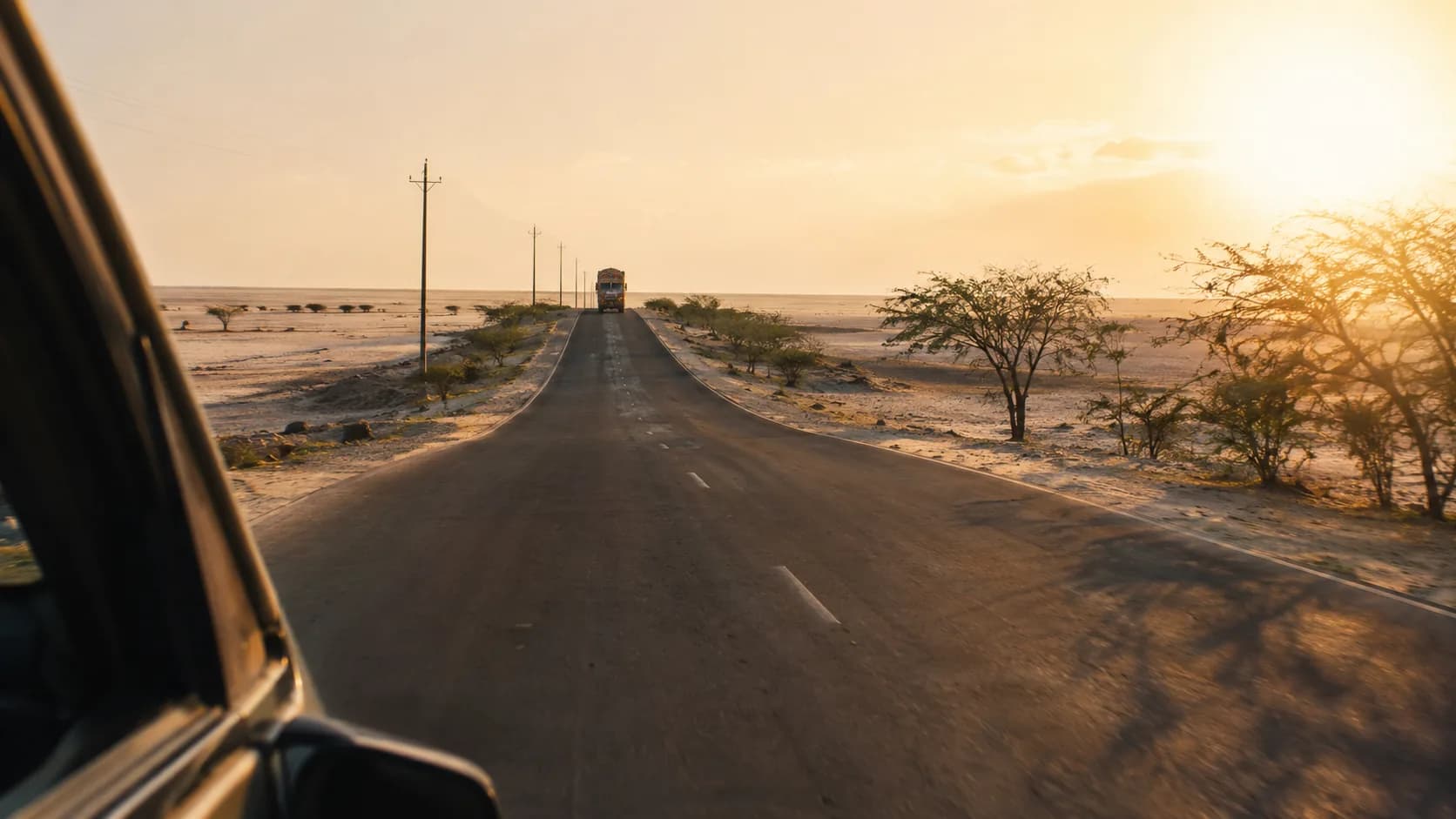
Beyond the White Rann: Why Dhordo Is the Perfect Base
Dhordo village sits at the very edge of the Great Rann of Kutch, a quiet settlement of roughly 300 households whose lives have been shaped by salt flats, seasonal flooding and, in recent years, the glittering spectacle of Rann Utsav. For most visitors, the tent city itself is destination enough — and one can entirely understand why. The White Rann at full moon is one of those rare sights that renders even seasoned travellers speechless. Yet to come all this way and not venture into the surrounding landscape would be to miss half the story.
The region around Dhordo rewards curiosity generously. Within a radius of 100 kilometres, you will find the highest point in Kutch, one of India's most dramatic border checkpoints, a flamingo sanctuary of quiet magnificence, and the walled heritage city of Bhuj — each offering something entirely distinct from the salt desert. What follows is a practical and unhurried guide to organising day trips from Dhordo, written for guests staying at the Rann Utsav tent city who want to see more of this extraordinary corner of Gujarat.
Kala Dungar — The Black Hill
At 462 metres above sea level, Kala Dungar — literally translated as Black Hill — is the highest point in all of Kutch, and its views across the Rann are nothing short of extraordinary. On a clear winter morning, you can see the white salt desert stretching to the horizon in every direction, a vast gleaming canvas interrupted only by the occasional shrub or distant mirage. The silence up here is physical — the kind that settles in your chest.
The hill lies approximately 25 kilometres from Dhordo, making it a comfortable half-day excursion. The road winds upward through low scrubland and rocky terrain before arriving at a small Dattatreya temple that sits at the summit. This temple has an unusual tradition: every day at noon, the priests offer food to jackals that have, over generations, become entirely accustomed to the ritual. Visitors are welcome to observe this quiet ceremony, which takes only a few minutes but carries a certain meditative quality that lingers long after you have descended.
The best time to visit Kala Dungar is either at sunrise or in the late afternoon, when the light across the Rann takes on shades of gold and copper that no photograph quite captures adequately. Many guests at the tent city arrange for their vehicle to depart at five in the morning, arriving at the summit just as the sun breaks over the horizon. The tent city concierge can arrange transport — a private vehicle with driver costs approximately ₹800 to ₹1,200 for the return journey, depending on the season and vehicle type. You can also enquire directly with us by calling +91 92747 30220.
Getting to Kala Dungar from Dhordo
The distance is short enough that a tempo traveller or Innova can make the journey comfortably on the paved road. There are no petrol stations between Dhordo and Kala Dungar, so ensure your vehicle is fuelled before departing. Carry water — at least one litre per person — as vendors at the top are limited. The temple itself is open to all faiths and there is no entry fee, though a small donation to the temple trust is customary and appreciated.
India Bridge — The Last Checkpoint Before Pakistan
Few experiences in India are as quietly stirring as standing at India Bridge, the country's last road checkpoint before the Pakistani border. Located roughly 40 kilometres from Dhordo on the road toward Khavda and beyond, India Bridge marks the point beyond which civilian travel is not permitted without special military clearance.
Visitors with valid Indian identity documents can reach this checkpoint freely, and many find the experience unexpectedly moving. On one side lies the familiar landscape of Kutch — the scrub, the road, the distant salt flats. On the other, separated only by a striped barrier, is contested terrain. Indian Border Security Force personnel man the post with professional courtesy, and photography is generally not permitted near the barrier itself, though the surrounding landscape may be documented freely.
The drive from Dhordo to India Bridge passes through Khavda, a small town with a petrol pump and a few tea stalls — an ideal place for a morning chai before continuing. The entire excursion, including time at the checkpoint and a return stop at Kala Dungar, makes for a full day's programme that most guests find immensely satisfying. Allow five to six hours in total.
A Word on Permissions
The area approaching the international border is a restricted zone and requires what is known as a Protected Area Permit (PAP) for foreign nationals. If you hold a foreign passport, this permit must be obtained in advance from the Collector's office in Bhuj or through the official Rann Utsav authorities. Indian nationals do not require this permit for the standard day trip, though you should carry your Aadhaar card or passport. Our team at +91 92747 30220 can guide international guests through the permit process well ahead of their visit.
Chhari Dhand — The Flamingo Sanctuary
There are places in the world that ask very little of you and give everything in return. Chhari Dhand, a seasonal wetland approximately 30 kilometres south of Dhordo, is one of them. Each winter, this shallow marshy lake becomes home to thousands of flamingos — both greater and lesser — that arrive in swirling pink clouds to feed on the blue-green algae that proliferates in the brackish water. Their numbers can reach into the tens of thousands during peak season, typically between November and February.
The sight of a flamingo flock in flight, their coral-and-white wings catching the winter light, is the sort of image that tends to end up on the first page of a travel journal rather than buried in the middle. Beyond flamingos, Chhari Dhand is also home to migratory ducks, sandpipers, pelicans and the occasional painted stork — making it a worthwhile destination even for those who would not normally call themselves birdwatchers.
There is no formal visitor infrastructure at Chhari Dhand, which is largely what gives it its appeal. A local guide from Dhordo or Khavda (costing roughly ₹300 to ₹500 for a two-hour session) will walk you to the best vantage points along the lake's edge without disturbing the birds. Binoculars are strongly recommended — eight times magnification at minimum. The tent city can help arrange guides on request.
The optimal time for flamingo viewing is in the early morning, when the birds are most active and the light is soft. An afternoon visit is pleasant but the midday heat, even in winter, tends to push the flamingos further into the centre of the lake where they are harder to observe. Plan to arrive by seven or eight in the morning for the best experience.
Bhuj — The Heritage Heart of Kutch
At approximately 80 kilometres from Dhordo — roughly one and a half to two hours by road — Bhuj is close enough for a day trip yet substantial enough to merit an overnight stay if your schedule permits. The city serves as the administrative capital of Kutch district and is, in many ways, the cultural and commercial anchor for the entire region.
Bhuj carries its history with some weight. A devastating earthquake in January 2001 destroyed much of the old city, killing thousands and altering the urban landscape permanently. Yet Bhuj has rebuilt itself with remarkable tenacity, and the old quarter — with its narrow lanes, traditional havelis and artisan workshops — has been substantially restored. The Aina Mahal, the extraordinary mirror palace built in the 18th century by Rao Lakhpatji, reopened after restoration and remains one of the most visually arresting interiors in western India. Its Hall of Mirrors, with hundreds of Venetian glass panels and Flemish chandeliers, is genuinely unlike anything else you will find in the country.
A day in Bhuj might include the Aina Mahal and the adjacent Prag Mahal — a Gothic Revival palace built in 1865 that feels entirely at odds with its surroundings, which is partly why it is so fascinating — followed by a walk through the Kutch Museum (established in 1877, the oldest museum in Gujarat) and lunch at one of the Sindhi-influenced restaurants near the main bazaar. The Bhuj craft markets, particularly around the Hamirsar Lake area, are excellent for Kutch embroidery, Bandhani work and copper bells.
Combining Bhuj with Your Rann Utsav Trip
Most guests travelling to Rann Utsav from outside Gujarat fly into Bhuj airport or reach the city by train before continuing to Dhordo. Spending a day in Bhuj either at the beginning or end of your trip is, in our experience, one of the best investments of time you can make. The city provides essential context for everything you will see in the tent city — the crafts, the cuisine, the cultural traditions — and the journey between Bhuj and Dhordo is beautiful in its own right, passing through open scrubland and scattered villages.
Our packages — starting at ₹6,300 for one night and two days, ₹12,600 for two nights and three days, and ₹18,900 for three nights and four days — can be customised to include a Bhuj extension. Speak with our team at +91 92747 30220 to discuss the options that work best for your group.
Planning Your Day Trips: Practical Considerations
The tent city at Dhordo typically operates a cultural programme each evening — folk music, dance performances, camel rides and the evening walk to the White Rann — which means most guests prefer to schedule their day trips during the morning and afternoon hours, returning to the camp by late afternoon for the evening festivities. This rhythm works very well in practice.
A private vehicle arranged through the tent city or a local Bhuj travel agent will give you the most flexibility. Shared jeeps and government buses do operate between Dhordo and Bhuj, but their schedules are not well suited to day-trip itineraries and they do not stop at Kala Dungar or Chhari Dhand.
Carry cash — ATMs are not available in Dhordo itself and the nearest reliable ATM is in Khavda town. Petrol stations are similarly limited, so plan your fuel stops accordingly. The winter sun in Kutch is gentle in the early hours but can be strong between eleven and three, so sunscreen and a light hat are practical companions for any outdoor excursion.
For any questions about arranging day trips, local guides or transport from the tent city, do not hesitate to contact our team at +91 92747 30220. We are happy to assist with planning itineraries that make the most of your time in this remarkable part of India.