Packing for a Landscape That Has Two Personalities
The White Rann of Kutch is a study in contrasts, and it communicates those contrasts most emphatically through temperature. The same stretch of salt desert that bakes at 30°C during a November afternoon becomes genuinely cold — sometimes bitterly so — after midnight in January. Daytime on the Rann rewards light, breathable clothing and a wide-brimmed hat. The cultural programme at eight in the evening calls for something with a little more occasion. Midnight on the salt flat under a full moon demands your warmest layer and possibly a second one on top of that.
Most visitors to Rann Utsav pack for one of these scenarios and are underprepared for the others. This guide takes you through each, month by month, so that everything you bring earns its place in your bag and nothing surprises you when the desert decides to change its character.
Daytime Wear: Sun, Salt, and Comfort
The White Rann is essentially a reflective surface. The salt crust bounces sunlight back upward from below while the sun bears down from above — a double exposure that makes midday on the Rann more intense than an equivalent day on a beach or in a city. Sunburn on the salt flat can happen significantly faster than in most environments, and the glare, even on overcast days, is relentless.
The practical response is to cover up more than you instinctively want to. Light cotton or linen clothing in pale colours — white, cream, pale blue, light grey — reflects solar radiation more effectively than dark fabrics and stays significantly cooler against the skin. Loose, full-length or three-quarter-length sleeves are strongly preferable to short sleeves for daytime salt-flat visits. The temptation to wear shorts and a vest on a warm October or November day is understandable; the sunburn that follows is equally predictable.
A sun hat is not optional. It is a piece of equipment in the same category as sunscreen and water — you simply do not go out on the White Rann during daylight without one. A wide-brimmed hat (at least a 7-centimetre brim) protects not just your face but your neck and the tops of your ears, which are among the first and most painful places to burn on the flat, open desert. Sun hats are available in the Rann Bazar within the festival grounds, but the selection and price are better in Bhuj if you have time to purchase there before arriving at Dhordo.
Sunglasses with UV400 protection are equally important. The brightness of the salt flat in full sun is eye-straining even for visitors who normally manage without sunglasses — the reflective surface essentially doubles the effective light intensity at eye level. Polarised lenses are particularly effective at reducing the glare from the salt's reflective surface and are worth the incremental cost over standard UV lenses.
Footwear for daytime salt-flat visits should be closed-toe and firmly strapped. The salt crust, while generally smooth, has crystalline formations and occasional sharp edges, particularly away from the developed viewpoint areas. Sandals or flip-flops are inappropriate. Comfortable walking shoes or light trail shoes work well. Avoid canvas shoes in the early morning when the surface may carry residual moisture; they will absorb salt water and become progressively more uncomfortable.
Evening Cultural Programme: Occasion Without Formality
The Rann Utsav cultural programme — the Garba evenings, the folk performances, the craft demonstrations, the bonfire nights — has a distinct atmosphere that sits somewhere between a festival and a wedding: celebratory, colourful, occasionally quite dressed up, but never formally so. You will not feel underdressed in a comfortable salwar kameez, and you will not feel overdressed in a well-chosen kurta set or even a light ethnic ensemble.
The cultural evenings at Dhordo are an invitation to dress with slightly more intention than daytime requires. Many visitors — particularly women — use the Rann Utsav cultural programme as an occasion to wear traditional Gujarati or Rajasthani dress, which they might not wear in their everyday city lives. The setting makes this feel entirely appropriate. Chaniya choli (the embroidered three-piece Gujarati festive dress), salwar kameez in deeper colours, and kurta-churidar sets all work beautifully for the evening programme. Men wearing kediyu (the traditional Gujarati flared top) with dhoti or churidar are completely in context and will attract warm appreciation from the Kutchi performers and staff.
If you are not interested in traditional dress, smart casual Western clothing — a comfortable shirt and trousers, a mid-layer pullover — works perfectly well. What matters more than the clothes is the decision to dress with some care for the evening, which signals respect for the cultural programme and its performers and makes the experience feel more like an occasion.
The one adjustment required even for the cultural programme evenings, from November onwards, is an outer layer. Temperatures after sunset drop faster than most visitors from warmer cities anticipate. By nine in the evening in December or January, a light jacket is not sufficient — you will want a proper woollen cardigan or fleece underneath whatever outer garment you bring. The performance area at Dhordo is open-air; there is no indoor heated venue to retreat to. This is part of the experience and part of the appeal, but it requires preparation.
Traditional Gujarati Outfits for Rent at the Bazaar
The Rann Bazar within the festival grounds at Dhordo includes stalls specialising in Kutchi and Gujarati festival dress, and several of these offer both sale and rental options for visitors who want to experience the cultural evenings in traditional clothing without purchasing a full outfit. Chaniya choli sets, dupattas, kediyu, and dhoti can typically be rented for between ₹200 and ₹500 for an evening, depending on the quality of the garment and the duration of the rental.
This is worth doing — not as a superficial costume exercise but as a genuine act of cultural participation. Watching the Garba circle in salwar kameez is enjoyable; joining it wearing a properly mirrored chaniya choli is something else. The other participants notice, appreciate it, and the interaction that follows is warmer and more inclusive. The stall owners can advise on what suits your colouring and the specific occasion of the evening — they have been doing this for years and know precisely what works.
Night Wear: The Cold the Photographs Don't Show
This is the section most visitors to Rann Utsav are most underprepared for, and the one that generates the most rueful feedback from first-timers who wish they had known: the full moon night on the White Rann, the experience most prominently photographed and most widely anticipated, happens in the cold. Not cool — cold. Genuinely, finger-numbing, nose-running, toes-aching cold.
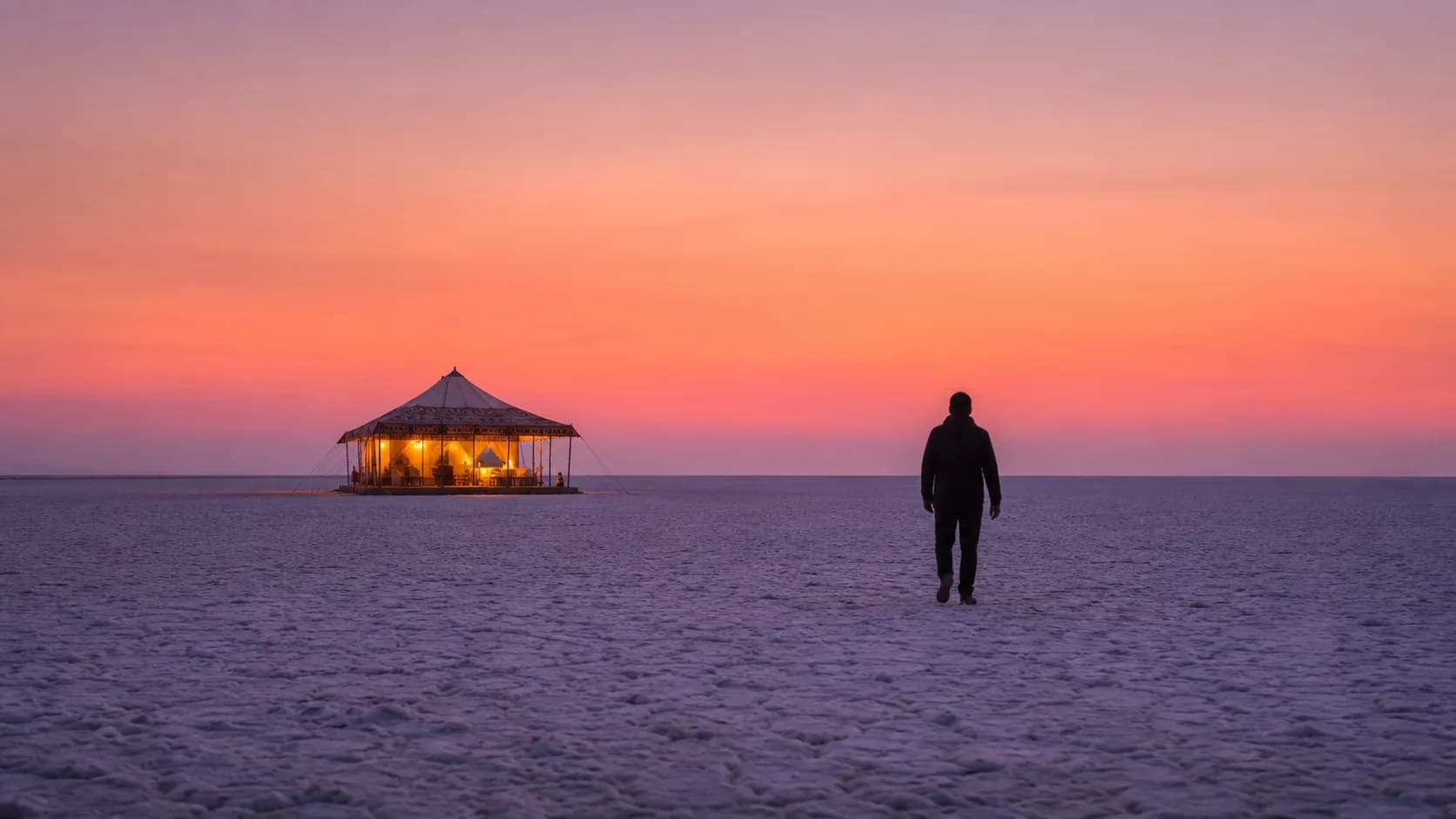
The photographs of full moon nights at the White Rann — and they are beautiful photographs — do not convey temperature. They show the luminous salt, the moonlit sky, the silhouettes of camels and people. They do not show that the person in the image is wearing four layers and is still cold, or that the photograph was taken and the person retreated quickly to the warmth of the camp. This is not a complaint — it is context. The cold is part of the experience, and being prepared for it means you can stay out on the salt long enough for the experience to fully register rather than retreating prematurely.
For December and January full moon nights, the minimum sensible layering system for extended time on the salt flat after dark is: a thermal base layer (top and bottom, not just a vest), a mid-layer fleece or woollen pullover, a down or synthetic insulated jacket as the outer shell, thermal or thick woollen socks, closed shoes or boots, a warm hat covering the ears fully, and gloves. This is the same layering system recommended for a winter night in the hills at moderate elevation, and it is appropriate — Kutch winter nights are comparable in temperature to Manali or Pahalgam in their shoulder seasons.
Many visitors who come prepared with a down jacket bring nothing for their lower body beyond regular trousers and are surprised to find their legs are the coldest part of them on the salt flat. Thermal leggings worn under jeans or over trousers make a substantial difference. A neck gaiter or scarf prevents the wind from entering at the collar, which is one of the most effective cold-management measures available.
Month-by-Month Temperature Guide
Understanding how the temperature changes across the season allows you to calibrate your packing precisely rather than over- or under-preparing.
October is the gentlest month for clothing planning. Daytime temperatures run between 28 and 33°C — warm, requiring the full sun protection protocol — while nights drop to around 18 to 22°C. A light cotton shawl or a thin fleece is sufficient for October evenings. You do not need heavy winter clothing for October visits.
November maintains warm days (25 to 30°C) and begins introducing cooler evenings (12 to 18°C). A proper fleece or light down jacket is appropriate for November evenings and nights. The early part of the month is milder; the final week can feel notably colder.
December is when the Kutch winter asserts itself. Days remain pleasant at 22 to 27°C, but nights drop to between six and 14°C, with cold waves from Rajasthan occasionally pushing temperatures below five. The full winter layering system described above is appropriate for December nights. Do not underestimate December cold based on Gujarat's reputation as a warm state.
January is the coldest month. Daytime temperatures of 18 to 24°C make for excellent walking weather, but nights from six degrees downward, occasionally with a cold wave touching three or four degrees, make the full cold-weather wardrobe mandatory. January visitors who have come from tropical cities consistently find the nights colder than they expected.
February marks the temperature's turn. Days warm toward 25 to 30°C and nights stay above 12°C through most of the month. A medium fleece and a light outer layer are generally sufficient. February is the most forgiving month for clothing planning.
March, in the final weeks of the season, is warm. Days can reach 30 to 35°C and nights rarely drop below 18°C. The light-cotton protocol returns, heavy layers are left at home, and the Rann shows yet another face.
The Packing List in Summary
For any Rann Utsav visit, the following items earn their place in the bag: two or three sets of light cotton or linen clothing for daytime, a wide-brimmed sun hat, UV400 sunglasses, closed-toe shoes for the salt flat, a mid-layer pullover or fleece (required from October), thermal underlayers (required from November), a down or insulated outer jacket (required from December), a warm hat covering the ears, gloves, and at least one set of clothing suitable for the cultural programme evenings — either traditional Indian dress or smart casual.
The one category worth considering that often goes unpacked is something to wear at the Garba. Even if you have no intention of dancing, a colourful dupatta or a mirror-work kurta adds significantly to the experience of an evening at the Rann Utsav cultural programme. If you forget or decide against it, the Rann Bazar at Dhordo has you covered.
For any questions about what to pack based on your specific travel dates and preferred activities, the team at +91 92747 30220 is happy to advise. Package options begin at ₹6,300 for one night and two days, ₹12,600 for two nights and three days, and ₹18,900 for three nights and four days.