Uttarayan at Rann Utsav: When the Sky Above the Salt Desert Fills With Kites
Every year on January 14, the state of Gujarat undergoes a transformation that is difficult to convey to those who have not witnessed it. From before dawn until after dark, the skies above every city, town, village, and open field fill with kites — thousands of them, tens of thousands, in every colour and pattern imaginable, flown from rooftops and fields and riversides across the length and breadth of the state. This is Uttarayan, the Gujarati kite festival that marks Makar Sankranti — the solar transition that signals the sun's northward movement, the beginning of longer days, and the end of winter's darkest stretch.
Gujarat takes Uttarayan more seriously than any other state takes any kite festival. In Ahmedabad, where the celebration is most elaborate, International Kite Festival events draw participants from dozens of countries. But across the state, in every district, Uttarayan is fundamentally local — a rooftop festival, a neighbourhood festival, a festival of string and competition and the particular pleasure of watching something you have made and launched find its way into the wind.
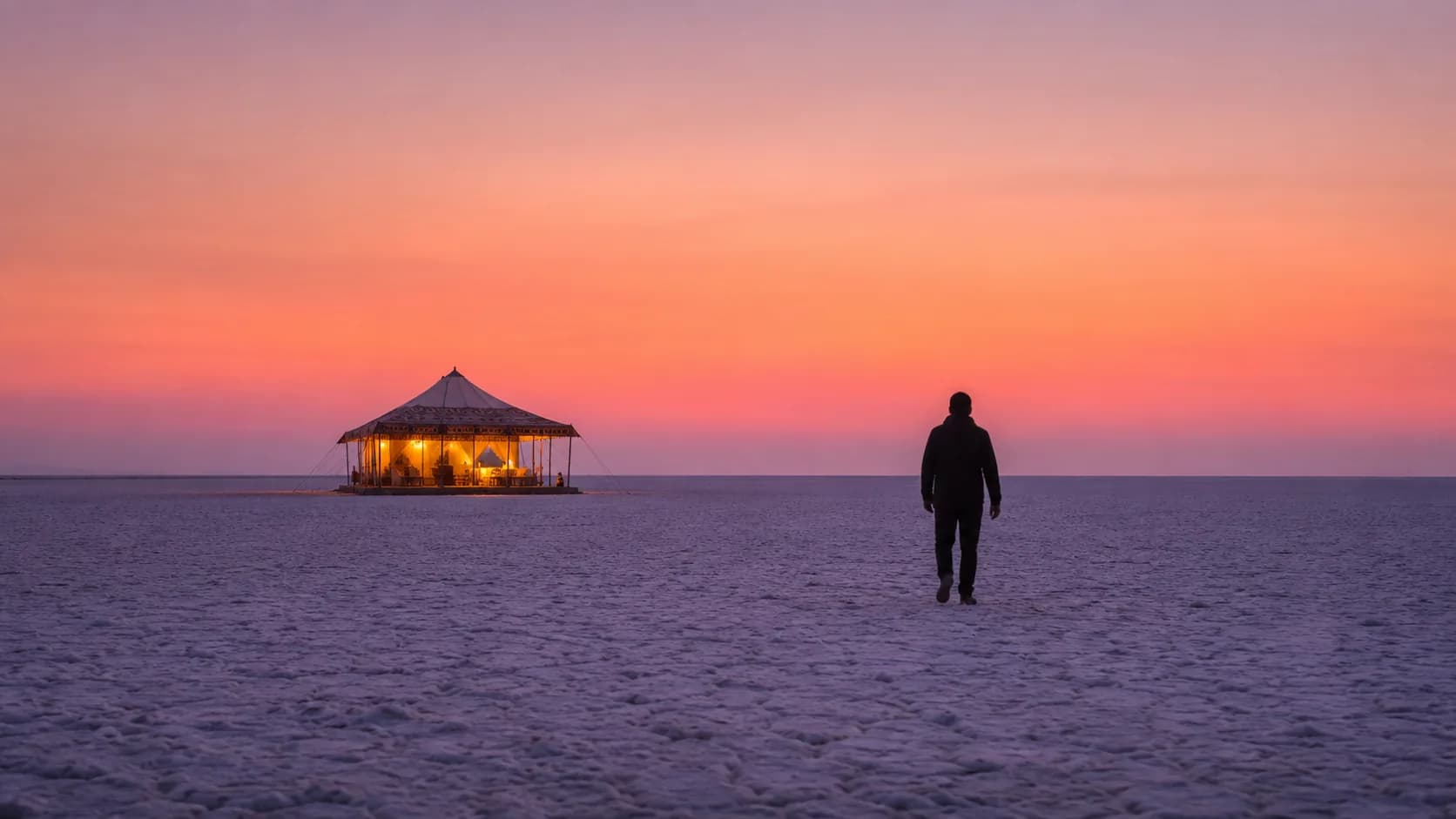
At Rann Utsav, Uttarayan on January 14 takes on a dimension unavailable anywhere else: the White Rann of Kutch, the vast flat salt desert of northwestern Gujarat, offers a kite-flying environment of almost theoretical perfection. No trees. No buildings. An absolutely flat horizon in all directions. The light winter breeze that moves across the Rann from the west, consistent in direction and gentle in force. And above it all, a sky so wide and so clear that a kite launched here seems to rise into a different dimension than a kite launched from a city rooftop.
Why the White Rann Is the Ideal Kite-Flying Landscape
The practical requirements for good kite flying are simple: open space, steady wind, and clear sky above. The White Rann satisfies all three conditions more completely than almost any other location in India.
The salt flat extends for thousands of square kilometres in every direction from the Dhordo tent city. There is no obstruction to wind movement, which means the light breeze that typifies January in Kutch arrives at the kite-flyer undisturbed, without the turbulence that buildings and trees create. Kites fly straighter, climb more predictably, and hold altitude more easily over the Rann than over any urban environment.
The space available for kite flying at the Rann is also of a different order from city celebrations. In Ahmedabad, Uttarayan means competing for airspace above densely packed rooftops; string from other kites is both the medium of the game and a constant hazard. At the Rann, you can fly in relative solitude, with as much horizontal and vertical space as you choose to claim. This changes the character of the experience from competitive to contemplative — less about cutting your neighbour's kite string, more about the simple pleasure of something rising.
The Tent City Kite Programme on Uttarayan
Gujarat Tourism organises a dedicated kite-flying programme at the Dhordo tent city on January 14. Kites are available for guests who do not bring their own — both the traditional diamond-shaped patang in bright Gujarati colours and larger, more elaborate display kites that are set aloft from the edge of the Rann for guests to watch and photograph. Kite-flying instruction is available for those who have not flown before, and the staff who run the programme are themselves experienced festival flyers.
The programme begins in the morning — Uttarayan is traditionally a daylight event, the flying paused only when light makes it impossible — and continues through the afternoon. The peak hours are typically mid-morning to mid-afternoon, when the breeze is at its most consistent. As the day progresses, the salt flat surrounding the tent city gradually populates with kites at various altitudes, and the visual effect — dozens of bright diamonds against the blue January sky, with the flat white Rann below — is one of the most photographed scenes in the entire Rann Utsav season.
The cultural programme on Uttarayan evening acknowledges the festival's significance in the Gujarati calendar. Special foods associated with Makar Sankranti — til laddoo, the sesame and jaggery sweets that are exchanged across Gujarat on this day, and undhiyu, the traditional Gujarati winter vegetable dish — are typically served. The evening folk music performance runs with particular energy on Uttarayan, as the day's celebrations shift indoors when darkness falls.
The Significance of Makar Sankranti in the Kutch Context
Uttarayan is the Gujarati name for Makar Sankranti — the day the sun transitions from Sagittarius (Dhanu) to Capricorn (Makar) in the Indian astronomical calendar. This is one of the few Hindu festivals fixed to the solar rather than the lunar calendar, which is why it falls reliably on January 14 each year rather than shifting with the moon.
The festival marks the sun's Uttarayan — its movement toward the north, the promise of warmth and longer days. In agricultural communities across India, Makar Sankranti marks the end of the winter harvest; the sesame and jaggery sweets that are eaten on this day are understood as warming foods appropriate to the cold season. In Gujarat, where the kite-flying tradition has become so central that Uttarayan effectively means kite festival rather than harvest festival, the day retains its agrarian roots beneath the spectacle.
In Kutch specifically, Makar Sankranti is celebrated within a landscape that has a deep relationship with the sun — the salt flat itself is a solar phenomenon, its crystalline surface the product of salt-saturated water evaporating under summer heat. The Rann in January, cold and white and flat, is in some ways the most literal possible environment for celebrating the sun's return. There is a rightness to flying kites here on January 14 that is not merely logistical.
The January 22 Full Moon: Eight Days After Uttarayan
One of the most compelling features of January 14 in the Rann Utsav calendar is its proximity to the January 22 full moon — the most celebrated full moon night of the festival season. The gap between Uttarayan and the January full moon is exactly eight days: long enough to be two distinct events, short enough to combine into a single extended stay.
Guests who arrive on January 13 for Uttarayan and depart on January 23 — after the full moon — experience a ten-day stay that encompasses two of the festival's most distinctive events. The Uttarayan kite programme on January 14 and the full moon night on January 22 are fundamentally different experiences — one diurnal, festive, and social; the other nocturnal, quiet, and almost meditative — and the contrast between them gives an extended stay a narrative richness that a shorter visit cannot.
The January 22 full moon at the White Rann is, by the account of many experienced Rann Utsav visitors, the finest single night of the festival season. The winter sky is at its clearest, the Rann is at its most reflective, and the season's cultural programme is fully mature. Gujarat Tourism designates full moon nights as special events, with extended access to the salt flat after dark and late-running cultural performances. The full moon night following Uttarayan in 2027 falls on a Thursday, which typically makes travel convenient for guests arriving over the preceding weekend.
Kite Flying for Guests Who Have Never Flown Before
Uttarayan at Rann Utsav is an accessible experience regardless of prior kite-flying experience. The tent city programme provides kites, string (manja), and instruction; the conditions over the salt flat are forgiving enough that even first-time flyers typically get their kite airborne within a few minutes.
The traditional Gujarati kite — the patang — is a lightweight diamond shape made from tissue paper and bamboo, designed to fly in the lightest of breezes and to respond instantly to string manipulation. Learning to fly one is not technically demanding; the greater part of the skill lies in reading the wind and making small, instinctive adjustments to keep the kite aloft. On the open Rann, where the wind is steady and unobstructed, this is easier than in any urban setting.
For guests with children, Uttarayan at the Rann Utsav is particularly well suited to a family experience. The open space means children can run freely; the kite instruction is patient and informal; and the spectacle of the festival day — the sky above the salt flat gradually filling with coloured diamonds, the sound of wind and string — is the kind of sensory memory that stays with young travellers for years.
Packages and Pricing for Uttarayan at Rann Utsav
Accommodation at Dhordo tent city for Uttarayan is available in the standard Rann Utsav packages:
The 1 Night 2 Days package at ₹6,300 per person — arriving on January 13 or the morning of January 14, experiencing the full Uttarayan programme, and departing on January 15 — is the minimum stay for capturing the kite festival.
The 2 Night 3 Days package at ₹12,600 per person, arriving January 13 and departing January 15, is the most natural fit for Uttarayan: it gives you the full day of January 14, with a relaxed arrival the evening before and an unhurried departure the morning after.
The 3 Night 4 Days package at ₹18,900 per person, or a custom extended stay, is the option for guests who wish to combine Uttarayan with the approach to the January 22 full moon in a single trip. Contact the booking team on +91 92747 30220 to arrange an extended stay that bridges both events.
An Open Sky Over the Edge of India
Kite festivals happen across India every January. But there is only one place where you can fly a kite over the largest salt desert on the subcontinent, with a clear winter sky above and the international border visible in the distance, eight days before one of the most beautiful full moon nights in the Indian travel calendar.
That place is here. The date is January 14, 2027. The number to call is +91 92747 30220, and the right moment to call is before someone else takes the last tent.