The Sea at the Edge of the Desert
There is something pleasingly paradoxical about driving from the White Rann of Kutch — one of the world's largest salt deserts — to the coast of the Arabian Sea in the same morning. Yet this is precisely what a Mandvi day trip from the Rann Utsav tent city offers: a complete geographical contrast within a single day's travel, the flat white expanse of the Rann giving way gradually to green coastal lowlands and, finally, the blue-grey of the sea.
Mandvi is approximately 130 kilometres from the Dhordo tent city — a drive of two and a half to three hours depending on traffic and road conditions. It is comfortably achievable as a day trip, allowing four to five hours of exploration in Mandvi before a return journey in the late afternoon. For guests staying two or more nights at Rann Utsav, Mandvi makes an ideal second-day excursion after the first evening's cultural programme and White Rann visit.
The Route from Dhordo to Mandvi
The standard route runs from Dhordo southward through Khavda, then continues toward Bhuj on the main Khavda-Bhuj highway before cutting south-west on the Bhuj-Mandvi road toward the coast. The total road time is approximately two and a half hours at a comfortable pace — longer if you pause in Bhuj for tea or fuel, which is recommended since petrol stations are absent for long stretches of the Dhordo-Bhuj road.
An alternative route avoids Bhuj entirely by taking the more direct Bhuj bypass, but for first-time visitors, passing through Bhuj — even briefly — provides useful geographical orientation and an opportunity to use the ATM if you are running low on cash. Mandvi itself has bank branches and ATMs, though they can be slow during peak season. Carry sufficient cash before leaving Dhordo.
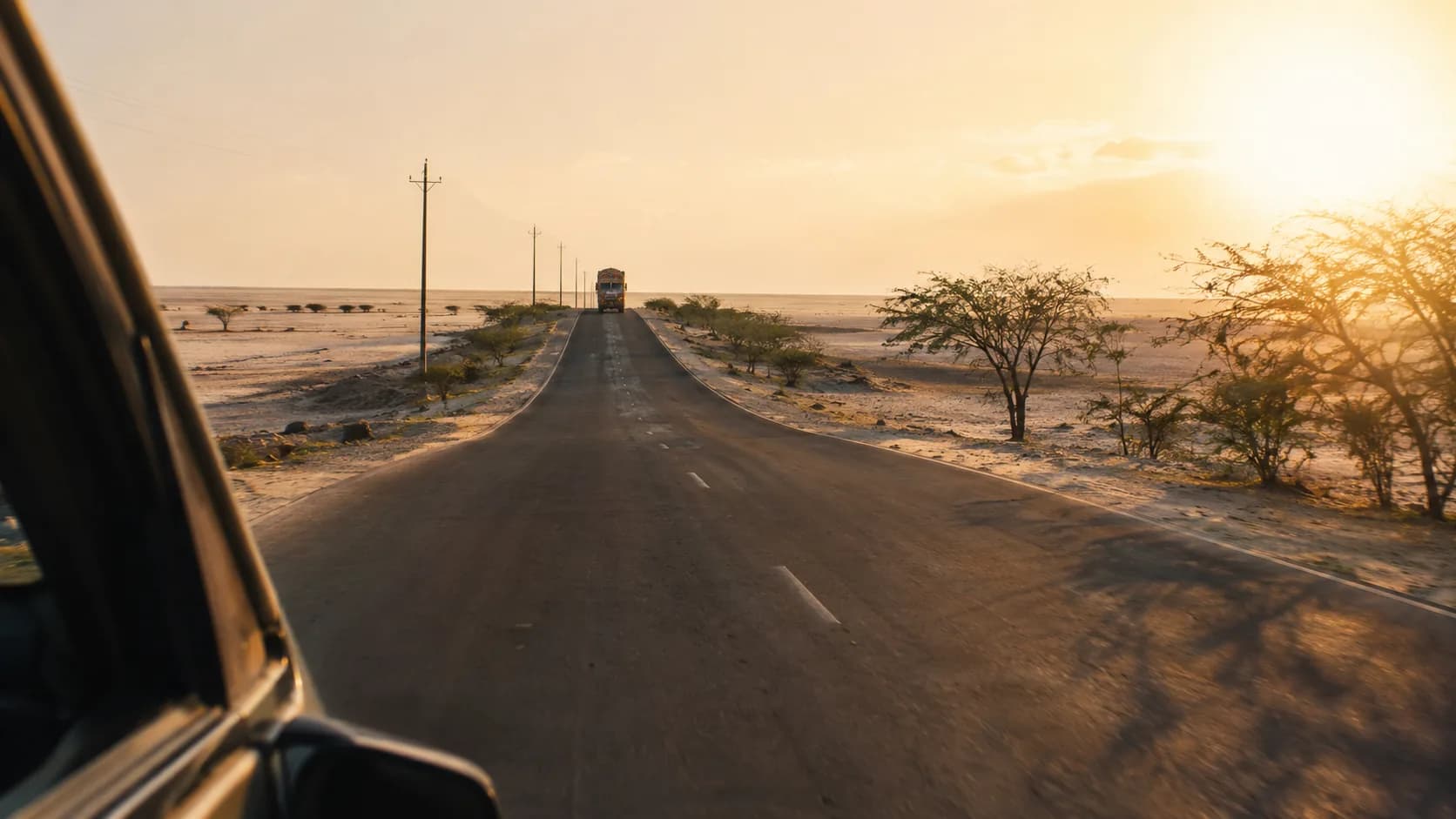
The drive between Bhuj and Mandvi is straightforward: a well-maintained state highway through flat agricultural land, passing several small villages and the occasional camel cart or tractor before the road begins to smell of salt air in the final kilometres before the coast. It is not a scenic drive in the dramatic sense, but it is pleasant and uncomplicated.
Vijay Vilas Palace — Rajput Grandeur on the Mandvi Shore
The Vijay Vilas Palace sits on a low headland above Mandvi's western beach — a remarkable building in the Rajput style, built in 1929 as the summer retreat of Maharao Khengarji III of Kutch. Its sandstone towers, ornate jharokhas (window projections) and chhattris (dome-covered pavilions) would look at home in Rajasthan, yet here they face the Arabian Sea, which gives the complex a slightly dream-like quality, as though a palace from one landscape had been carefully transplanted to another.
The palace is still the property of the Kutch royal family and parts of it serve as a guest residence, but the main pavilions and gardens are open to visitors on a modest entry fee. The interiors contain original period furnishings, royal portraits and a modest collection of hunting trophies that reflect the fashions of the era. The terrace above the main entrance offers a fine view of the coastline in both directions.
Vijay Vilas is probably best known to younger Indian visitors as the filming location of the beach scenes in the 2001 film Hum Dil De Chuke Sanam — a context that has made it a pilgrimage site of sorts. Set this information aside if you wish; the palace is worth visiting entirely on its own merits.
The Beach and Its Pleasures
Mandvi beach itself is one of the least developed stretches of coastal Gujarat — a long curve of pale sand backed by casuarina trees, with a modest number of vendors and a handful of basic beach huts. The water is clean by Gujarat standards and safe for wading, though not dramatically suited to swimming by the standards of Goa or Kerala. The beach is at its best in the early morning (before ten am) and in the late afternoon (from four pm onward), when the light is soft and the crowds minimal.
Camel and horse rides along the beach are available from local operators at fixed prices posted on boards near the main entry point. A short camel ride of fifteen to twenty minutes costs approximately ₹150 to ₹200 per person. It is an enjoyable addition for those travelling with children or for those who have not yet experienced a camel ride during their Kutch visit.
The sunset at Mandvi beach is, by most accounts, the finest available in Kutch. As the sun drops toward the Arabian Sea, the light turns everything — the sand, the palace towers, the water — into shades of copper and rose that no filter is needed to enhance. This makes timing important: if you plan to stay for sunset, which we strongly recommend, calculate your departure for the return journey accordingly. Sunset in winter (November to February) occurs between approximately five-thirty and six pm. A seven pm departure from Mandvi puts you back at Dhordo by approximately nine-thirty pm — after the cultural programme has ended, which is the one timing trade-off of a sunset Mandvi trip.
The Dhow Yard — One of India's Most Remarkable Working Heritage Sites
For many visitors, the dhow-building yard on the eastern bank of the Rukmavati River is the most unexpected and memorable part of a Mandvi day trip. Here, master craftsmen continue to build large wooden sailing vessels — dhows, in the Persian Gulf and East African maritime tradition — using techniques that have been passed down through generations over four centuries, without the use of formal blueprints or computer-aided design.
The boats are enormous — some exceeding 30 metres in length — and watching the craftsmen work with adzes, chisels and saws on these massive timber frames is an encounter with a form of knowledge so embodied and practiced that it seems almost impossible in the contemporary world. The yard is informal in the sense that there is no ticket booth or designated visitor entrance; you simply approach, express interest, and the workers — accustomed to curious visitors — will generally allow you to watch and ask questions. A small tip of ₹100 to ₹200 for any worker who takes time to explain the process is a respectful acknowledgment of their time.
The dhow yard is located on the north bank of the Rukmavati near the old town bridge. Ask your driver to take you to the naav banane ki jagah (boat-making place) — every Mandvi local will know it.
When to Schedule the Mandvi Day Trip
If you are staying two nights at Rann Utsav, the second day is the natural choice for a Mandvi excursion. The first evening's cultural programme tends to run until ten or eleven pm, making an early departure on Day Two inadvisable; a nine am start from Dhordo arrives in Mandvi by noon, allowing a full afternoon. Those staying three nights have greater flexibility and may prefer to take Mandvi on Day Two and save Day Three for a Kala Dungar or Chhari Dhand excursion.
The cultural programme runs every evening at the tent city, and missing one evening to accommodate a Mandvi sunset is a reasonable trade-off. Speak with the tent city concierge about the evening schedule — on most nights the programme begins at seven or seven-thirty pm, so a return from Mandvi by seven thirty is achievable if you depart Mandvi by five pm.
Arranging Transport
A private vehicle with driver is by far the most practical arrangement for the Mandvi day trip. A full-day hire from Dhordo to Mandvi and return — including waiting time — typically costs between ₹2,500 and ₹3,500 for an Innova or equivalent, depending on the operator and season. The tent city can arrange this through their in-house or partner transport service; alternatively, contact us at +91 92747 30220 and we will connect you with a reliable operator.
Share taxis between Bhuj and Mandvi operate from Bhuj bus stand but are not well suited to a day trip from Dhordo, as they do not call at Dhordo itself and their schedules are oriented toward commuters rather than tourists. Self-drive rental is available in Bhuj for those who prefer independence — but confirm that your hire agreement permits the Dhordo-to-Mandvi route, as some operators restrict vehicles from the restricted zone areas near the border.
Mandvi is a genuinely rewarding day trip that adds considerable texture to a Rann Utsav visit — the contrast between the two landscapes, the unexpected magnificence of the dhow yard, and the quality of the sunset make it one of the most satisfying single days that Kutch offers.