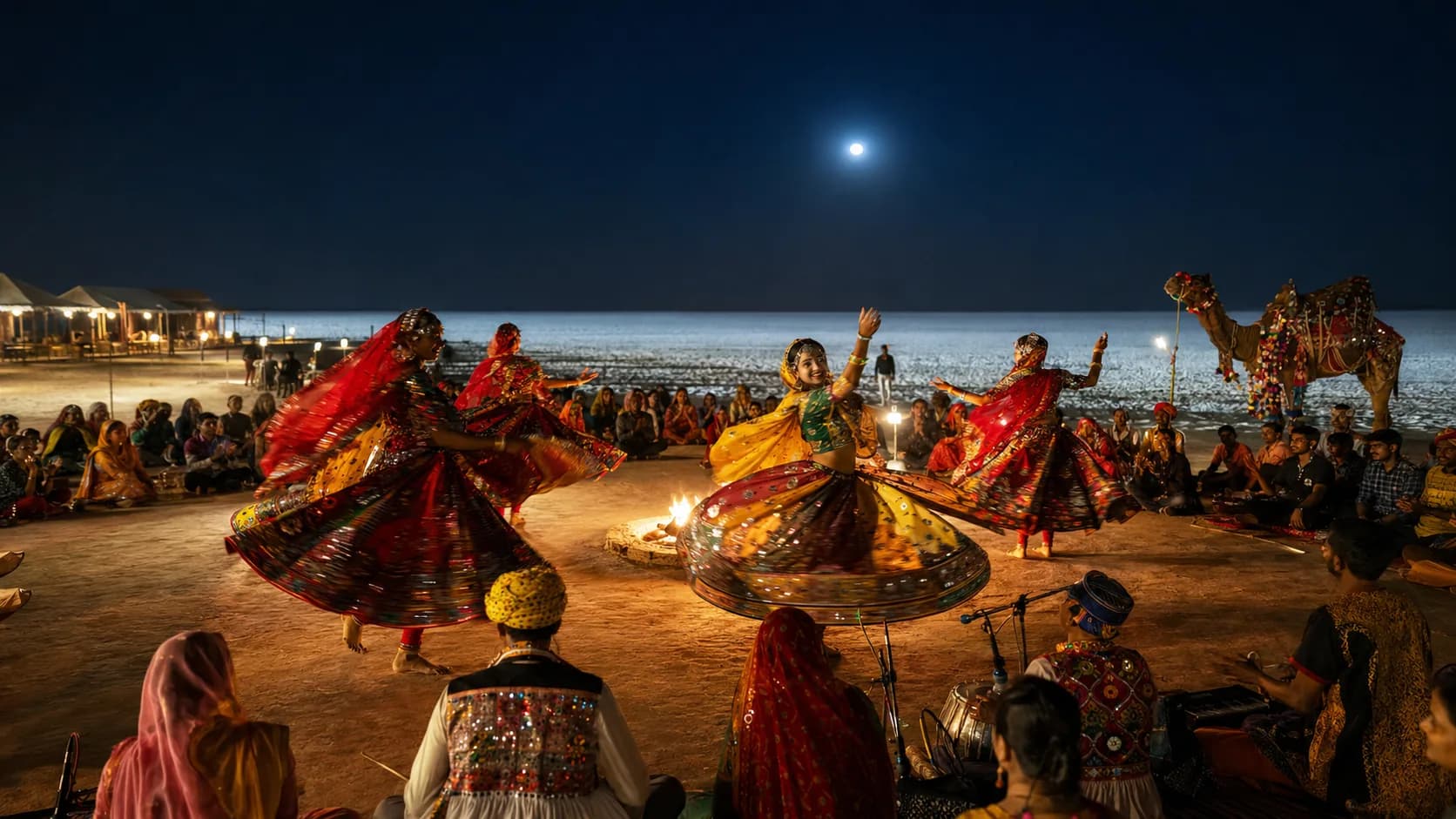
Long before Rann Utsav pitched its first tent on the salt, before Dhordo had a tourism office or Dholavira had a signboard pointing towards its Harappan ruins, the white desert of Kutch was already inscribed with a language. It was not written on paper. It was stitched into cloth, worn on the body, carried across migrations, and handed from a mother's needle to her daughter's fingers. This is the language of Rabari and Mir embroidery — two of Kutch's most distinctive textile traditions, and among the reasons UNESCO and textile scholars alike consider this arid corner of Gujarat one of the world's great living repositories of hand embroidery.
To visit Kutch during festival season and buy a mirrored bag or a embroidered cushion cover is a pleasant transaction. To understand what that mirror-work actually represents — the community history, the technique, the symbolism, the legal protections now shielding it — is to understand Kutch itself rather more deeply. This piece is not a shopping guide, nor an itinerary for the craft villages (we cover both elsewhere). It is, instead, an attempt to sit with the thread itself, and with the women whose hands have carried it for roughly four hundred years.
Two Communities, One Desert
Kutch is home to more than a dozen embroidering communities, but two names recur most often in any serious account of the region's needlework: the Rabari and the Mir.
The Rabari are a pastoral, semi-nomadic community — herders of camels and cattle, traditionally — who trace their arrival in Kutch to a long migration out of Sindh, in what is now Pakistan, sometime around the sixteenth or seventeenth century. Popular memory within the community places their origins even further afield, in the deserts near the Iran-Afghanistan frontier, with the Sindh sojourn as a staging point before they crossed into Kutch and Saurashtra in successive waves. What is documented with more certainty is that by the seventeenth century, Rabari clans were well established across Kutch, grazing their herds along routes that shifted with the seasons and the rains.
The Mir community's story runs in a related but distinct channel. Also tracing lineage to Sindh, the Mir are traditionally associated with a Muslim pastoral and artisan heritage, and their embroidery — while sharing the broader Kutchi vocabulary of mirror and thread — carries its own technical signature, developed in relative isolation in the villages around Nirona and the Banni grassland belt on Kutch's northern edge, the very tract that borders the Great Rann where Rann Utsav's tent cities now stand.
What unites both communities is not just geography but circumstance: a semi-arid, resource-scarce landscape where portable wealth mattered, where a woman's dowry was worn rather than banked, and where embroidery became both practical armour against a harsh climate and a canvas for identity in a land with few other ways to declare who you were and where you belonged.
The Stitch as Signature
Kutchi embroidery is often spoken of as a single tradition by outsiders, but practitioners and textile historians draw sharp lines between community styles — lines visible chiefly in stitch technique and mirror placement.
Rabari Work
Rabari embroidery is instantly recognisable for its bold, chain-stitch outlines worked with a hook (the *ari*) rather than a needle, filled generously with small, angular mirrors — locally called *abhla* or *sheesha* — set in dense clusters. The chain stitch gives Rabari work a graphic, almost architectural quality: thick black or dark-thread outlines, punctuated by mirrors that catch and scatter light across a garment or hanging as the wearer moves. Motifs tend towards the pictorial — peacocks, scorpions, camels, trees of life, human figures in procession — rendered with a directness that reads more like folk narrative than abstract pattern. Within the Rabari community itself, there are further sub-styles: Dhebaria Rabari work is denser and more elaborate, Kachhi Rabari is comparatively restrained, and Vagadia Rabari sits somewhere between the two — a reminder that "Rabari embroidery" is itself a family of related dialects, not one fixed grammar.
Mir Work
Mir embroidery, by contrast, is prized for its needle-based counted stitches — a technique often described locally as *suf* or worked in fine cross-stitch and herringbone variants — producing geometric, almost mathematically precise patterns built from the reverse side of the cloth by counting threads rather than sketching a design first. Where Rabari work reads as pictorial storytelling, Mir work reads as pattern discipline: triangles, diamonds and rosettes built up stitch by counted stitch into symmetrical fields, with mirror-work used more sparingly and precisely, often as small circular or diamond accents within a geometric frame rather than as the dominant visual event. Mir needlework additionally overlaps with — and is sometimes confused with — the *suf* and *kharek* styles practised by other Kutchi Muslim communities such as the Meghwal and Sodha, though Mir practitioners maintain their own distinct lineage and preferred colour and motif vocabulary, often leaning towards deep reds, blacks and golds against off-white or indigo grounds.
Set the two side by side and the difference is legible even to an untrained eye: Rabari work is bold, dark-outlined, and pictorial; Mir work is fine, geometric, and built on counted precision. Both use mirrors to fracture and multiply desert light across cloth, but for different visual ends.
What the Motifs Mean
Embroidery in Kutch has rarely been decoration for its own sake. Among Rabari women especially, a piece of embroidered cloth functioned historically as a kind of visual biography — a record of a woman's household, her marital status, her clan, and her craft standing within the community, all readable at a glance by anyone versed in the vocabulary.
The peacock, a recurring Rabari motif, carries associations of grace and monsoon — a bird that dances at the first rain, in a region where rain itself is scarce enough to be nearly mythic. The scorpion, unsettling to outsiders, appears frequently as a protective symbol, invoked less out of fear than familiarity — a creature of the same desert the embroiderer knows intimately, drawn into cloth almost as a charm against its bite. Trees of life and flowering vines speak to fertility and continuity, appropriate on dowry pieces meant to travel with a bride into a new household. Human figures, often in procession or paired, reference marriage, community gatherings, and ancestral memory.
For Mir embroiderers, whose work leans more abstract, the symbolism sits closer to pattern logic than to figurative storytelling — repetition, symmetry and geometric balance carrying their own aesthetic and, some scholars argue, spiritual weight, consistent with broader patterns in Islamic decorative art where figurative representation is treated with restraint and geometry becomes the primary expressive language.
In both traditions, colour choices were rarely arbitrary. Deep reds and yellows dominated bridal and festive pieces; darker indigos and blacks marked more everyday or mourning-adjacent garments. A woman's dowry chest, filled with pieces she had embroidered across years of preparation, was simultaneously a trousseau, a resume of skill, and an heirloom destined to be passed down or gifted at her own daughter's wedding in turn.
Roughly Four Hundred Years of Evolution
Textile historians place the arrival of these embroidery traditions in Kutch alongside the Rabari and allied communities' migration from Sindh, broadly dated to the sixteenth and seventeenth centuries — putting the craft's local lineage at somewhere in the range of four hundred years, though the deeper roots of mirror-work and chain-stitch technique in the wider Sindh-Kutch-Kathiawar cultural belt likely extend further back still.
What has changed across those centuries is less the core technique than its context. Embroidery that began as an entirely domestic, dowry-focused practice — worked slowly, over months or years, for a woman's own household — began shifting towards a market-facing craft from the mid-twentieth century onward, as urbanisation, changing pastoral economies, and the devastating 2001 Bhuj earthquake pushed many Kutchi communities to reconsider embroidery as a source of direct income rather than purely domestic obligation. Cooperatives and self-help groups, many of them women-led, emerged in the earthquake's aftermath specifically to convert traditional skill into livelihood, formalising what had previously been an uncommercialised, intra-community practice.
This shift has been double-edged. It has brought real income to Rabari and Mir households, particularly to women whose economic independence within pastoral communities was historically limited. It has also introduced pressure — faster production timelines, synthetic threads and machine-made imitations flooding the market, and a gradual thinning of the elaborate, time-intensive pieces that once took a woman months to complete for her own trousseau.
The GI Tag: Protecting the Thread
In 2012, "Kutch Embroidery" received a Geographical Indication (GI) tag under India's Geographical Indications of Goods (Registration and Protection) Act, administered through the Geographical Indications Registry in Chennai. The registration, pursued with the involvement of Kutchi artisan collectives and craft-development bodies, formally recognises hand embroidery from the Kutch region — encompassing the range of community styles including Rabari, Mir, Ahir, Sodha, and Mutava work among others — as a product whose authenticity and quality are tied inseparably to its geographic and cultural origin, in the same legal category that protects products like Darjeeling tea or Banarasi silk.
In practical terms, the GI tag exists to draw a line between genuine, hand-worked Kutchi embroidery and the machine-embroidered or printed imitations that have become common in tourist markets across India, sold under a Kutch label with no actual connection to the region or its artisans. For a craft this labour-intensive — a single elaborate Rabari panel can represent dozens of hours of hand-work — the imitation market represents a genuine threat to both artisan livelihoods and the traditional knowledge itself, since underpricing by machine-made lookalikes discourages younger generations from investing the time needed to master hand technique.
The GI tag alone cannot police every roadside stall, and enforcement in practice remains uneven. But its existence matters symbolically and legally: it establishes, on the record, that this is not generic "ethnic embroidery" but a specific, place-bound craft tradition with named community custodians, deserving the same protected status as any other geographically rooted Indian heritage product.
Thread as Identity
Ask a Rabari woman what her embroidery means to her, and the answer rarely stays confined to aesthetics or income. For many Rabari and Mir women, needlework has functioned historically as one of the few culturally sanctioned forms of individual creative expression and status available to them — a space in which skill, patience and originality were visibly rewarded within the community, at a time when few other public forms of recognition existed for women in these pastoral societies.
A young Rabari woman's embroidered dowry pieces were, in effect, her portfolio — evidence to her new household of her diligence and skill. A finely worked Mir panel, with its precise counted-thread geometry, carried its own quiet prestige, a demonstration of discipline that other women in the community would recognise instantly. Marriage, migration, mourning and celebration all had their embroidered register, and a woman fluent in her community's stitch vocabulary was, in a very real sense, fluent in the social language of her own life.
That is worth holding in mind the next time a length of mirrored fabric catches your eye at a Kutch craft village or in a shop near the tent city. It is beautiful, certainly, and it is for sale — but it also carries four centuries of migration, protection, grief, celebration and identity stitched into every mirror and every counted thread. Kutch's embroidery traditions are not a backdrop to the desert festival. They are, in their own quiet way, one of the oldest and most continuously practised art forms the region has to offer — older than any tent city, and likely to outlast this one too.
Seeing It for Yourself
The clearest way to encounter these traditions in person is to combine a Rann Utsav stay with time in the surrounding craft villages, where Rabari and Mir artisans still work from home workshops rather than purely retail counters. Visiting during the festival season — 1 November 2026 to 7 March 2027 — means the villages nearest Dhordo are at their most accessible, with cooler weather and the shortest possible drive back to camp before evening programming begins.
To arrange time with embroidery artisans alongside your festival stay, call our team on +91 92747 30220. Packages start from ₹6,300 per person for a one night, two day stay.