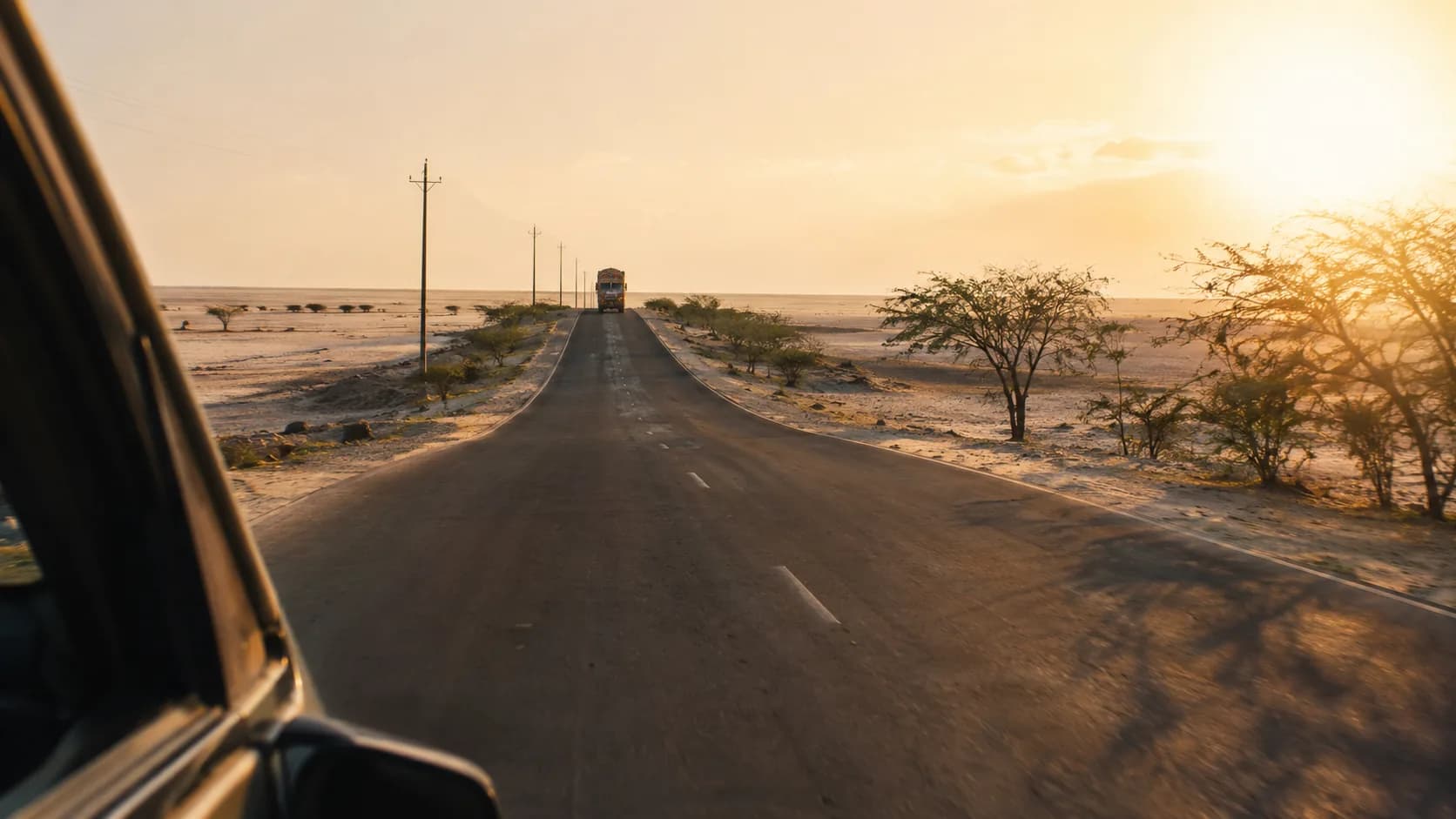
Most first-time visitors to Rann Utsav assume that once a tent is booked, the journey is sorted. It is not quite that simple, and this is the one piece of paperwork that catches otherwise well-prepared travellers off guard. The White Rann of Kutch sits inside a notified border security zone, a few kilometres from the India-Pakistan international boundary, and entry into that zone requires a separate government permit — one that has nothing to do with your tent city reservation and is issued by an entirely different authority.
This guide sets out exactly what the permit is, what it costs, how to apply for it, and how it interacts (or rather, does not interact) with a Rann Utsav package booking, so that nobody arrives at the checkpost only to be turned back.
What the permit is, and why it exists
The Great Rann of Kutch runs along a stretch of the international border, and the stretch that includes Dhordo, the White Rann viewing point, and the Kalo Dungar hill is administered as a protected border area under the Border Security Force and the Gujarat government's Border Tourism scheme. Because this land falls within a security-sensitive zone, movement in and out of it is regulated the way it would be near any international frontier — not to discourage tourism, but to keep a record of who is entering an area that borders a foreign country and to allow the BSF to manage traffic sensibly during peak season.
The permit itself is a short, standard government form — not a background check or a lengthy clearance process. For the vast majority of Indian travellers it takes a few minutes to fill in and is approved instantly online. The reason it exists at all, though, is precisely why it cannot be skipped: without it, security personnel at the Bhirandiyara checkpost — the last control point before the White Rann — will not let a vehicle through, tent booking or not.
It is legally separate from your Rann Utsav booking
This is the point worth underlining. A confirmed reservation with any Rann Utsav tent city operator, ours included, books your accommodation, meals, and access to the festival grounds. It does not book your entry permit. The tent city sits inside the same notified zone as the White Rann viewpoint, so guests staying overnight at Dhordo or Dholavira also need the permit to reach the property in the first place. Think of the permit as the gate pass for the zone itself, and your booking as what happens once you are inside it — two different systems, two different issuing authorities, and two different pieces of paper to carry.
Current permit fees
Fees are modest and are typically revised slightly each season, so treat the figures below as the ballpark for 2026-27 and reconfirm the exact amount at the time of application, since the state periodically updates the tariff.
- **Indian adults**: a nominal per-person fee, generally in the range of Rs 100–Rs 150 - **Indian children** (below a specified age, usually around 12 years): a reduced fee, roughly half the adult rate, with very young children often exempted entirely - **Foreign nationals**: a higher per-person fee, generally several times the domestic rate, reflecting the additional documentation checks involved - **Vehicles**: a separate, small vehicle entry charge, which varies by vehicle type (car, tempo traveller, coach)
These fees are paid at the point of application, whether online or in person, and the receipt or QR-coded permit itself must be carried and produced at the checkpost — a screenshot on a phone is usually accepted, but a printed copy is the safer option in an area where network coverage can be patchy.
How to apply: online versus in person
Applying online via rannpermit.gujarat.gov.in
The Gujarat government runs a dedicated portal, rannpermit.gujarat.gov.in, where the permit can be applied for in advance. The process, in outline, involves registering with a mobile number, entering the details of every traveller in the group, uploading identity proof, selecting the date of visit, and paying the fee online. Once approved, the system issues a digital permit that can be downloaded or shown on a phone.
The advantage is obvious: it removes the checkpost from your list of things to worry about on travel day, and during the peak weekends of the festival season — broadly late December through February — the queue at Bhirandiyara can run long enough that arriving with a permit already in hand saves a genuinely useful amount of time.
The portal is, however, a government system, and like most such systems it occasionally sees downtime or slow processing during the busiest weeks of the season. Apply a few days ahead rather than the night before, and keep the confirmation email or SMS as a backup in case the app itself will not load with poor signal en route.
Applying in person at the Bhirandiyara checkpost
For travellers who prefer not to deal with an online form, or who decide on the trip at short notice, the permit can also be obtained in person at the Bhirandiyara checkpost, roughly the halfway point on the drive from Bhuj towards Dhordo. A counter here issues permits on the spot against the same documents required online.
The trade-off is time. During the height of the season, particularly on weekends and around long weekends, the in-person queue can extend to thirty minutes or more, and vehicles are processed in batches. If your travel plans allow flexibility, applying online in advance is the more comfortable route; if not, budgeting extra time into the itinerary for this stop is essential.
Documents required
**For Indian nationals**: any one government-issued photo identity document per traveller — Aadhaar card, PAN card, voter ID, driving licence, or passport. Children below the age threshold for a fee are still generally expected to be listed by name and age, even without their own ID.
**For foreign nationals**: a valid passport and details of the Indian visa, since the permit process for non-Indian citizens involves an additional layer of verification given the border-zone location. Foreign nationals should expect the process to take a little longer, whether online or at the checkpost, and are advised to apply well ahead of the visit date rather than relying on the in-person route.
In both cases, carry the physical documents, not just photographs of them, since the checkpost may ask to see the original alongside the permit.
Permit timing and validity
The permit is typically valid for a single day and a specific entry window, since the White Rann and the border zone around it operate on set hours rather than being open around the clock. Entry is generally permitted from around midday through to a defined evening cut-off, with the exact hours published on the portal for the season and worth checking close to your travel date, since they can shift slightly depending on sunset timings across the festival's five-month run from November through March.
A permit issued for one date is not valid on another, so if travel plans change, a fresh permit — or at least an amendment — is needed rather than assuming the original will still be honoured.
Do Rann Utsav package guests still need to arrange this themselves
In short: usually yes, though it is worth confirming directly with whichever operator you book through, since practices vary. Some larger tent city operators offer to handle the permit application as part of a package add-on, particularly for group bookings, corporate retreats, or wedding parties where dozens of guests are arriving together and a single coordinated application saves everyone the trouble. Independent travellers and smaller groups, however, should generally plan to apply for their own permit, either online in advance or at Bhirandiyara on the day, treating it as a separate task from confirming their tent city stay.
The safest approach for any guest, regardless of how the booking was made, is to ask the operator directly at the time of confirmation whether the permit is included or arranged on the traveller's behalf. Never assume it is bundled in simply because the tent booking itself was smooth.
A common point of confusion: Kalo Dungar
One detail that trips up even repeat visitors is Kalo Dungar, the black hill north of Khavda that offers the best elevated view over the Rann and is a near-mandatory addition to most itineraries. Kalo Dungar sits further into the border zone than the White Rann viewpoint itself, and there is a second checkpost en route where the same permit is checked again — it does not require a separate document, but the original permit must be carried onward for this leg of the trip and not left behind at the tent city after the first checkpost stop. Travellers who leave their permit paperwork in their room, assuming the first check was the only one, are sometimes asked to turn back from the Kalo Dungar road, which is an entirely avoidable disappointment on what is usually the highlight excursion of the stay.
Step-by-step checklist so you are never turned away
1. Confirm your Rann Utsav tent city booking as normal — this does not include the permit. 2. Ask your operator directly whether the entry permit is arranged for you or needs to be self-booked. 3. If self-booking, apply online at rannpermit.gujarat.gov.in at least three to four days ahead of travel, especially for peak-season weekends. 4. Have photo ID ready for every Indian traveller in the group, or passport and visa details for foreign nationals. 5. Pay the applicable fee — adult, child, and vehicle charges are separate line items. 6. Download and save the digital permit, and print a copy as backup where possible. 7. If applying in person instead, budget thirty to forty-five minutes at the Bhirandiyara checkpost during peak weekends. 8. Carry the permit with you at all times during the visit, not just for the initial checkpost — it will be checked again en route to Kalo Dungar. 9. Note the entry and exit time window printed on the permit and plan the day's itinerary around it. 10. If travel dates change after the permit is issued, apply for a fresh one rather than assuming the original remains valid.
Handled this way, the permit becomes a five-minute formality rather than a source of stress — one more small piece of planning that, once out of the way, leaves nothing between you and the Rann's white horizon.
Our team can help you get the permit process right alongside your booking — call us on +91 92747 30220 and we will walk you through the current fees and the online application, so there are no surprises at the checkpost. Packages at the Tent City start from ₹6,300 per person for a one night, two day stay.