Two Worlds, One Journey
There is a particular satisfaction that comes from travelling in a way that creates genuine contrast — not merely moving from one hotel to another, but shifting between entirely different registers of experience. The Rann Utsav and Dholavira combination itinerary offers precisely this kind of journey: from the vibrant, music-filled, colour-saturated present of the Dhordo tent city to the silent, ancient, archaeology-layered past of one of the world's earliest urban settlements.
The two sites are connected not just by the road between them but by something more fundamental: both exist within the same extraordinary landscape of the Rann of Kutch — that vast seasonal salt flat whose ecology has shaped human life in this corner of South Asia for five millennia. Understanding Dholavira deepens the experience of the Rann; experiencing the Rann makes Dholavira's water management systems — designed precisely to survive this challenging environment — far more legible. Together, they make for one of the most intellectually and aesthetically satisfying short trips available anywhere in India.
Quick answer: the Rann Utsav and Dholavira combination works best over four nights — two nights at the Dhordo tent city for the White Rann and cultural programme, then two nights, or a well-paced day trip, covering the Dholavira UNESCO site roughly 90 kilometres away, with an easy half-day drive linking the two.
The Itinerary in Detail
Day One — Arrival at Dhordo, First Evening at the White Rann
Most guests travelling to Rann Utsav from outside Gujarat fly into Bhuj or arrive by train from Ahmedabad, then transfer to Dhordo by private vehicle — a journey of approximately 80 kilometres taking one and a half to two hours. We strongly recommend arranging an early afternoon arrival at the tent city so that you have time to settle in, take tea, and orient yourself before the evening programme begins.
The Dhordo tent city is a substantial operation — a temporary but well-appointed settlement of Swiss cottage tents, food courts, artisan stalls, folk performance stages and camel stations, all set within walking distance of the White Rann. The tents offer modern amenities: clean bedding, private bathrooms, running hot water and electricity. This is comfortable camping rather than roughing it.
The first evening is perhaps the most memorable of the entire trip. As the sun drops and the light across the salt flat turns from gold to deep amber, guests gather at the Rann edge for the evening walk. In the presence of a full moon — a Purnima night — the salt desert takes on a luminosity that is genuinely eerie and beautiful: the white surface catches the moonlight and seems to glow from within, the horizon dissolving into a whiteness that has no visible end. Folk musicians play Kutchi songs somewhere behind you; camels are silhouetted against the sky. This is why people come.
Dinner at the tent city is a generous affair — a spread of Kutchi and Gujarati cuisine, vegetarian by default but with some non-vegetarian options available, served buffet-style under canvas.
Day Two — Cultural Programme, Bazaar and the Craft Experience
The second day at Dhordo is best spent in the slower, more exploratory mode that the tent city rewards. The morning is ideal for the artisan bazaar, where craftspeople from across Kutch — Bhujodi weavers, Bandhani dyers, Ajrakh block printers, leather workers — sell directly from their stalls. Early morning is when the stalls are freshest and the craftspeople are most willing to demonstrate their techniques and discuss their work; by afternoon, the bazaar can become crowded and the heat, even in winter, encourages a more cursory approach.
The cultural programme in the evening — typically including Garba, Bhavai theatre, Langa folk music, Kalbelia dance from Rajasthan and puppet shows — runs for approximately three hours and is, for many guests, the emotional highlight of Rann Utsav. The performances are held on an outdoor stage with tiered seating; arriving a few minutes early secures the best view.
Packages starting at ₹12,600 for two nights and three days cover both evenings of cultural programming, meals and the White Rann visit. Those looking to extend the Dhordo stay can opt for the ₹18,900 three-night, four-day package, which allows a more leisurely morning for day trips before the Dholavira leg.
Day Three — The Drive to Dholavira
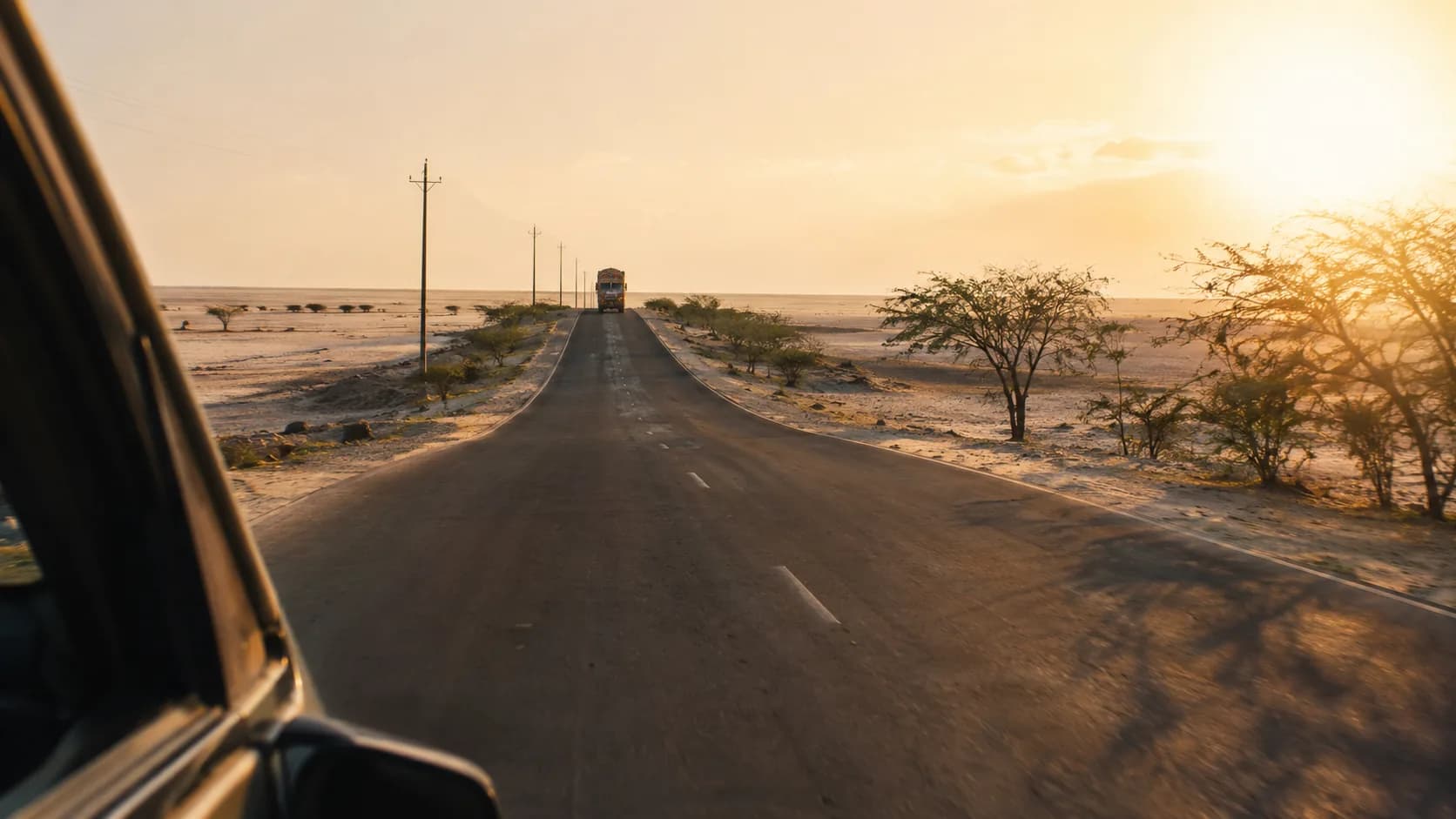
The distance from Dhordo to Dholavira is approximately 170 kilometres, routed through Khavda and then eastward — a drive of roughly three hours on roads that are largely paved, occasionally narrow, and consistently beautiful. The landscape shifts gradually from the scrubby terrain around Dhordo to the more open, mineral-pale expanses of the Little Rann approach, with views that change character every thirty minutes.
We recommend departing Dhordo after an early breakfast — seven-thirty or eight in the morning — which brings you into Dholavira in time for a full afternoon at the archaeological site. The advantage of arriving in the afternoon (after the main midday heat, from two pm onwards) is that the evening light is exceptional on the exposed stonework of the ruins.
The Dholavira tent city — our second property, designed specifically for guests exploring the UNESCO site — is located close to the excavation and provides an equivalent level of comfort to the Dhordo camp, with particular attention to the site-specific experience: guided walks are available, archaeology-focused evening talks are offered, and the cuisine reflects the local traditions of this part of Kutch.
Check-in at Dholavira tent city, a short rest, then the first walk through the ruins in the golden hour before dinner.
Day Four — A Full Morning at the Harappan City
Allow the entire morning of Day Four for a properly paced exploration of the Dholavira site with a knowledgeable guide. The archaeological complex covers a substantial area, and the temptation to rush from feature to feature should be resisted firmly. The most rewarding approach is to allow the guide to set a measured pace, beginning at the fortified citadel at the northern end and working southward through the middle town and lower town, with pauses at the water reservoirs — the most sophisticated ancient water management system yet found in South Asia — and the site of the famous signboard inscription.
The on-site museum, located near the entrance, should ideally be visited after rather than before the site itself — the objects it contains (seals, pottery, beads, tools) are far more legible once you have walked among the structures from which they came.
After lunch at the tent city, the afternoon is well spent in the area around Dholavira: the Little Rann, with its distinctive landscape quite different from the Great Rann near Dhordo, and the Indian Wild Ass Sanctuary — home to the last wild population of the Indian wild ass (khur), a species that exists nowhere else on earth. Wildlife drives in the Little Rann are best arranged through the tent city and are most productive in the early morning, so those with particular interest in the khur might consider spending an additional half-day for a pre-dawn drive.
Day Five — Return to Bhuj and Onward
The return journey from Dholavira to Bhuj takes approximately two and a half to three hours, giving you a morning at leisure before departure. If your flight or train is in the afternoon or evening, a stop in Bhuj for lunch and a brief visit to the Aina Mahal or Prag Mahal is an excellent way to conclude the trip.
Bhuj airport has connections to Mumbai, Delhi and Ahmedabad. If you are continuing onward to Ahmedabad by road or rail, the journey takes approximately seven to eight hours — consider an overnight train from Bhuj or a morning departure with a stop in Ahmedabad for the evening before your return flight.
Booking the Combo Trip
Both the Dhordo and Dholavira tent cities can be booked through our website or by calling +91 92747 30220. The most popular configuration — two nights at Dhordo followed by two nights at Dholavira — represents excellent value when booked as a combined package. Dhordo packages begin at ₹6,300 for one night and two days, with the ₹12,600 two-night option being ideal as the first leg of this itinerary.
Private vehicle hire for the Dhordo-to-Dholavira transfer (with stops en route if desired) can be arranged through our team. International guests should note that Dholavira is in a remote district and connectivity is limited — download offline maps and carry sufficient cash before leaving Bhuj.
Why This Combination Works
The Rann Utsav and Dholavira pairing works because it satisfies two quite different travel impulses simultaneously. Rann Utsav is sensory, celebratory and immediate — it puts you in the midst of living cultural traditions, music, colour and landscape. Dholavira is contemplative, historical and demanding of patience — it asks you to exercise your imagination in order to populate its silent stones with the urban life they once contained.
Together, they offer what the best travel always offers: the sense that you have understood something about a place that you could not have understood merely by reading about it.