Making One Night Count at Rann Utsav
Not everyone can take three or four days away. Work schedules, school terms, and the sheer logistics of a long weekend mean that for many travellers, one night at Rann Utsav is either the only option or the first step before a longer visit in a subsequent year. The question we hear most often when people call us at +91 92747 30220 is a simple one: is one night actually worth it? The honest answer is yes — but only if you plan it correctly and enter with a clear sense of what you will experience and what you will not.
The 1 night 2 days package starts from ₹6,300 per person and includes accommodation, all meals during the stay, and access to the cultural programme. It is the most accessible entry point to Rann Utsav, and for travellers arriving from Ahmedabad, it is entirely feasible as a weekend trip without requiring a flight. What follows is a realistic, hour-by-hour guide to making those two days as full and as rewarding as possible.
Day One: Arrival, the Rann at Sunset, and an Evening to Savour
Getting to the Tent City
The most important logistical decision on a one-night trip is how early you can arrive. Every hour you save on travel is an hour you have at the festival, and on a tight schedule those hours matter considerably. From Ahmedabad, the drive is approximately 340 kilometres and takes around five to six hours by road — a pre-dawn departure is feasible for those determined to arrive by noon. From Bhuj, the nearest airport, the journey is a manageable 85 kilometres or roughly ninety minutes.
If you are flying, early morning flights from Mumbai or Delhi that connect through Ahmedabad or arrive directly in Bhuj will put you at the tent city by early afternoon. The check-in window opens from noon, and on a one-night trip, arriving close to noon is the ideal. Arriving at three or four in the afternoon is not a disaster, but it does compress the afternoon considerably.
Early Afternoon: Settling In and a First Look at the Bazaar
Once checked in to your Swiss tent — comfortable, warm, with an attached bathroom and reliable electricity — give yourself thirty minutes to unpack the essentials and change into flat, closed-toe shoes. The salt crust of the Rann is uneven in places and heels of any kind are a poor choice. A light layer for the afternoon is sufficient, but keep your jacket accessible because the temperature shift at sunset is rapid and significant.
The handicraft bazaar within the tent city is the ideal place to spend your first hour and a half. The stalls are arranged along a winding lane and feature work from across the Kutch region: hand-embroidered blouses and wall hangings, bandhani textiles in deep indigo and crimson, silver jewellery with the characteristic raised-dot patterns of Kutchi silverwork, painted pottery, and leather goods. On a one-night trip, the bazaar visit that happens before the sunset transfer is particularly important because you may not have time after breakfast the following morning — so browse deliberately, identify what interests you, and do your buying either now or later in the evening.
The food court begins serving snacks and chai from around two in the afternoon. A plate of dabeli — the Kutchi street food of spiced potato filling in a soft roll, garnished with pomegranate seeds and chutneys — is a good introduction to the regional flavour profile. The kitchen teams at the tent city do it well.
Late Afternoon: The White Rann at Sunset
The shuttle or jeep transfers to the White Rann viewing point depart at around five to five-thirty, depending on the time of year. On a one-night trip this is not simply one highlight among many — it is the centrepiece of the whole experience, and arriving at the salt flat with time to walk well out onto the crust before the sun sets is essential. The walk from the drop-off point to a good position on the flat takes fifteen minutes at a comfortable pace; aim to be off the vehicle by five-fifteen to give yourself this buffer.
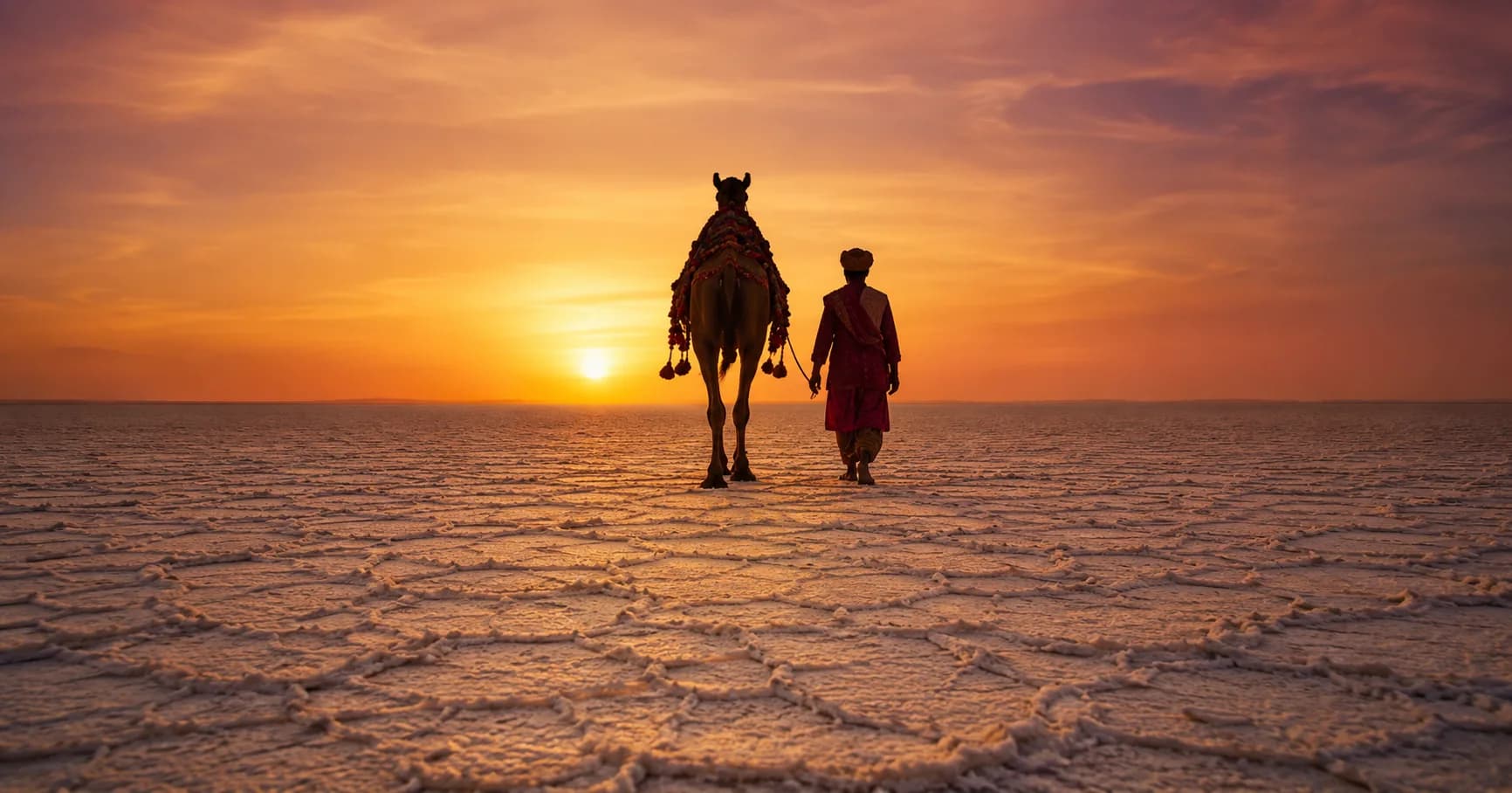
The Rann at sunset delivers something that photographs — however good — consistently fail to capture: the quality of the silence. The salt plain absorbs sound in a way that produces not quiet but absence, a total lack of ambient noise that is so complete it becomes a physical sensation. Into this silence the sky performs: gold deepening to amber, amber to coral, coral to a brief violent rose, and then the long blue fade as the sun drops behind the flat horizon. If you are visiting near the full moon, the moon rises on the opposite horizon in the final minutes of the sunset, and the two-way illumination of the plain is extraordinary.
Dress for cold. The temperature on the Rann drops sharply after sunset — by seven or eight degrees within the first hour — and the wind that was pleasant in the afternoon becomes genuinely biting. A warm jacket, a scarf, and if you are visiting in December or January, gloves and a thermal layer beneath. The ride back to camp takes twenty minutes and you will be grateful for every layer.
Evening: Cultural Programme, Dinner, and the Moonlit Rann
The cultural programme begins at around seven-thirty in the open-air amphitheatre and runs for approximately ninety minutes. On a one-night stay, this is not optional — it is one of the two or three experiences that define Rann Utsav and that you cannot replicate anywhere else. The performances draw on Kutchi folk traditions: the Garba and Dandiya circle dances, the Bhavai pot dance in which performers balance a tower of earthenware pots on their heads while moving with extraordinary precision, Sufi devotional singing, and puppet theatre. The atmosphere is warm and communal, the audience a mix of families, couples, and groups who quickly lose any self-consciousness and join in when the dancers invite participation.
Dinner at the main dining tent follows the programme, typically from around nine in the evening. The Gujarati thali spread is generous: dal, three or four vegetable sabzis, rotis, rice, pickle, papad, and a dessert that usually includes shrikhand or mohanthal. If you have dietary restrictions, inform the kitchen team at check-in and they will accommodate you with notice.
After dinner, if the moon is sufficiently bright, some guests return to the edge of the Rann for a brief night visit. This is not an organised transfer — it is a short walk or auto-rickshaw ride to the viewpoint — and whether it is feasible depends on the lunar phase and the camp's specific layout. Ask at the reception desk when you check in. A moonlit Rann at ten o'clock at night, with the salt catching the light and the sky full of stars, is an experience with very few equivalents in India. If there is any chance of it on your one-night visit, take it.
Day Two: Morning Activities and a Thoughtful Departure
Early Morning: Sunrise on the Rann (Highly Recommended)
The sunrise transfer is the activity on a one-night trip that most guests are initially tempted to skip — an alarm before five-thirty feels brutal after a late dinner. Do not skip it. The Rann at sunrise has a completely different quality from the Rann at sunset: the light is cooler, more diffuse, the colours moving from a deep pre-dawn grey through silver-white to a spreading warmth that comes from below the horizon as much as above it. The salt crystals catch the horizontal light and turn briefly iridescent, the landscape flattening and then gaining relief as the sun rises.
Allow fifteen minutes of acclimatisation — the cold at five-thirty in the morning is more serious than the cold at sunset, and if you are visiting in December or January, temperatures on the flat can be as low as four degrees Celsius with wind chill. Dress as warmly as you would for a cold British morning: thermal base, fleece, outer jacket, scarf, gloves. The sunrise itself typically lasts around twenty minutes of peak light quality, after which the warmth builds quickly.
Back at camp by seven-thirty, breakfast is served: poha, parathas, eggs to order, fresh fruit, and chai. Eat well — it is a long drive home.
Mid-Morning: The Camel Safari and Final Bazaar Browse
If checkout is at eleven, you have roughly two hours between breakfast and departure. The camel safari operates from around eight-thirty and a forty-five-minute circuit is achievable before ten. The camel ride across the salt flat in morning light is calmer and less crowded than in the afternoon, and the low angle of the sun makes for excellent photography. Book your slot at the activity counter the previous evening if possible.
Use any remaining time before checkout to return to the bazaar for any purchases you decided on yesterday. The stalls open by eight-thirty and the morning light is flattering for assessing colour in textiles. Pay by cash where possible — smaller stall-holders often cannot process cards reliably.
Checkout itself is smooth if you have settled any activity charges the evening before. Your transfer back to Bhuj departs from the main gate at the agreed time, and most afternoon flights from Bhuj give you a comfortable margin.
What You Will Miss on a One-Night Trip — And Whether It Matters
It is worth being honest about the trade-offs. On one night and two days, you will not have time for a day trip to Kala Dungar (the Black Hill, Kutch's highest point, with a view across the Rann to Pakistan), the India Bridge border viewpoint, or the old city of Bhuj with its remarkable Aina Mahal and Prag Mahal palaces. You will also not experience the cumulative, almost meditative quality that the tent city acquires over two or three nights — the way the rhythm of the place settles into you, the way the cold and the light begin to feel familiar.
If you are visiting for the first time and have any flexibility, we would encourage you to stretch to two nights. The difference in cost — packages move from ₹6,300 for one night to ₹12,600 for two — is meaningful, but the additional night more than doubles the experiential value. That said, one night done well is substantially better than no Rann Utsav at all, and for many guests who go on to return for longer stays, the one-night visit is what convinced them it was worth coming back.
Practical Notes for the 1 Night 2 Days Package
Confirm your transfer arrangements before you arrive — whether you are being picked up from Bhuj airport, the bus stand, or arranging your own vehicle. The tent city is 85 kilometres from Bhuj and there is no public transport on the final stretch. Package prices begin at ₹6,300 per person; call +91 92747 30220 to check availability and discuss transfer options. Carry cash for activities and bazaar shopping. Mobile signal is generally available in the camp but patchy on the Rann itself.