The Best Way to Experience Rann Utsav: 2 Nights, 3 Days
Two nights and three days is, without question, the most popular way to experience Rann Utsav — and with good reason. It gives you enough time to settle into the unhurried rhythm of the tent city, witness the White Rann at both sunset and sunrise, and still squeeze in the activities that make this festival genuinely memorable. It is the format that most guests choose when they book through us at Rann Utsav Tickets, and it is the one we recommend most often when callers ring us at +91 92747 30220 asking which package suits a first-time visitor.
Packages for this duration begin at ₹12,600 per person, covering accommodation in the tent city at Dhordo, all meals, and access to the cultural programme. What follows is a detailed, hour-by-hour account of how those three days actually unfold — written so you know exactly what to look forward to, what to wear at each stage, and how to pace yourself so you leave feeling thoroughly unhurried.
Day One: Arrival, First Impressions, and the Sunset That Changes Everything
Morning and Early Afternoon: Getting There
Most travellers flying in from Mumbai, Delhi, or Ahmedabad opt for the morning flight into Bhuj, the nearest commercial airport to Dhordo. The drive from Bhuj to the tent city takes roughly 85 kilometres and, depending on traffic near the town centre, around one and a half to two hours. If you have arranged a transfer through your package — which is advisable — your driver will be waiting at the arrivals hall with your name on a board.
The road out of Bhuj passes through flat, scrubby countryside dotted with small villages. Within about forty minutes the landscape begins to shift: the greens thin out, the sky seems to open wider, and you start to sense the vast emptiness that defines the Rann. Your first glimpse of white on the horizon — the salt crust catching the afternoon sun — is always a small revelation, even if you have seen photographs a hundred times.
Check-in at the tent city opens from noon onwards, though the majority of guests arrive between one and three in the afternoon. The Swiss tents are considerably more comfortable than the name might suggest: proper beds with warm duvets, attached bathrooms, electricity, and heaters for the colder months. Take twenty minutes to unpack, change into comfortable flat shoes (essential on the salt crust), and orient yourself to the layout of the camp.
Afternoon: Your First Walk Around the Tent City
Resist the temptation to rush straight out to the Rann. The tent city itself is worth an hour of exploration. The handicraft bazaar — a winding lane of stalls run by Kutchi artisans — is best browsed in the afternoon light before the evening crowds gather. You will find hand-embroidered textiles, bandhani dupattas, mirror-work cushion covers, silver jewellery, and the distinctive pottery of the region. Bargaining is expected and generally good-natured. If you plan to buy, this afternoon session is ideal because stall-holders are more relaxed and willing to talk about their craft.
The food court begins warming up around three in the afternoon. A cup of masala chai or a plate of bajra rotla with fresh white butter is the traditional way to settle in. The cuisine here leans heavily on Kutchi staples — dal dhokli, kadhi, khichdi, and the remarkable dabeli — and the kitchen teams at the tent city do them well.
Evening: Sunset at the White Rann — The Defining Moment
The jeep or shuttle transfers to the viewing point at the edge of the White Rann typically depart from the tent city between five and five-thirty in the afternoon, depending on the time of year and the precise sunset hour. It is worth being ready at least ten minutes early, because the walk from the drop-off point to the salt flat itself takes around fifteen minutes, and you will want to be in position well before the sun touches the horizon.
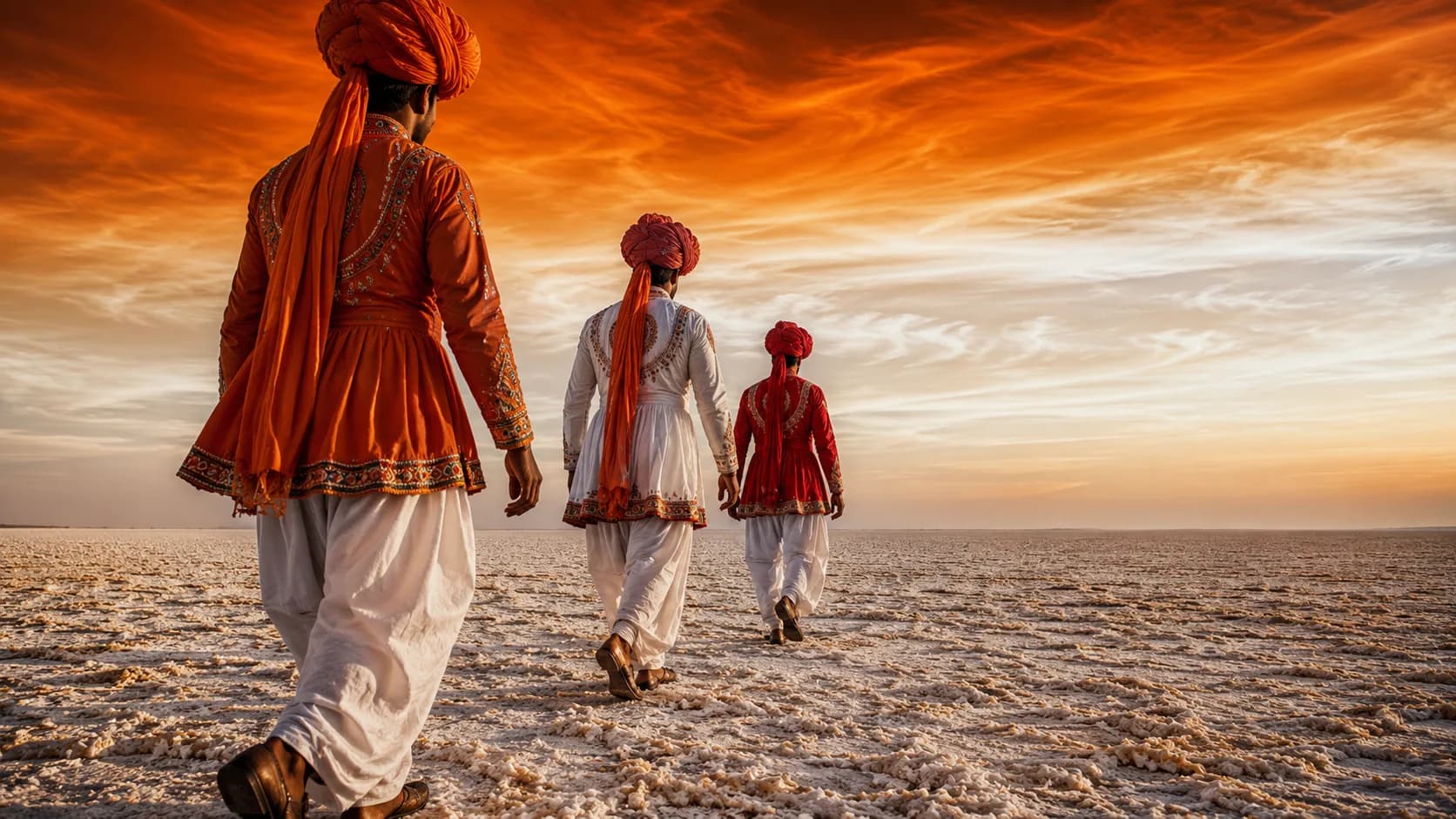
Nothing quite prepares you for what you see. The Rann of Kutch — a 7,505-square-kilometre expanse of salt desert — turns from blinding white to a deepening sequence of gold, coral, rose, and finally a bruised violet as the sun descends. If the moon is near full, it begins to rise on the opposite horizon just as the sun sets, and for a few extraordinary minutes you are standing between two luminous bodies on a flat, silent plain. Carry your camera, but also allow yourself a few minutes without it.
After sunset, temperatures drop noticeably — often by five to eight degrees within the first hour. Have a light jacket or shawl in your bag before you board the transfer. The ride back to camp takes around twenty minutes.
Evening: Cultural Programme and Dinner
The cultural programme at Rann Utsav is one of the festival's genuine highlights, and the two-night package gives you two evenings to enjoy it. On your first night, take it in fully: the performances typically begin around seven-thirty and run for roughly ninety minutes, featuring Kutchi folk dances such as the Garba, Dandiya, and the particularly spectacular Bhavai (pot dance), alongside Sufi music sessions and puppet shows. The open-air amphitheatre is lit with lanterns and the atmosphere is festive without being chaotic.
Dinner is served buffet-style at the main dining tent, with a spread that combines Gujarati thali elements — sweet dal, three or four vegetable preparations, rotis, rice — with a few North Indian and continental options for those less accustomed to regional food. Dessert invariably includes mohanthal, a dense Gujarati fudge made with besan, ghee, and cardamom that is worth trying even if you do not have a sweet tooth.
Lights-out time is your own, but most guests find that the cold and the day's travel conspire to make an early night feel natural. The tents are quiet; the only sound is wind crossing the salt.
Day Two: Sunrise, Safari, Bazaar, and the Full Afternoon
Early Morning: Sunrise Walk on the White Rann
Set your alarm for five-fifteen. It sounds brutal, but the Rann at dawn is a completely different experience from the Rann at dusk — quieter, cooler, with a pale silver light that turns the salt crystals iridescent. Transfers to the sunrise point leave around five-forty-five, and the walk out onto the flat takes the same fifteen minutes as the evening before.
At sunrise, especially in the winter months between November and February, temperatures on the salt flat can fall below ten degrees Celsius and the wind carries a sharp edge. Layer properly: a thermal base, a fleece mid-layer, and a wind-resistant outer shell. Gloves are not unnecessary. The reward is a sky that shifts from deep indigo through pearl grey to a spreading amber, and the entire Rann illuminated in horizontal light that reveals every texture of the salt crust — a surface that looks smooth from a distance but is, up close, a mosaic of tiny crystalline hexagons.
Return to camp by seven-thirty for breakfast. The morning spread typically includes poha, upma, fresh fruit, parathas, and eggs cooked to order.
Mid-Morning: Camel Safari
The camel safari is the activity that guests most consistently name as a highlight, even those who were initially sceptical. The ride takes you across a section of the Rann at a lumbering, swaying pace that is, after the first few minutes of adjustment, genuinely meditative. The camels here are well-maintained and the handlers are experienced; most safaris last between forty-five minutes and an hour and a half, depending on the circuit chosen.
Bring sunscreen and a hat — the morning sun on the salt flat reflects upward as well as downward, and the UV exposure is higher than it feels. A light scarf across the face is practical if you find the dust irritating.
Late Morning: ATV Rides and Other Activities
The tent city activity zone offers ATV (all-terrain vehicle) rides on a marked circuit that sweeps out across a section of the flat. These are available from around nine in the morning and can be booked at the activity counter near the main entrance of the camp. The rides are supervised, the vehicles are easy to handle, and the fifteen-minute circuit is genuinely exhilarating on the open terrain. There is also horse riding available on most dates, as well as a zip-line installation near the activity zone.
If you would rather avoid the more adrenaline-focused options, the Folk Museum within the tent city offers a thoughtful introduction to Kutchi culture — textiles, tools, photographs from the region's history, and explanations of the various craft traditions you will encounter at the bazaar.
Afternoon: Bazaar, Photography, and Free Time
The bazaar is best visited again in the early afternoon, when the light is strong and the colours of the textiles photograph beautifully. This is also when the artisans are most likely to be at work — you may catch a woman doing fine embroidery with a needle no thicker than a pin, or a craftsman hammering silver into a traditional bangle form.
If you are travelling with a camera, the afternoon light between two and four o'clock has a warm, directional quality that suits portraits and still-life shots. Ask permission before photographing individual people — it is considered courteous and most artisans are happy to oblige once asked.
Second Evening: Moonlit Rann and Dinner
On your second evening, the transfer to the Rann returns. If your visit falls close to a full moon — and many guests deliberately plan their trip around the lunar calendar — this evening outing is the one that people talk about for years afterwards. The White Rann under a full moon becomes a mirror, the light so even and sourceless that shadows disappear and depth perception subtly distorts. You are standing inside what appears to be a lake of white light. It is worth planning your visit for the full moon dates if you have any flexibility; call us at +91 92747 30220 and we can advise on which dates to target.
The second evening cultural programme often features a slightly different set of performers, or a special themed performance if it falls on a significant date in the festival calendar. Dinner follows the same format as the previous evening, with some variation in the menu.
Day Three: Peaceful Morning and Departure
Morning: Final Sunrise (Optional) and Check-Out
Checkout is typically by ten or eleven in the morning, but most guests are awake well before then. The third morning offers a choice: a final sunrise outing if you have the energy, or a leisurely breakfast with time to pack and browse the bazaar one last time for anything you missed.
If your flight or onward train departs from Bhuj in the afternoon, your transfer back to the city leaves mid-morning. The drive back feels different from the arrival: the Rann looks familiar now, the landscape legible in a way it was not three days ago. Most guests find they want to return before they have even arrived home.
What to Photograph on a 2 Night 3 Day Trip
The two-night itinerary gives you two golden hours at sunset and at least one sunrise, which is the minimum you need to do the Rann justice photographically. Key subjects: the salt crust in close-up with a wide-angle lens; the horizon at the precise moment of sunset when the sky layers into bands of colour; the camel handlers in silhouette against the flat; the embroidery stall in the bazaar with its extraordinary density of colour; and the tent city itself at night, lanterns lit against a sky unpolluted by city light.
A tripod is useful for night photography and for capturing the cultural performances without camera shake. A wide-angle lens (24mm or equivalent) handles the scale of the landscape; a short telephoto (85–135mm) works well for portraits in the bazaar.
Practical Notes for the 2 Night 3 Day Package
Packages start from ₹12,600 per person and include all meals, accommodation, and cultural programme access. Activities such as ATV rides and horse riding are typically charged separately at the activity counter. The tent city has reliable mobile connectivity on most networks, though signal can be patchy on the Rann itself. Carry a portable power bank. The nearest ATM is in Bhuj, so arrive with sufficient cash for activities and shopping.
The published 2026–27 Dhordo Tent City stay season runs from 1 November 2026 to 7 March 2027. December and January are the coldest months; check the forecast for your dates and plan warm layers accordingly.