Why Three Nights is the Right Length for Rann of Kutch
There is a version of travel that is about ticking boxes, and there is a version that is about immersion. The 3 nights 4 days itinerary at Rann Utsav is emphatically the second kind. Three nights gives you enough time not just to experience the White Rann in multiple lights and moods, but to venture beyond the tent city into the wider landscape of Kutch — one of India's most culturally and geographically remarkable regions — and return to the tent city feeling that you have understood something of where you are and why it matters.
Packages for this duration start at ₹18,900 per person, which includes accommodation in the Dhordo tent city, all meals, and access to the cultural programme. It is the most comprehensive package we offer, and when guests call us at +91 92747 30220 asking which option to choose, those who have any flexibility whatsoever are almost always directed here. What follows is a day-by-day, hour-by-hour account of how four days at and around Rann Utsav actually unfolds.
Day One: Arrival, Exploration, and a Sunset That Sets the Tone
Getting There and Settling In
Most guests on a three-night package arrive by afternoon on Day 1, having taken a morning flight into Bhuj. The 85-kilometre transfer from Bhuj to Dhordo takes around ninety minutes through countryside that grows progressively more spare and dramatic the closer you get to the Rann. By the time the tent city comes into view — a structured settlement of white canvas against an enormous sky — the transition from city to desert feels complete.
Check-in opens from noon. Your Swiss tent will have proper beds with warm duvets, an attached bathroom, electricity, and in the winter months, heating. Unpack properly; you are here for four days and a settled base camp makes a difference. Get your bearings: note the location of the dining tent, the amphitheatre, the activity counter, the bazaar lane, and the main gate where transfers depart.
Afternoon: The Handicraft Bazaar Without Hurry
One of the distinct advantages of a three-night stay is that you can approach the bazaar without any sense of urgency. On Day 1, simply browse. Do not buy anything yet — spend the first afternoon identifying what interests you, talking to the artisans, and understanding the distinction between different craft traditions. Kutch is home to an extraordinary density of craft communities, each with its own distinct visual vocabulary: the Rabari community's bold, heavily mirror-worked embroidery; the Ahir community's more geometric needlework; the Mutwa community's fine silk thread work on velvet; the bandhani tyers of Bhuj and Mandvi with their precisely knotted resist-dye textiles; the Lakhara community's lac-coated glass bangles. A knowledgeable stall-holder will explain these differences if you ask — and on a three-night trip, you have the time to ask.
Evening: Sunset on the White Rann and Cultural Programme
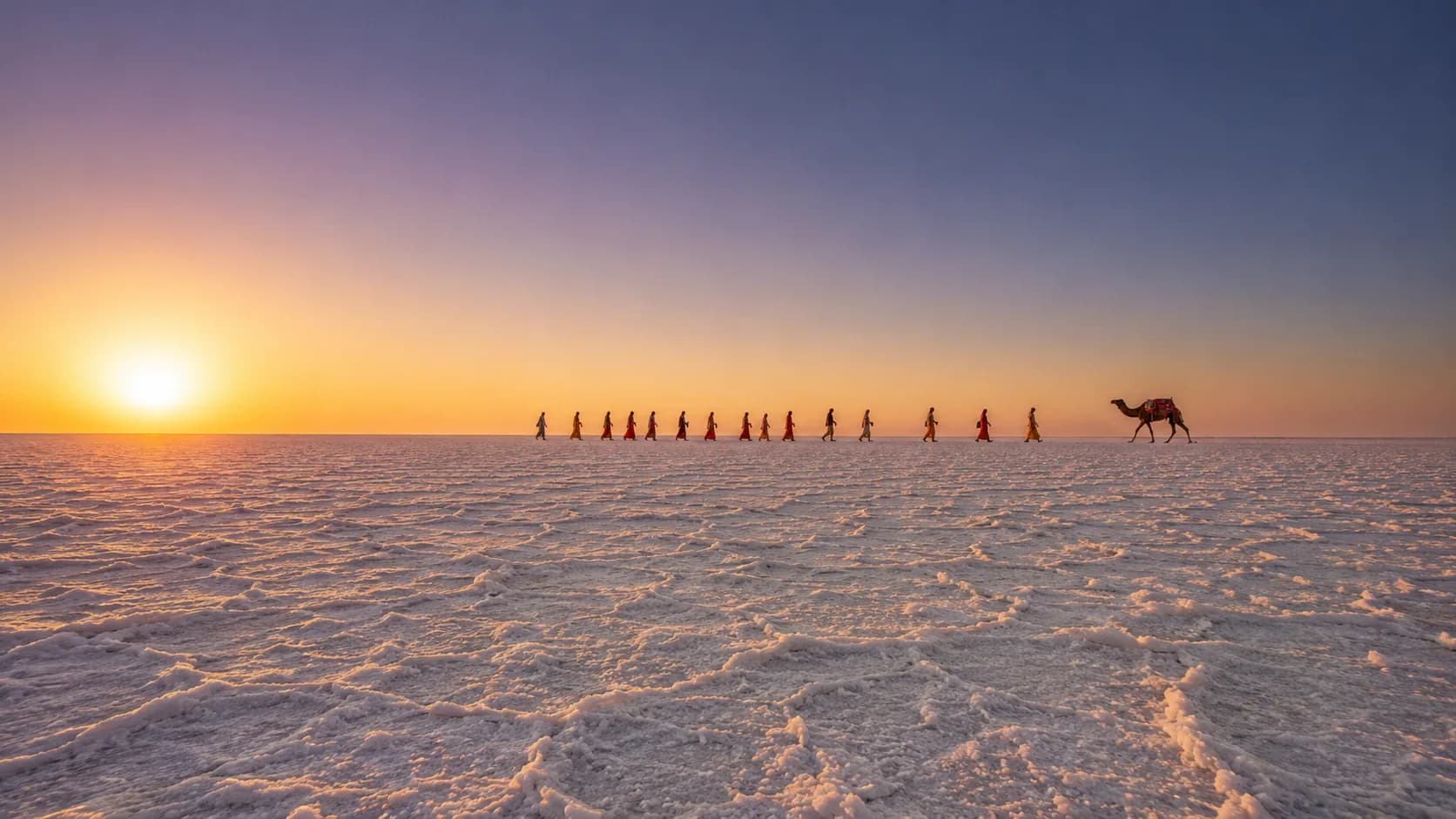
The afternoon shuttle to the White Rann viewing point departs at around five, and Day 1's sunset is your orientation sunset — the first of three you will witness over the coming days. Do not attempt to do everything at once. Walk out onto the salt flat, find a position away from the main crowd, and simply watch. Note the quality of the light, the direction of the wind, the temperature shift that begins about forty minutes before the sun actually sets.
The cultural programme follows dinner — two hours of Kutchi folk performance in the open-air amphitheatre. On your first night, watch it in its entirety. The performers are exceptional and the context — a tent city on the edge of a salt desert, under stars that are startlingly bright this far from any city — makes the music and dance resonate in a way it simply does not in an auditorium.
Day Two: Deep into the Rann and the Activities You Came For
Early Morning: Sunrise on the Salt Flat
The alarm goes off at five-fifteen. By five-forty-five you are on a transfer heading for the viewing point in the dark, the temperature outside the vehicle somewhere between three and ten degrees Celsius depending on the month. The sunrise walk on Day 2 is your first full engagement with the Rann in its morning state: the light building from below the eastern horizon, the salt crystals catching the first rays, the extraordinary quality of silence that the flat plain produces.
Carry a good camera if you have one, and a tripod if you are serious about the photography. The horizontal light of the first fifteen minutes after sunrise is the most photogenic period — everything is revealed in fine relief, the texture of the salt crust visible in a way that the harsher midday light conceals. Back to camp by seven-thirty for breakfast.
Mid-Morning: Camel Safari and ATV Rides
The camel safari circuit departs from the activity zone from eight-thirty. On a three-night stay, the camel ride on Day 2 is your primary safari; book a longer circuit if available — ninety minutes rather than forty-five — to get further into the Rann and away from the busier sections near the camp. The handlers are experienced and informative; many speak enough English to explain the landscape and point out birds, including the greater flamingos that gather in the shallow seasonal water along the Rann's edges.
After the safari, the ATV ride — a fifteen-minute circuit on marked tracks across the salt flat — offers a completely different sensory experience: fast, slightly reckless, and very loud. Follow it with a quiet cup of chai at the activity zone and the contrast will make you laugh.
Afternoon: Rest, Photography, and the Folk Museum
The early afternoon on the Rann is genuinely hot in October and November, and bright enough in December and January that extended outdoor time requires a hat and sunscreen. This is the period for the Folk Museum — a curated collection of Kutchi artefacts, textiles, photographs, and explanatory materials that gives context to everything you have been seeing in the bazaar — and for the kind of long, aimless photography walk around the tent city that only works when you are not on a schedule. The kitchen serves a light lunch, and the seating area around the food court is a good place to sit with a chai and write notes or simply watch the camp go about its afternoon rhythm.
Second Evening: The Rann in Different Light
Return to the White Rann for your second sunset. The same landscape in different light is a genuinely different landscape — you will notice things you missed yesterday, choose a different position, stay longer or shorter depending on the weather. If the moon is moving towards full, its rise on the eastern horizon will now be noticeably earlier than the previous evening, and the interplay of solar and lunar light as the sun sets is the kind of visual experience that is very difficult to describe to someone who has not seen it.
Day Three: Kutch Beyond the Tent City — Kala Dungar and the India Bridge
A Day Trip into the Wider Landscape
Day 3 is the day that distinguishes the three-night itinerary from all shorter options. A hired vehicle — arranged through the tent city's activity desk or your package operator — takes you on a full-day exploration of the broader Kutch landscape. The two primary destinations are Kala Dungar and the India Bridge viewpoint; depending on your pace, the village of Dhordo itself (the community adjacent to the tent city) and the Hodka village with its craft cooperative can be added.
Kala Dungar, the Black Hill, is Kutch's highest point at 462 metres above sea level. The drive from the tent city takes around forty minutes on a road that climbs through increasingly rocky terrain, the salt plain spreading below you as you gain altitude. At the summit, a small Dattatreya temple is tended by priests who feed wild foxes at a specific hour each day — an oddly moving tradition in an already dramatic setting. The view from the top encompasses the entire northern Rann, stretching to the horizon in every direction; on a clear day, which is most winter days, you can see deep into what the maps label as Pakistan. It is one of the most expansive views available from Indian soil.
The India Bridge viewpoint — approximately thirty kilometres from Kala Dungar — sits at the edge of the Rann near a crossing point that marks the border region. The landscape here is utterly flat and utterly white, the silence even more complete than at the festival viewpoint, and the sense of being at the edge of something — geographical, political, conceptual — is powerful. Photography is permitted at the viewpoint but do observe the restrictions posted on site and the guidance of any security personnel present.
Afternoon: Bhuj — Aina Mahal and the Old City
If your schedule and energy allow, the return route from Kala Dungar to the tent city passes through or near Bhuj, and an afternoon in the old city is a natural complement to the Rann experience. The Aina Mahal — the eighteenth-century palace of Rao Lakhpatji, its interior covered in European glass, mirrors, and Venetian chandeliers ordered by a ruler fascinated by Dutch craftsmanship — is a deeply peculiar and beautiful place, entirely unlike anything the rest of India has prepared you for. The Prag Mahal, its Victorian-Gothic neighbour built in the 1860s with Italian marble and Belgian tiles, is equally disorientating in its mix of influences.
The old city bazaars around the Swaminarayan Temple and the Darbargadh complex offer a different dimension of Kutchi craft: here the shops are permanent and the selection wider, particularly for silver jewellery, antique textiles, and the fine block-printed cottons for which Kutch has been known for centuries.
Return to the tent city for dinner and the third evening cultural programme. By now the performance is familiar enough that you notice details — the footwork of a particular dancer, the call-and-response structure of the folk singing — that were invisible on the first night.
Day Four: Final Morning and Departure
Last Sunrise and a Slow Goodbye
The final sunrise on Day 4 is the one that most guests find most affecting — partly because it is now familiar enough to appreciate fully, and partly because it is the last. Set the alarm. Walk out onto the salt flat in the pre-dawn dark. Watch the light change. On a three-night trip you have earned a kind of relationship with this landscape that a shorter stay does not permit, and the final morning on the Rann is when that relationship becomes legible.
Breakfast and checkout follow. Most guests departing on Day 4 aim to check out by ten-thirty or eleven to allow for the ninety-minute drive to Bhuj and afternoon flights. If you have an evening flight, you have the option of spending the final morning not at the Rann but at a craft cooperative or weaver's workshop in one of the nearby villages — ask the tent city's activity desk about which communities welcome visitors; several do, and a morning spent watching a Rabari woman embroider or a Khatri family dye resist-printed cloth is a quietly extraordinary thing.
What Makes Three Nights Different from Two
The qualitative difference between two nights and three nights is not simply additive. By the third night, the tent city feels familiar in a way that is genuinely relaxing — you know the staff, you have a regular table at dinner, you know which stall in the bazaar has the finest Ajrakh block prints. The Rann itself shifts in your perception from a spectacle to something closer to a landscape you inhabit briefly. The day trip to Kala Dungar and Bhuj gives the experience depth and geographical context that transforms it from a festival visit into something more like a genuine journey.
For those who want the fullest possible experience of what Kutch offers during the Rann Utsav season — the salt desert, the cultural traditions, the craft heritage, and the wider landscape — three nights is the right length. Packages start at ₹18,900 per person; call +91 92747 30220 to check availability and to discuss which dates best suit the activities you most want to prioritise.
Practical Notes for the 3 Nights 4 Days Package
The ₹18,900 package includes accommodation, all meals, and cultural programme access. The day trip to Kala Dungar and Bhuj requires a hired vehicle; this can be arranged through the activity desk at an additional cost, typically in the range of ₹2,500–₹4,000 for a full-day vehicle with driver depending on group size. Entrance to the Aina Mahal in Bhuj is charged separately. Carry cash for day-trip expenses and bazaar shopping. The tent city has mobile connectivity on most networks; signal is intermittent on the Rann and absent near the India Bridge viewpoint.
The published 2026–27 Dhordo Tent City stay season runs from 1 November 2026 to 7 March 2027. Full-moon windows and the Christmas–New Year period can be popular; check current availability for your selected dates. December and January are typically the coldest months.