Why the White Rann Is One of India's Great Photography Destinations
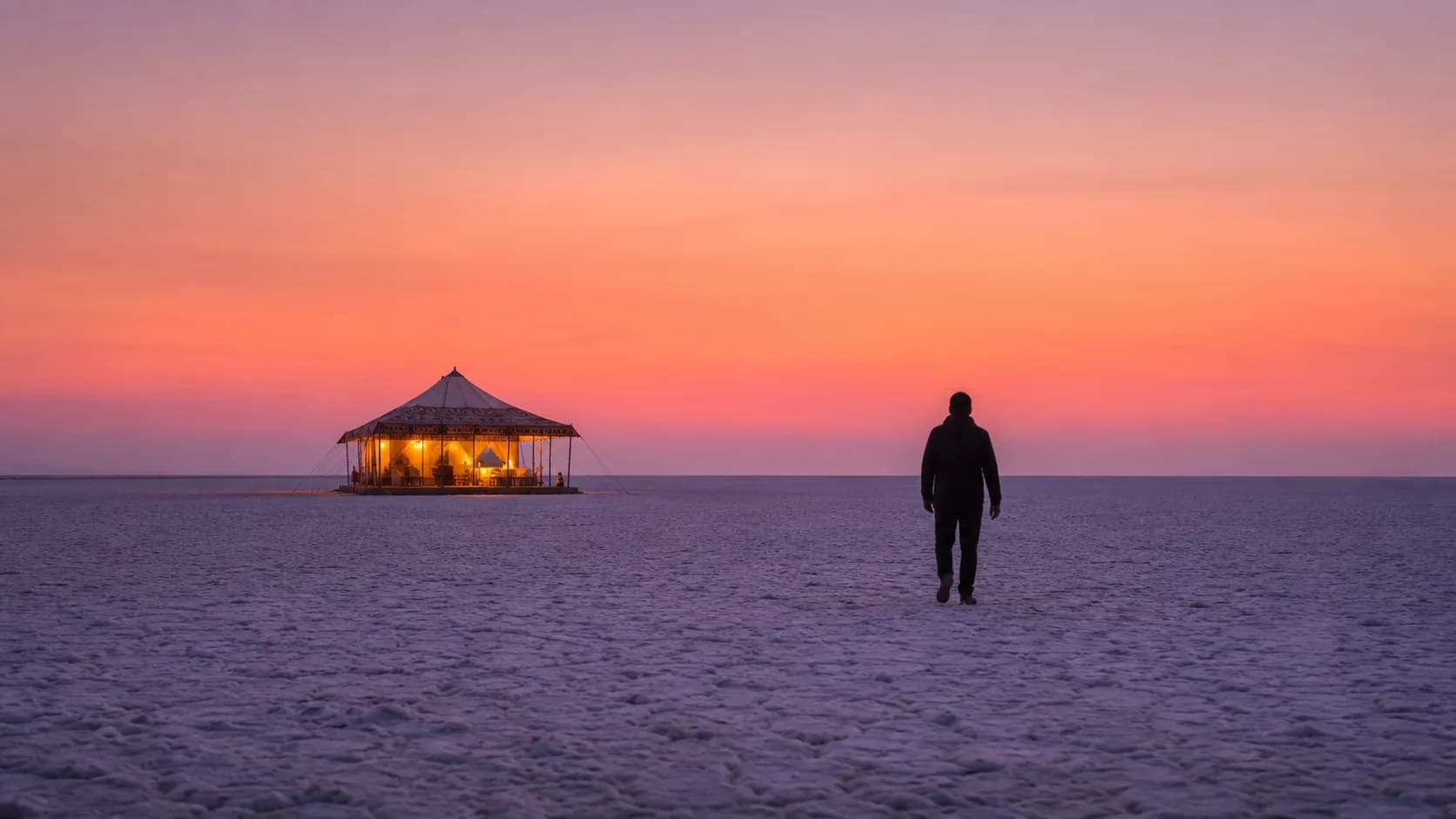
The White Rann of Kutch offers photographers — professional, serious amateur, and enthusiastic phone shooter alike — a combination of conditions that is genuinely rare in India and, in some respects, rare in the world. The ingredients are specific and powerful: a flat, highly reflective surface that transforms in colour and quality across the day from blinding white to deep amber to silver moonscape; a horizon unobstructed in every direction that allows the full drama of sky and light to play out without competing architecture or terrain; and a winter festival that brings camels, musicians, artisans, and folk performers into frame as human and cultural elements in an otherwise elemental landscape.
This is not a destination where you have to work to find photographs. The difficulty at the White Rann is not finding the shot — it is choosing between an abundance of them, understanding which ones matter most, and positioning yourself correctly in the limited windows when the light reaches its highest quality.
Understanding the Light: The Golden Hours and Beyond
The photography of the White Rann is fundamentally about light management. The salt flat in direct midday sun is overwhelmingly bright, harsh on shadows, and difficult to expose correctly for both the white surface and the sky. This is not the time to make your best images. The times that matter — the times that the images in your memory are made of — are the golden hour after sunrise, the golden hour before sunset, the blue hour at dusk, and the full moon night.
Golden Hour at Sunrise
Sunrise on the White Rann begins — as described elsewhere in this guide — not with the sun itself but with the pre-dawn colour. For photographers, the action starts roughly 20 to 25 minutes before the sun breaks the horizon. At this point, the eastern sky shifts from black to deep blue to indigo, and the first hint of warmth appears at the horizon. The salt, which appears black in the darkness before this point, begins to absorb the colour from the sky — an early indication of the extraordinary sky-ground conversation that is the White Rann's photographic signature.
As the pre-dawn colour deepens, the window for the best images is narrow — approximately 30 to 40 minutes from the first colour to the moment the sun rises fully and the harsh directional light begins. In this window, the light is horizontal, warm, and diffused. Long shadows extend across the salt from every slight irregularity in the surface, from people, from camels, from festival structures. The salt itself turns gold, then amber, then a deep warm orange that is nothing like the white it will return to by mid-morning.
Camera settings for this window: expose to protect the highlights in the sky rather than the foreground, then recover the shadows in post-processing. The salt is a forgiving subject for shadow recovery — it holds detail at very low exposure values. A graduated neutral-density filter, if you use one, helps balance the sky and the salt in a single exposure. Alternatively, shoot two exposures — one for the sky, one for the foreground — and blend them in processing.
For phone photographers, HDR mode handles the high-contrast sunrise conditions better than standard mode. Alternatively, tap to set exposure on the brightest part of the sky and accept some underexposure in the foreground for a more dramatic, silhouette-leaning result.
Golden Hour at Sunset
Sunset is the other major photography window, and in many ways the more accessible one — it requires no pre-dawn alarm, and the light builds gradually over the late afternoon rather than arriving suddenly at sunrise. The late afternoon light from approximately three to five o'clock, depending on the month, transforms the salt flat through a similar colour progression as sunrise but in reverse: white to warm white to gold to deep amber, with the sun sinking toward the horizon and shadows extending progressively eastward.
The sunset at Dhordo has the advantage of additional compositional elements. Camels return from their afternoon excursions at this hour. The tent city's flags and structures catch the warm light. The salt flat is populated with visitors, creating scale and human interest that the early morning emptiness does not always provide. Camel silhouettes against a sunset sky at the White Rann are one of India's iconic photographs, and for very good reason — the combination of the organic camel form, the extraordinary colour of the sky reflected in the salt, and the horizontal geometry of the flat horizon is nearly impossible to photograph poorly.
The best position for sunset at Dhordo is to the east or south-east of the viewpoint, shooting back toward the tent city with the sun behind and to your right. This positions the sun's light raking across the foreground salt from the left while the tent city's structures silhouette against the warm sky behind. The images that result from this angle — which is not the most obvious one and therefore the least used — are frequently more interesting than the standard west-facing sunset composition that most visitors default to.
Blue Hour: The Underrated Window
The blue hour — the 20 to 30 minutes after sunset when the sky transitions from warm to a deep, even blue before full darkness — is a photography window that most Rann Utsav visitors miss entirely because they are en route to the cultural programme. This is a significant oversight.
In the blue hour, the White Rann's reflective surface acts as a natural mirror for the sky. The flat salt picks up the deep blue of the twilight in a way that creates an almost surreal sense of standing inside the sky rather than below it. The tent city lights begin to come on, adding warm artificial light as a counterpoint to the cool sky blue. The early stars appear at the top of the frame while the horizon still holds colour.
For long-exposure work, the blue hour is ideal: the light levels allow exposures of two to ten seconds without star trails, the sky and salt provide natural colour balance without the extremes of the golden hour, and the scene has a painterly quality that no other time of day produces. ISO 400 to 800, aperture at f/5.6 to f/8, and exposures of two to eight seconds will capture the blue hour salt reflection in a way that the RAW file handles cleanly.
The Full Moon Night: Photography's Hardest and Greatest Challenge
The full moon night at the White Rann is the most photographed subject of the festival and, paradoxically, the one that most photographs fail to capture accurately. The difficulty is exposure: the reflected moonlight on the salt flat, while visually extraordinary to the eye, is objectively very dim by photographic standards. A camera exposing for the moonlit salt at ISO 1600 requires exposures of 15 to 30 seconds, during which any movement — people, camels, wind-blown dust — will blur. Getting a sharp, well-exposed image of the moonlit White Rann requires technique and patience.
The approach that works: a stable tripod is non-negotiable for full moon night photography. Set the camera to manual mode, open the aperture as wide as your lens allows (f/2.8 is excellent; f/1.8 even better), set ISO between 800 and 3200 depending on your camera's noise performance, and begin with a 20-second exposure. Review and adjust. The goal is to expose the salt surface with enough detail to read as glowing rather than grey, while holding the moon itself without complete overexposure — which means the moon will likely blow out to a white circle in the same frame as the salt, and that is acceptable.
The reflection of the moon in the salt surface, when the surface has any residual moisture or thin water layer, creates a vertical streak of light that is one of the most dramatic images the White Rann produces. After rain, or at the very edge of the water table where the brine sits close to the surface, these reflections occur naturally and the camera captures them better than the eye.
For phone photographers: open the camera app's pro or manual mode, set ISO to 1600, exposure time to 10 to 15 seconds (use a timer or voice control to avoid camera shake), and place the phone on a flat surface or small travel tripod. Night mode on current-generation smartphones handles full moon conditions reasonably well but tends to smooth out the texture of the salt, which is one of its most interesting photographic qualities.
The Best Specific Spots for Photography at Rann Utsav
India Bridge
The small bridge over the creek at the India–Pakistan border area near Dhordo — commonly referred to as the India Bridge — offers a distinctive geometry for compositions that is different from the open salt flat. The linear structure of the bridge, the creek below, and the vast salt desert beyond create layers of depth in a landscape that can sometimes feel too flat for compositionally interesting images. The late afternoon is the best time here, when the low sun catches the structure from the side and the water in the creek (if present) reflects the sky.
The Salt Desert Viewpoint
The official viewpoint at the White Rann — the raised platform approximately two kilometres from Dhordo — is the most visited photography location at the festival, and visiting at peak times means competing for space on the platform. The solution is to arrive 45 minutes before sunrise or 30 minutes before sunset, positioning yourself before the crowd arrives, and staying after most visitors have departed. The viewpoint's elevated position adds foreground interest to an otherwise completely flat landscape.
The Tent City at Night
The tent city itself, photographed at night, offers a completely different kind of image from the salt flat. The colourful festival lights — the illuminated pathways, the lanterns in the bazaar, the warm glow from the performance stage — against the dark desert sky create a festive, intimate kind of photograph that serves as a counterpoint to the vast landscape images. The bazaar in the evening is particularly rich: artisans working by lamplight, textile stalls glowing with colour, the smoke from food stalls adding atmospheric haze.
Camel Silhouettes at Golden Hour
The most reproducible and reliably successful photograph of Rann Utsav — camel silhouettes against a golden or orange sky — requires positioning yourself between the setting sun and the camels returning from their afternoon excursions. Walk south of the tent city in the late afternoon and turn to face the tent city with the sun at your back-left. The camels and their handlers cross between you and the sun, creating natural silhouettes. Use your longest focal length (or zoom in on a phone) to compress the perspective and increase the visual impact of the camel forms against the sky.
The Cultural Programme
The cultural stage at Dhordo in the evenings presents photography challenges — relatively low light, performers in motion, a mixed background — that require different technique from the landscape work. A fast lens (f/1.8 or f/2.8) or a phone with a strong night mode is more useful here than the tripod needed for the salt flat. Expose for the performer's face, accept that the background may blow out or the periphery may be noisy, and prioritise the expression and movement that make folk performance photography compelling.
Gear Recommendations
For camera photographers, the White Rann rewards a wide-angle lens (16 to 35mm on full-frame, or equivalent on crop sensors) for landscape work and a longer focal length (85 to 200mm) for camel silhouettes and cultural programme compression. A tripod is essential for full moon nights, blue hour, and any pre-dawn work. A remote shutter release or the camera's self-timer eliminates shake from the camera press. Neutral-density filters (three-stop and six-stop) are useful for long exposures during the golden hour.
For phone photographers, the most important accessories are a small collapsible tripod (readily available for ₹500 to ₹1,500), a wide-angle clip-on lens for the full-scale salt flat, and a power bank — the cold depletes phone batteries faster than expected, and a full day of photography on the White Rann can drain a modern smartphone to zero by evening.
Protect your equipment from salt. The salt flat's dust and occasional salt particles can enter camera bodies and coat lenses in a fine residue. Keep lenses capped when not shooting, use a camera bag rather than an open case, and clean your equipment thoroughly after each salt-flat session. The grit that the wind carries on the open flat is the primary risk to sensitive optics.
Rann Utsav photography is available to anyone with an overnight package — the landscapes, the golden hours, and the full moon nights are part of the shared experience for all guests. Packages begin at ₹6,300 for one night and two days, ₹12,600 for two nights and three days (allowing you two golden hours at sunrise and two at sunset), and ₹18,900 for three nights and four days. For the most dedicated photographers, the three-night package gives you enough time to learn the light patterns of the specific spot you are in, which makes a significant difference to what you bring home.
For package enquiries and advice on which dates offer the best photography conditions for your specific interests — full moon work, cultural programme photography, or landscape — call the team at +91 92747 30220.