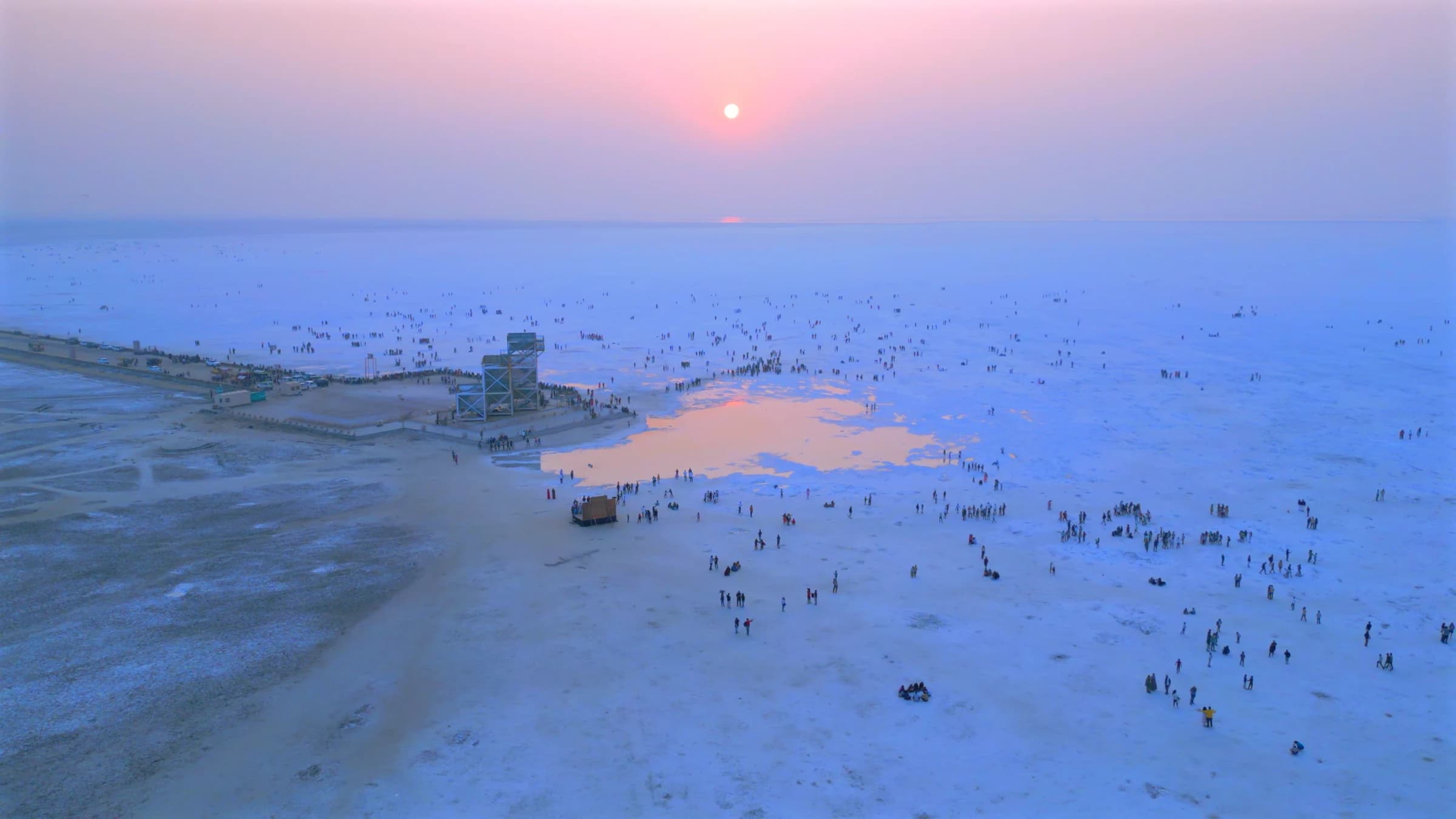
Most Rann Utsav guides tell you what to pack. Fewer tell you what you are simply not permitted to do. This distinction matters more here than at almost any other Indian destination, because the tent cities at Dhordo and Dholavira sit within a few kilometres of the India-Pakistan international border, inside a designated Border Security Force (BSF) zone. Some of what follows is standard Gujarat law. The rest exists specifically because of where you are standing, and visitors who arrive unaware of it can find themselves turned back at a checkpoint, relieved of a drone, or asked to leave a restricted stretch of the salt flats after dark.
This is not a packing list — that lives elsewhere. Think of this as the compliance checklist: the things that could genuinely derail your trip if you get them wrong.
Gujarat is a dry state — alcohol is prohibited
Gujarat has enforced statewide prohibition since 1960, and Kutch district is no exception. This is not a festival-specific rule that relaxes for tourists — it is state law, and it applies with particular firmness in a border district where security presence is already elevated.
What this means in practice:
- No alcohol is served, sold, or permitted anywhere within the Rann Utsav tent cities, including in the premium and luxury tent categories. There is no bar, no wine list, no exception for private celebrations such as anniversaries or bachelorette groups. - Carrying alcohol into Gujarat, or possessing it within the state without a permit, is a punishable offence — not a matter of hotel policy. Bags are subject to checks at highway posts and near the tent city entrance. - Foreign nationals and visitors from other states can apply for a temporary liquor permit through Gujarat's prohibition department, but this is a bureaucratic process intended for specific circumstances, not something arranged casually for a festival weekend, and it does not translate to alcohol being available on-site at Rann Utsav regardless. - If you are travelling from a wet state and have alcohol in your vehicle from before you crossed into Gujarat, the safest course is to not carry it at all rather than assume it will go unnoticed.
Plan your Rann Utsav evenings around what the festival actually offers instead — folk music performances, bonfires, and stargazing under some of the darkest skies in western India — rather than expecting a bar scene that will not exist.
Drone photography requires advance permission — handheld photography does not
This is the rule that catches the most visitors off guard, particularly photographers and content creators who assume a drone is standard festival kit.
Because Dhordo and Dholavira lie within a few kilometres of the international border, the airspace above the White Rann is monitored and restricted. Flying a drone — for a wedding shoot, a travel vlog, or simply to capture the salt flats from above — is not something you can decide to do on arrival.
What's required for drone use
- Advance written permission from the BSF and local district authorities, applied for well before your travel dates — this is not a same-day or on-site approval. - Applications typically need to be routed through the Gujarat Tourism office or the Rann Utsav organising authority, who can advise on the current process, as requirements are reviewed periodically for security reasons. - Even with permission granted, flights are usually restricted to specific zones, altitudes, and time windows, and are subject to being grounded without notice if the security situation warrants it. - Unauthorised drone flights are treated as a security matter, not a minor infraction. Confiscation of the equipment is the least of the possible consequences — questioning by security personnel is a realistic outcome.
What's unrestricted
Ordinary handheld photography — phones, DSLRs, mirrorless cameras, tripods for long-exposure shots of the Rann under moonlight — is entirely unrestricted within the tent city and the designated visitor areas of the White Rann. The vast majority of the festival's iconic imagery, including the famous shots of the salt desert stretching to the horizon, is taken this way. If a drone shot is not essential to what you are planning, leave it at home and photograph from the ground instead — it saves an application process that may not clear in time regardless.
No pets within the tent city
Rann Utsav's tent cities do not permit pets, whether accompanying guests for the duration of their stay or brought along for a single day visit. This applies across all tent categories, from non-AC Swiss tents through to luxury cottages.
The reasoning is practical rather than sentimental: the tent city operates as a controlled, high-footfall environment with shared dining areas, cultural performance spaces, and proximity to a sensitive border zone where unfamiliar movement is something security personnel actively monitor. There is no kennel facility on-site, and no exception process for well-behaved animals. If you are travelling with a pet, arrange boarding before you leave rather than assuming accommodation will be found locally — Dhordo and the surrounding villages have very limited infrastructure for this.
Restricted zones and timing curfews on the White Rann
The White Rann itself — the vast salt desert that draws most visitors to the festival — is not a single open expanse that tourists can wander freely at any hour.
- **Marked boundaries**: The visitor area of the Rann is clearly demarcated, and venturing beyond these markers is prohibited. What looks like an unbroken white horizon extending toward the border is, in security terms, a monitored zone with a hard edge that visitors are not meant to cross. - **Evening and night access**: The Rann is open to visitors during specified hours, generally from late afternoon through a set point in the evening for sunset and early-night viewing. After the designated closing time, the area is off-limits, and this is enforced by BSF and local police patrols, not left to visitor discretion. The moonlit-desert photographs associated with Rann Utsav are typically taken during officially permitted evening windows around full moon dates, not through unsupervised night wandering. - **Checkpoints**: Entry to Dhordo, and onward to the Rann viewing area, involves security checkpoints where identification is checked. Carrying a valid photo ID (passport, Aadhaar card, or driving licence) at all times during your stay is effectively mandatory, not optional — this applies to every member of your travelling party, including older children. - **Foreign nationals**: Visitors travelling on a foreign passport should carry that passport at all times in the region and be prepared for additional identity checks, given the proximity to the international border. It is worth confirming current requirements with your tour operator or the Rann Utsav booking desk ahead of travel, as protocols can be adjusted for security reasons.
Other border-security-driven restrictions
A handful of further rules exist because of the region's strategic location rather than ordinary festival management:
- **Kite flying near the border is discouraged and, in designated zones, prohibited.** Kutch has a strong kite-flying tradition, but anything airborne near a monitored international boundary invites the same scrutiny as drones, and visitors should not assume a kite is treated any differently from other unauthorised aerial objects in sensitive stretches. - **Photographing security installations, checkpoints, or BSF personnel and equipment is prohibited**, wherever this is encountered en route to or within the festival area. This is a standard rule at any Indian border district and applies regardless of festival status. - **Large, unmarked, or unusual luggage may attract additional security checks**, simply because of the area's profile. Travelling with standard luggage and being cooperative at checkpoints makes for a considerably smoother arrival. - **Off-road driving beyond marked routes** on the approach to the Rann is not permitted — stick to the designated vehicle paths, both because it is a security matter and because the salt crust itself can be unstable off the marked track.
A pre-travel checklist
Before you leave for Rann Utsav 2026-27, it is worth running through this shortlist:
1. Do not pack or plan to source alcohol — Gujarat is dry, and Kutch is not an exception. 2. If a drone shot matters to your trip, apply for permission through the appropriate authority well in advance, and have a handheld backup plan regardless. 3. Arrange pet boarding elsewhere — the tent city cannot accommodate animals. 4. Carry valid photo ID for every traveller, at all times, and keep it accessible for checkpoints. 5. Plan Rann visits within the posted opening hours, and treat the marked boundaries on the salt flats as final, not advisory. 6. Leave kites, and anything else that flies, out of your luggage near the border stretch. 7. Keep cameras pointed at the landscape and the culture, not at security infrastructure.
None of this is designed to make Rann Utsav feel forbidding. In practice, the vast majority of visitors move through the tent city, the cultural programme, and the White Rann itself without encountering these rules directly, because they are simply travelling within the marked areas during the marked hours with the obvious things left at home. Knowing the boundaries in advance is what keeps it that way.
For everything else — what to bring, how to photograph the desert well, and the full range of questions visitors ask before booking — the related guides below cover the ground this article deliberately leaves out.
If you are unsure whether something you are planning to bring or do is permitted, it is always worth checking before you travel. Call our team on +91 92747 30220 and we will confirm the current rules for your specific plans. Tent City packages start from ₹6,300 per person for a one night, two day stay.