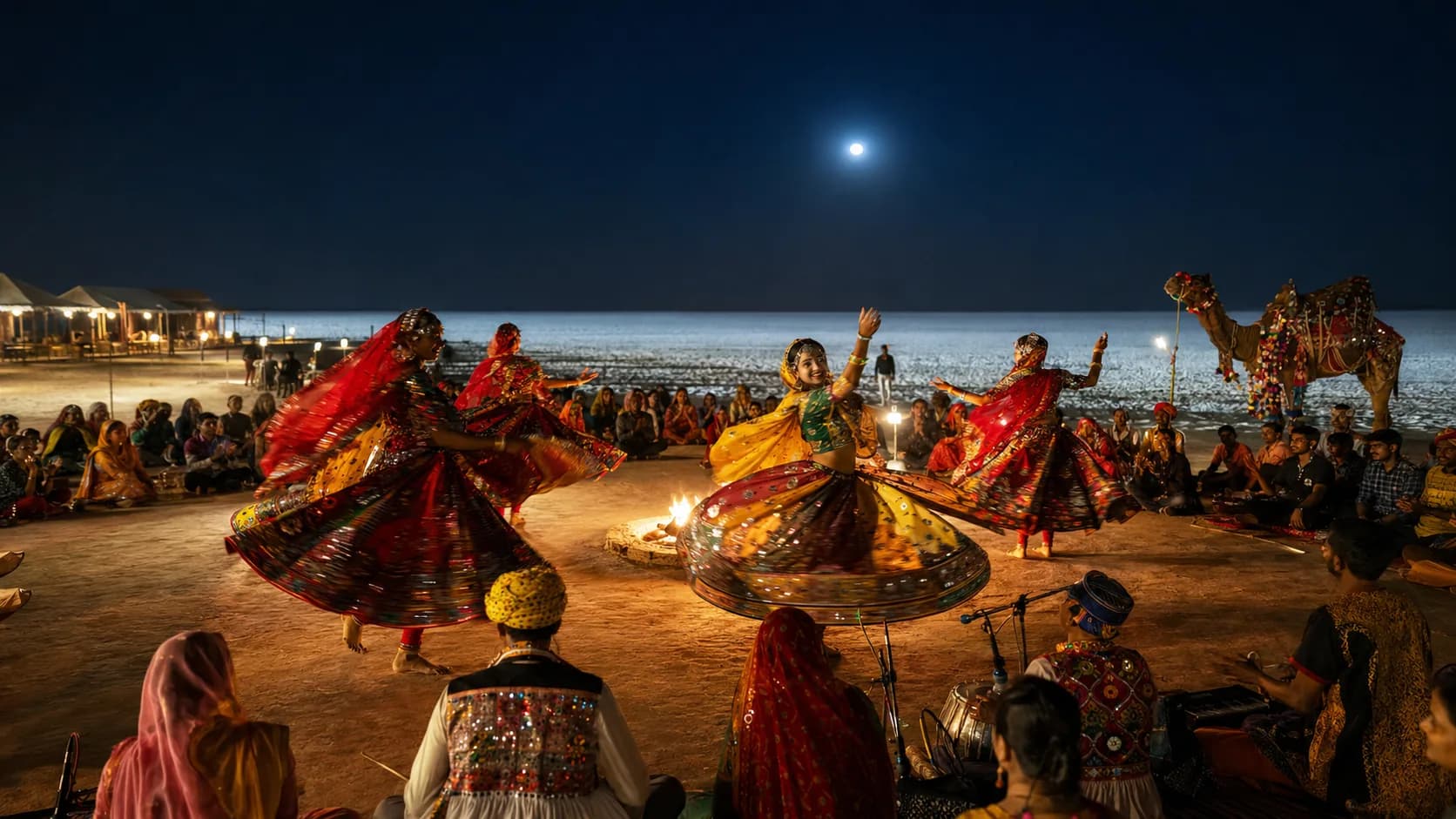
A Sky Unlike Any Other: Stargazing at the White Rann
India has many spectacular places to watch the night sky. The high-altitude deserts of Ladakh, the dark plateaux of Spiti, the remote beaches of Andaman — all offer skies that city dwellers rarely encounter. But the White Rann of Kutch occupies a category of its own, and experienced astronomers and astrophotographers who have visited during Rann Utsav consistently place it among the finest stargazing locations in the country.
The reasons are geological and geographic as much as they are anything else. The Rann is flat — extraordinarily, almost disconcertingly flat — and it extends for thousands of square kilometres in every direction from Dhordo. There are no hills, no trees, no structures of any height to interrupt the horizon. When you stand on the salt crust at night and look upward, the sky does not feel like a dome above you. It feels like a sphere surrounding you, horizon to horizon, in every direction simultaneously. This is a sensation that is genuinely difficult to describe to someone who has not experienced it, and it is one of the reasons visitors return to Rann Utsav year after year.
Why the White Rann Is Exceptional for Dark Sky Observation
The factors that make a location suitable for stargazing are well understood by astronomers: low light pollution, dry air, minimal atmospheric moisture, a stable atmosphere, and a wide, unobstructed horizon. The White Rann satisfies all of these criteria to a degree that few locations in India can match.
Light pollution in Kutch is among the lowest in the country. The nearest major city, Bhuj, is roughly 85 kilometres from Dhordo, and its glow on the horizon is negligible. The smaller towns of the region — Khavda, Bhirandiyara, Hodka — add nothing detectable to the night sky. When the moon is below the horizon or in its new phase, the sky above the Rann achieves a darkness that visitors accustomed to urban or even semi-rural India find genuinely startling.
The air above the Rann is exceptionally dry for most of the Rann Utsav season. Gujarat's winter, running from October through February, brings clear, moisture-free nights with remarkable consistency. Atmospheric seeing — the stability of the air column above you, which determines how steady stars appear — is generally very good during this period. Stars do not twinkle wildly at the Rann in winter; they burn with a steadiness that suggests the atmosphere above is unusually calm.
And then there is the salt itself. The White Rann's surface is highly reflective, and on nights when the moon is present, the salt throws moonlight back upward in a soft, diffuse glow that illuminates the landscape without obscuring the sky above. It is one of the few places in India where you can walk around at night without a torch on a full moon night — the reflected light is sufficient — while still looking up and seeing a sky full of stars.
The Milky Way Above the Rann
Between October and January, the winter arm of the Milky Way is visible from the White Rann on moonless nights. This is not the dramatic, central bulge of the galaxy visible from higher-altitude locations in Ladakh during summer, but it is the Milky Way nonetheless — a dense, luminous band arching across the sky that most Indians raised in cities have never seen with their own eyes.
For many visitors to Rann Utsav, seeing the Milky Way for the first time is an emotional experience. There is something humbling about understanding, visually rather than intellectually, that the smear of light overhead is the galaxy you inhabit — that each of those hundreds of millions of points of light is a star, and that you are looking at your cosmic home from the outside. The White Rann provides the conditions for this realisation that most of India's populated areas do not.
Beyond the Milky Way, the winter sky above the Rann offers Orion in his full glory, the Pleiades cluster, the brilliant twin stars of Gemini, and the brightest star in the night sky, Sirius, blazing low in the south. Jupiter and Saturn are frequently visible to the naked eye during the Rann Utsav season, and their presence adds depth to an already extraordinary display.
Best Months for Stargazing at Rann Utsav
The published 2026–27 Dhordo Tent City season runs from 1 November to 7 March. Winter nights may offer clear skies, but stargazing conditions depend on weather, moonlight and local lighting. Ask whether an organised activity is available for your selected provider and dates; February and early-March visits should be checked like any other date.
Moon phase matters enormously. The three or four nights around new moon — when the moon is absent from the sky — offer the darkest conditions and the most spectacular stargazing. The nights immediately before and after full moon, while visually beautiful on the salt (the reflected moonlight creates an ethereal silver landscape), are less ideal for deep-sky observation because the moon's brightness washes out fainter stars and the Milky Way.
If you are planning your visit primarily around stargazing, it is worth checking the lunar calendar for the year and booking your nights to coincide with new moon or the days immediately surrounding it. The full moon nights at Rann Utsav are celebrated for a different reason — the moonlit Rann is a spectacular sight in its own right — but for pure stargazing, darkness is your friend.
What to Bring for a Night Under the Stars
The single most important item for a stargazing session on the White Rann is warm clothing — far more than you think you will need. Winter nights at Dhordo can drop to between four and eight degrees Celsius, and the flat, open terrain offers no shelter from the wind. The cold comes on faster than expected once the sun sets, and standing still on the salt flat for an extended period while looking upward means your body generates minimal heat. Thermal underlayers, a down jacket, a woollen hat covering your ears, and gloves are not excessive — they are essential.
A red-light torch is the second most important item. White light destroys night vision — the eye's ability to adapt to darkness and perceive faint objects — in seconds, and recovering full night vision takes approximately 20 minutes after white-light exposure. Red light, by contrast, preserves night vision entirely. Most astronomy suppliers sell small red-light torches for a modest sum, and they are invaluable for navigating the salt flat without ruining your dark adaptation.
Binoculars are worth bringing even if you have no particular astronomical knowledge. Seven-by-50 or ten-by-50 binoculars — numbers referring to magnification and lens diameter — reveal the Milky Way in extraordinary detail, resolve star clusters like the Pleiades into hundreds of individual stars, and show the four large moons of Jupiter as tiny but distinctly visible points on either side of the planet. You do not need a telescope to have a profound stargazing experience on the White Rann; binoculars are sufficient.
A star map or stargazing app on your phone — used sparingly, in night mode, with minimum brightness — can help you identify what you are looking at. Apps like Stellarium or Sky Map are free and work offline, making them ideal for locations where data connectivity may be limited.
Astrophotography on the White Rann
For those who photograph the night sky, the White Rann offers several unusual advantages. The flat, featureless salt crust makes foreground composition both simpler and more dramatic — a single camel silhouette, a lone figure, or even an empty expanse of salt can anchor a Milky Way shot in a way that complex terrain cannot. The lack of horizon obstructions means wide-angle shots capture the full arch of the galaxy from horizon to horizon.
Standard astrophotography techniques apply: a camera capable of manual exposure control, a wide-angle lens with a maximum aperture of f/2.8 or faster, ISO settings between 1600 and 6400 depending on your camera's noise characteristics, and exposures of 15 to 25 seconds. The 500 rule — dividing 500 by your lens's focal length to determine the maximum exposure before stars begin to trail — is a useful starting point.
The salt's reflectivity is both an opportunity and a challenge for astrophotographers. On full moon nights, the reflected light creates a natural fill light on any foreground subjects — a feature that photographers who specialise in landscape astrophotography will recognise as extremely useful, as it removes the need for artificial foreground lighting. On moonless nights, the salt surface goes completely dark, which creates a stark contrast between the glittering sky above and the black earth below.
Arranging Your Stargazing Experience
Stargazing at Rann Utsav requires no special arrangement beyond the decision to step away from the tent city's cultural programme on a clear night and walk a short distance out onto the salt flat. The darkness comes on naturally, the stars appear, and the experience begins.
Some guests coordinate with tent city staff to arrange a private evening on the salt flat with chai and a guide, which adds a social and conversational dimension to the experience. These arrangements are worth enquiring about when you arrive. The packages starting at ₹12,600 for two nights and three days offer sufficient time to dedicate one evening specifically to stargazing while enjoying the other evening activities — the cultural programme, the Garba, the bonfire — that the festival is also celebrated for.
For enquiries about what the current package includes and whether guided evening excursions to the salt flat are available during your dates, the team can be reached on +91 92747 30220.